



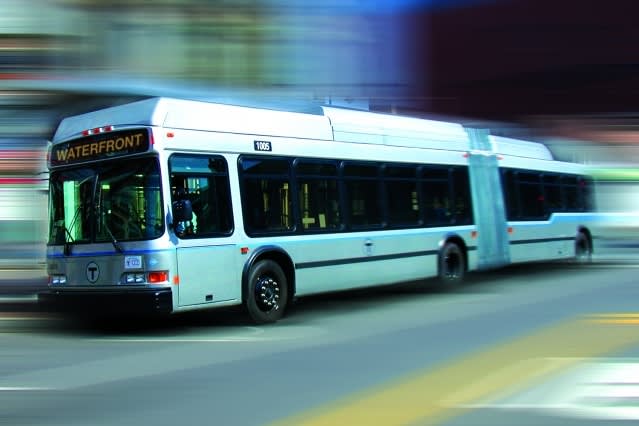
4 Greater Boston communities to pilot BRT in 2018
The pilots will include a combination of dedicated bus-only lanes that take bus riders out of car congestion, technology to time traffic signals so that buses get more green lights, and platforms that allow riders to “level-board” the bus quickly as they would a subway.

MBTA
MBTA
Communities around Greater Boston, in partnership with the MBTA, will seek to create faster and more reliable commutes for more than 30,000 bus riders through a sequence of three pilot projects testing bus rapid transit (BRT) features over the course of 2018. The pilots will include a combination of dedicated bus-only lanes that take bus riders out of car congestion, technology to time traffic signals so that buses get more green lights, and platforms that allow riders, including people in wheelchairs or with baby strollers, to “level-board” the bus quickly as they would a subway.
The projects are an effort of BostonBRT, an initiative spearheaded by the Barr Foundation. In January, BostonBRT issued a competitive request for proposals. And, this week, the Barr Foundation announced three $100,000 grants to advance projects in Arlington, Cambridge, Watertown, and Everett. The RFP invited municipalities to partner with the MBTA to demonstrate the potential of BRT in high-ridership, high-traffic areas, with the goal of improving the transit experience for the most people. During peak commute times, there are twice as many people in buses than cars in the combined corridors — with the potential for that number to grow with a more efficient and convenient bus system.
“These pilot projects will show BRT’s potential to transform how people in Greater Boston get to where they need to go, and how BRT can fit within the region’s transportation system,” said Mary Skelton Roberts, co-director for climate at the Barr Foundation. “For BRT to be successful, local and state governments, communities, and transit experts need to work together. These winning proposals demonstrated their readiness to do so. And we hope their commitment to collaboration during this pilot testing periods is just the beginning. Massachusetts residents deserve flexible, environmentally-sustainable transportation options they can count on like BRT.”
“With hundreds of thousands of our daily riders relying on buses to get them to their destinations in a timely manner, it’s terrific to have partners like the Barr Foundation and BostonBRT working with us to implement improvements,” said MBTA GM Luis Manuel Ramirez. “We owe it to all of our customers, particularly those for whom buses are their primary mode of commuting, to do everything we can to provide them with consistently reliable service.”
The grant recipients are:
Arlington — In collaboration with the MBTA, Arlington will conduct a one-month pilot of several BRT elements on the three-mile #77 bus route along Massachusetts Avenue, the town’s main thoroughfare, which has the highest ridership in Arlington and one of the top 15 highest-ridership routes in the overall MBTA bus system. The pilot includes transit signal prioritization, bus queue jumping at traffic signals, and a dedicated bus priority lane.
Cambridge/Watertown — Cambridge and Watertown will partner with the MBTA to pilot numerous BRT elements for bus routes on Mount Auburn Street west of Fresh Pond Parkway. Elements to be tested include all-day, dedicated bus lanes for significant segments of Mount Auburn Street between Belmont Street and Fresh Pond Parkway, inbound queue jump lanes on Mount Auburn Street and Belmont Street, and transit signal prioritization as feasible, which allow buses to travel without impediment from other vehicles.
Everett — In collaboration with the MBTA, Everett will enhance its new dedicated bus lane it implemented on the south side of Broadway, the city’s main transit corridor, by adding upgrades to further demonstrate elements of Gold Standard BRT. The pilot includes “platform level” boarding facilities, which allow of ease of boarding for riders in wheelchairs, strollers, or carts, at two bus stops in Everett Square, and TSP at three locations along Broadway that give southbound buses priority during peak-hours.
As part of the grant funding, BostonBRT will assist communities with coordination between state and municipal agencies, pilot design and implementation, communications, and community engagement.
Municipalities were selected by a committee comprised of Massachusetts transportation leaders convened by the Barr Foundation and BostonBRT technical consultants that reviewed criteria such as the number of BRT elements included within proposals, proof of concept, potential impact (including density of population and employment), municipal and community support, and willingness to partner with state agencies to create a successful pilot.
More Bus

New York MTA Plans Largest Bus Fleet Upgrade in More Than a Decade
The agency is seeking manufacturers for 650 new CNG buses to replace aging vehicles, improve reliability, and advance its broader fleet modernization strategy.
Read More →
Building a Flexible Path to Transit Electrification
John Hroncich discusses BAE Systems’ modular and scalable approach, lessons learned from decades of real-world operations, and how agencies can identify electrification strategies that fit their fleets.
Read More →
Bus Tech Talk: Keeping Transit Technicians Ahead of the Technology Curve
LA Metro’s Obed Mejia discusses technician training, evolving maintenance technology, fleet replacement, and strategies for getting the most out of today’s transit fleets.
Read More →
Biz Briefs: RIPTA Unveils New Frontrunners, Clevland RTA Adds New Siemens, and More
In METRO's latest installment, we take a look at recent news from Siemens, Prevost, Dodge, and more partnerships making headlines across the transportation sector.
Read More →
People Movement: Holly Arnold Joins Transdev and More
In this edition, we also cover recent appointments and announcements at Pace, CamTran, MCI, and more, showcasing the individuals helping to shape the future of transportation.
Read More →
The High Cost of Transit Buses: Industry Leaders Look to Procurement Reform
Transit leaders and policymakers examine how standardized bus designs, streamlined procurement, and predictable funding could help agencies stretch budgets and deliver better service.
Read More →
The Business Voice Behind Public Transportation
As chair of APTA’s Business Members Board of Governors, Ray Melleady explains how more than 850 business members are partnering with transit agencies to advance funding, innovation, and industry-wide collaboration.
Read More →
From Surviving to Thriving: Building Stronger Transportation Organizations
Bus Business Consultants founder Brian Dickson shares lessons on leadership, organizational health, and creating options for long-term success in a changing transportation industry.
Read More →
Finding the ‘Happy Medium’: Optimizing Maintenance Without Sacrificing Reliability
The key to maintenance optimization isn’t doing less work—it’s doing the right work at the right time on the right assets.
Read More →
LA Metro, City of West Hollywood, and Partners Advance Smarter Bus Lane Enforcement
The award-winning partnership combines AI-powered detection with human oversight to improve bus reliability, accessibility, and enforcement efficiency.
Read More →