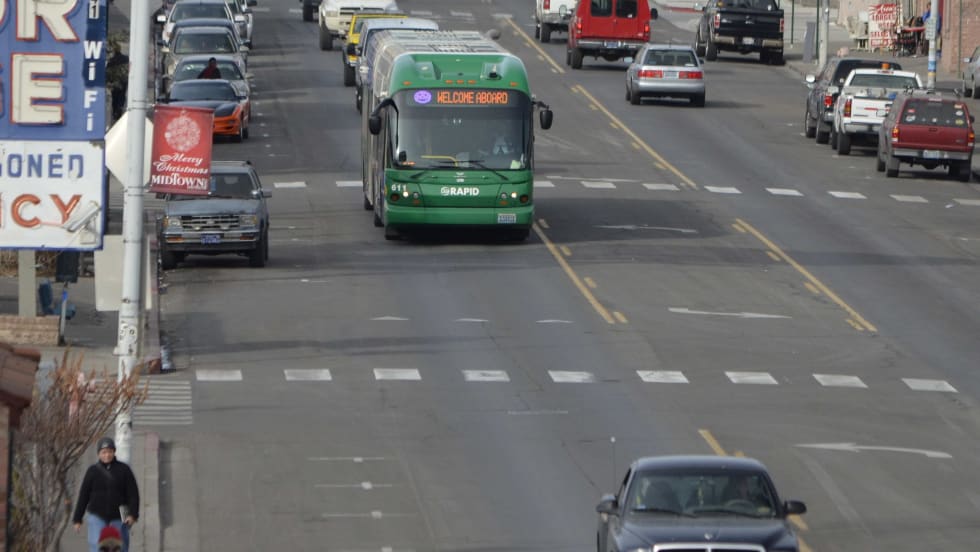


While the private and public bus sectors typically operate as separate entities, there are times when a partnership between the two is mutually beneficial. Motorcoach operators should see the partnership as a way to earn more revenue by providing transit agencies with commuter service. Transit agencies may experience savings of 30% to 40% when they outsource some of their services, according to the Reason Foundation in Los Angeles. "That's not small change, and for a transit agency trying to make budget dollars go as far as possible, that's enough to make a big difference," says Robert Poole, director of transportation studies at the foundation. "You could provide significantly more service with the same amount of dollars if your unit cost is a third or more lower." For years, the Connecticut Department of Transportation (DOT) has had contracts with private bus operators to provide daily commuter service. In fact, the agency's bus service is privatized. Transit and Ridesharing Administrator Michael Sanders says these types of contracts allow the agency to maintain the service quality desired since the private sector is able to fulfill such service with more modern coaches. Currently under contract is Coach USA Aeroline in East Hartford, Conn. General Sales Manager Carl Lajeunesse says the bus company provides peak-hour commuter services that come out of three different cities in Connecticut: Coventry, Meriden and Willimantic. Lajeunesse says such contracts are marginal operations for the DOT because of the small number of hours that the company actually uses the vehicles. However, he also says it does supplement income of such service by chartering those same buses. "There's other revenue available for that equipment," Lajeunesse says. "If there wasn't, it would be a losing proposition." For the Connecticut DOT, having these types of contracts benefits the agency because private bus operators are used to operating the equipment and providing quality service, as well as maintaining the equipment, says Sanders. Currently, the DOT has four motorcoach operators under contract, running seven different routes. About two-thirds of the DOT's transportation system is run by the state-owned Connecticut transit system and one-third is run by private contractors, Sanders says. "We run part of the system with the public operation and we run part with the private operation," he says. "We like the mix because [it's] relatively cost effective." However, this type of work is only for about four to five hours of work per day for the drivers, says Lajeunesse. "It's not the best piece of work they can get, but it is something that goes every day, so it gives the driver an opportunity to accumulate some hours doing this," he says. "Our primary business stream is more charter work. This type of operation supplements the charter work." For the DOT, when turnover happens, and it happens with at least one route every year, it goes out for competitive bid. Sanders says there's a change in operators about every two or three years. "As we put new services out, to the extent it might be a demonstration service where state law might now require us to do a competitive bid, we could give it to whomever we want for that demonstration period," Sanders says. "But once it leaves the demonstration period, we have to put it out for competitive bid." In terms of profit, times are rough for everyone, including private bus operators. For Coach USA Aeroline, the payment schedule with the state of Connecticut has crawled along. Costs and inflation have grown a bit faster than what the state is willing to pay, Lajeunesse says. "They haven't been able to get any additional money to offset the increases in costs that we've been facing. We're in the middle of a budget crisis here in the state of Connecticut," Lajeunesse says. "The budget has a shortfall of $650 million, and I don't know where that's going to lead as far as getting additional monies for providers."
Private contracting at MBTA For the Massachusetts Bay Transportation Authority (MBTA), outsourcing has helped the agency carry its commuter services from suburban communities into Boston. "Effectively, these are services that fill the gap or the niche between the commuter rail branches that we operate, and that's kind of their route," says Alan Castaline, deputy chief operating officer for the MBTA. MBTA has two different private contracting programs. One is strictly commuter service from suburban communities into Boston running 15 different routes by 10 different carriers. The other consists of a few carriers that provide more traditional local transit services or all-day services that are under subsidy of the MBTA. "Overall, it would be much more expensive if we tried to provide it ourselves," Castaline says. "Within that group of 15 routes, there's a wide range of cost effectiveness in there." Private bus operator Plymouth and Brockton in Plymouth, Mass., holds two types of contracts with the MBTA. One is based on incremental cost, where it gets a portion of the cost by way of financial assistance to provide commuter service in the morning and afternoon. The second contract allows Plymouth to receive the total cost by providing an extension of the subway system using a bus. "The two contracts are limited to an 8% return investment," says Plymouth Transportation Manager John Greene. "Everything cross-subsidizes. It subsidizes these particular trips. As we know, the more service, the more miles you can write into your fixed cost. So that's helpful all the way around." With a competitive bid process, the MBTA's contracts typically last about five years. The 10 carriers for 15 routes provide services to about 4,000 to 5,000 passengers daily.