Chief Practice Officer, Executive VP
Michael Baker International
Linthicum, Md.


 MENU
MENU SEARCH
She oversees 10 different areas of expertise within Michael Baker International, spanning from service transportation to tech and innovation.
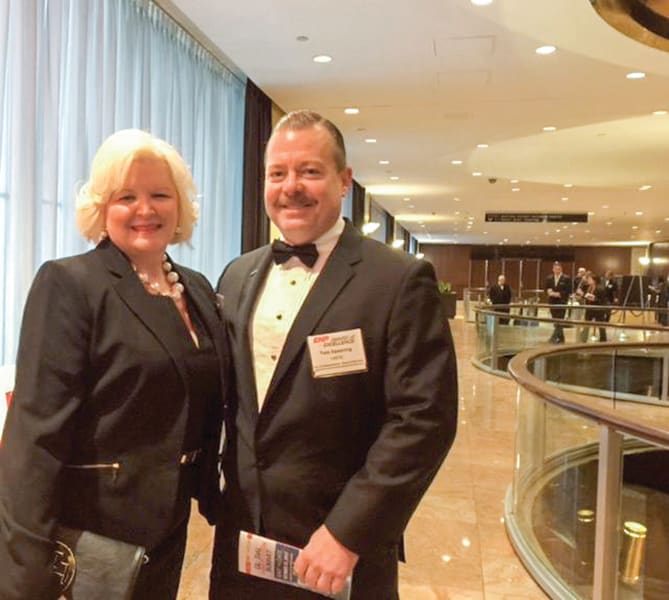
Shepherd (shown with HNTB’s Tom Spearing) is an active member of several industry organizations.
Shepherd (shown with HNTB’s Tom Spearing) is an active member of several industry organizations.
Bonnie Shepherd has been involved in the transportation industry for many years. Originally from Ontario, Canada, Shepherd worked for the Ontario Ministry of Tourism and Recreation. However, her office traveled to the U.S. for conferences frequently. Over time, she became exposed to the American market and connected with organizations like the American Public Transportation Association.
Shepherd eventually moved to the U.S. in 2004. While waiting for a work permit, she volunteered in order to stay active at the Conference of Minority Transportation Officials (COMTO). She attributes much of her field knowledge to what she learned from the countless industry employees she met during her time with COMTO.
EXPERIENCE. As soon as she received her permit, Shepherd began employment at Spear Technologies as the VP of sales. She sold open oracle architecture software to transit authorities in the federal, private, and public sectors. From there, she went on to become the VP of business development in the northeast for Hatch Mott MacDonald. She stayed there for 10 years before moving on to a vice president position at SYSTRA.
ROLE FOCUS. In 2016, Shepherd joined Michael Baker International. She originally started as the national market leader for the firm’s railroad and transit practice. However in February 2017, she was promoted to her current dual role as chief practice officer and executive VP. She oversees 10 different areas of expertise within the company, spanning from service transportation to tech and innovation. She is also responsible for planning the strategic growth of each of the firm’s practice groups.
“I’m very proud to work for an engineering firm that changes the footprint of the way we use our infrastructure,” says Shepherd. “Whether it’s getting people to work on time or improving the safety of a street, I’m proud to be contributing to that in some minor way.”
In her role, Shepherd has become somewhat of an overnight expert herself. She must stay privy to the unique lingo, culture, and trends of each of the ten practice groups.
“For example, I’m not an engineer, but I have learned so much about design-build this year,” says Shepherd. “I have a keen sense of understanding from my operational background, but the trick is to be a humbled learner. Trust me, I ask a lot of questions.”
Shepherd also coordinates all of the practices with the executive leadership team, as well as all interaction with the eight regional directors across the country. The different time zones make her role stretch well beyond the typical nine-to-five.
“I get to coordinate strategic plans moving forward, getting our national practice leads to practice with each other for cross-selling — that’s a big thing of mine,” she says.
On top of the work included in her job description, Shepherd donates her time to support the advancement of women in leadership within the transit industry.
“I used to supervise 65 men — I have always worked in a man’s world,” says Shepherd. “I am a huge advocate for women in this industry, and I love helping young professionals advance.”
INVOLVEMENT. Shepherd has been a member of Women’s Transportation Seminar for many years. She is also a former chair and current board member of the American Public Transportation Foundation (ATFP). At ATFP, Shepherd helps select recipients of a scholarship program for women persuing transportation career paths in school.
Additionally, Shepherd mentors a number of women in the industry, as well as young professionals within Michael Baker.
“I try to guide them in terms of how to conduct themselves and ways to educate themselves in the field.”
When not in the field, Shepherd can be found in the water. She is a certified scuba diver, and her last dive was in Turks and Caicos alongside seven-foot-long feeder sharks.

Nominations are now being accepted for METRO Magazine’s Operator of the Year and Innovative Operator of the Year awards.
Read More →
Contract Four is the largest in the Second Avenue Subway Phase 2 project and includes construction of station infrastructure, tracks, and signals for the subway expansion, MTA officials said. Work on Contract Four will begin in 2027.
Read More →
Leaders from 15 major transit systems shared crime-reduction results and safety initiatives while discussing the role of continued federal support.
Read More →
The new regional transit authority appointed its first board chair and interim executive director while extending reduced fares across CTA, Metra, and Pace for eligible riders.
Read More →
Reliability-Centered Maintenance helps transit agencies move beyond routine checklists to focus limited resources on the assets and failures that have the greatest impact on safety, reliability, and service.
Read More →
Leadership changes will help shape the association’s priorities and its representation of the transportation industry during the 2026–2027 term.
Read More →
The 90-day demonstration will deploy coordinated security teams at five light rail stations while testing controlled access and gathering data to guide future investments.
Read More →
Learn about delivering 1300 gates at 91 stations while managing fare evasion. Explore the large scale deployment, solution customization and real-world results that affect the region. Prepare for deployment in your region now.
Read More →
Between packed transit stations and team motorcoaches, see how agencies and operators across North America tackled the transportation demands of the 2026 FIFA World Cup.
Read More →
The stopgap keeps federal transportation programs moving, but missing advance funding could complicate the transit and rail projects agencies are planning next.
Read More →