Peer review finds Chicago's transit system ranks high in coverage, efficiency
According to the report, CTA, Pace, and Metra ranked in the top half of their peer groups for 14 of the 16 measures reviewed and in the top three for seven of those measures.
Pace retained its first-place ranking for operating cost per vehicle revenue hour for the eighth consecutive year and second-place rank for operating cost per passenger mile for the fifth year, measures of service efficiency and effectiveness.
Pace
3 min to read
Pace retained its first-place ranking for operating cost per vehicle revenue hour for the eighth consecutive year and second-place rank for operating cost per passenger mile for the fifth year, measures of service efficiency and effectiveness.
Pace
The Regional Transportation Authority (RTA) released its annual peer performance measure reports that examine Chicago Transit Authority (CTA), Metra, and Pace performance in relation to comparable peer systems around the country. The reports, which cover performance for the 2016 report year, show that the region’s system continues to perform well for measures relating to service coverage and efficiency and effectiveness.
The transit agencies ranked in the top half of their peer groups for 14 of the 16 measures reviewed and in the top three for seven of those measures. The region’s peer group consists of Atlanta, Boston, Dallas, Houston, Los Angeles, Miami, New York, Philadelphia, and Washington, DC.
Ad Loading...
“What we see with the regional peer review is that the Chicago region had a strong performance overall which is a testament to the hard work of the three transit agencies, who continue to excel in service to our riders,” said Leanne P. Redden, RTA executive director. “But the same report also shows many of our peers outspending us in terms of capital investment, which is a major concern when one looks at our state of good repair needs.”
The Regional Peer Review evaluates how the region’s transit system, as a whole, performs among the top 10 largest metropolitan regions in the U.S., with Chicago being the third largest by population. The sub-regional peer review examines how each of the transit agencies’ modes of transportation performs against five similar peer agencies. Both reports use data submitted to the Federal Transit Administration to ensure consistency and comparability.
Both reports use four categories for evaluating performance – Coverage, Efficiency and Effectiveness, Service Maintenance and Capital Investment, Solvency.
For the eighth consecutive year, CTA bus retained its top-ranked performance for operating cost per vehicle revenue hour.
Active Transportation Alliance
Regional Peer Review highlights include:
Coverage: Compared to its peer regions, Chicago placed in the top half for each measure of coverage. The Chicago region ranked second for annual ridership for the first time since regional reporting began, overtaking Los Angeles.
Ad Loading...
Efficiency and Effectiveness: Chicago retained its top-ranked position for operating cost per passenger mile for the sixth consecutive year, indicating the provision of cost-effective service throughout the region.
Maintenance and Capital Investment:The Chicago region dropped three rank positions for the performance measure miles between major mechanical failures, decreasing 22% compared to 2015 and returning to fourth-place rank for this metric.
Solvency: On a per-passenger basis, Chicago’s ranking for capital expenditures dropped to sixth place; Chicago transit expends roughly 35% of what New York spends per resident for capital projects.
With an average fleet age of 24 years, Metra’s revenue vehicles are four years older than the peer average and rank fifth place compared to peers.
Amtrak Russ
CTA
Ad Loading...
CTA bus remained a top performer, exceeding or equaling the peer average in eight of 11 measures.
For the eighth consecutive year, CTA bus retained its top-ranked performance for operating cost per vehicle revenue hour.
CTA rail was top-ranked for two service efficiency and effectiveness measures: operating cost per vehicle revenue hour (for the eighth consecutive year) and operating cost per passenger mile (for the sixth consecutive year).
Metra
Metra retained its second-place ranking for operating cost per passenger trip for the sixth consecutive year. Metra moved up one rank position for two other measures of efficiency and effectiveness: operating cost per vehicle revenue hour and operating cost per passenger mile, for which Metra achieved top ranking.
With an average fleet age of 24 years, Metra’s revenue vehicles are four years older than the peer average and rank fifth place compared to peers.
Pace
Pace retained its first-place ranking for operating cost per vehicle revenue hour for the eighth consecutive year and second-place rank for operating cost per passenger mile for the fifth year, measures of service efficiency and effectiveness.
Pace vanpool performed favorably to the peer average for operating cost per vehicle revenue hour and operating cost per passenger trip.
Pace ADA paratransit performed as well as or better than the peer average for nine of ten performance measures.
METRO’s People Movement highlights the latest leadership changes, promotions, and personnel news across the public transit, motorcoach, and people mobility sectors.
BART began offering select parking lots to non-BART riders to generate new revenue to help address its FY27 $376M operating budget deficit brought on by remote work.
Drawing on decades of industry experience, Evans-Benson offered insights into the differences between the two, along with tips for better customer engagement and more.
The renewals include continued operations at Fort Lauderdale-Hollywood International Airport in Florida; the PRTC in Virginia; and RTC Washoe in Nevada.
The governor’s proposed auto insurance reforms could save the agency $48 million annually by limiting payouts in crashes where buses are not primarily at fault.
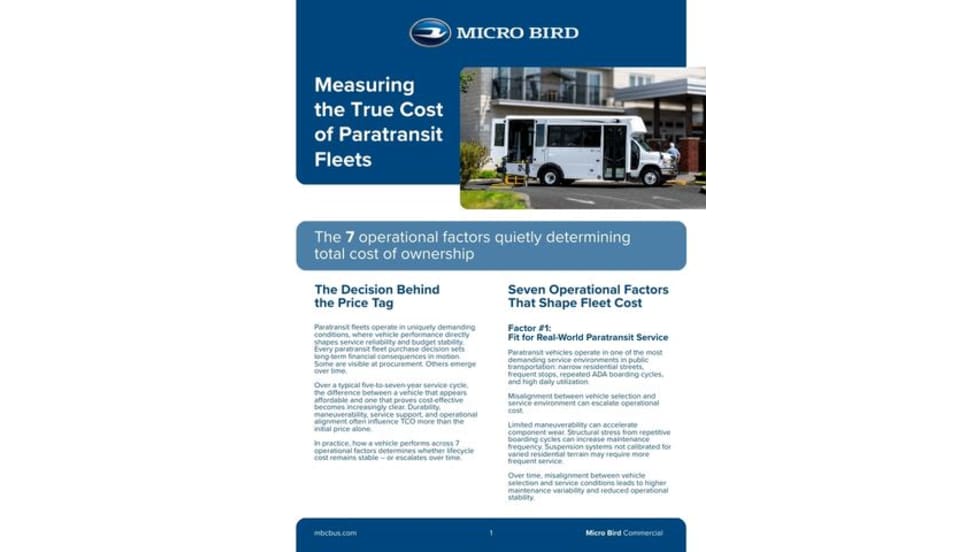
What truly drives the cost of a paratransit fleet? Beyond the purchase price, seven operational factors quietly determine maintenance frequency, downtime, and long-term service reliability. This whitepaper explores how these factors shape lifecycle cost and what agencies should evaluate when selecting paratransit vehicles.
In this conversation, TBC’s Executive Director Ed Redfern, President Corey Aldridge, and Washington Representative Joel Rubin outline the coalition’s key policy priorities, the challenges facing transit agencies, and how industry stakeholders can work together to strengthen the voice of bus transit at the federal level.
Amanda Wanke, who has worked at DART for 10 years, including the past 2½ years as CEO, will join Metro Transit as deputy chief operating officer, operations administration.