




RELATED: Seattle, Via team to provide transportation to rail stations
KC Metro, Sound Transit to continue integrated rail ops, maintenance
The new agreement has clearer lines of authority, cost containment, operating rules, data reporting, and other language.
May 1, 2019
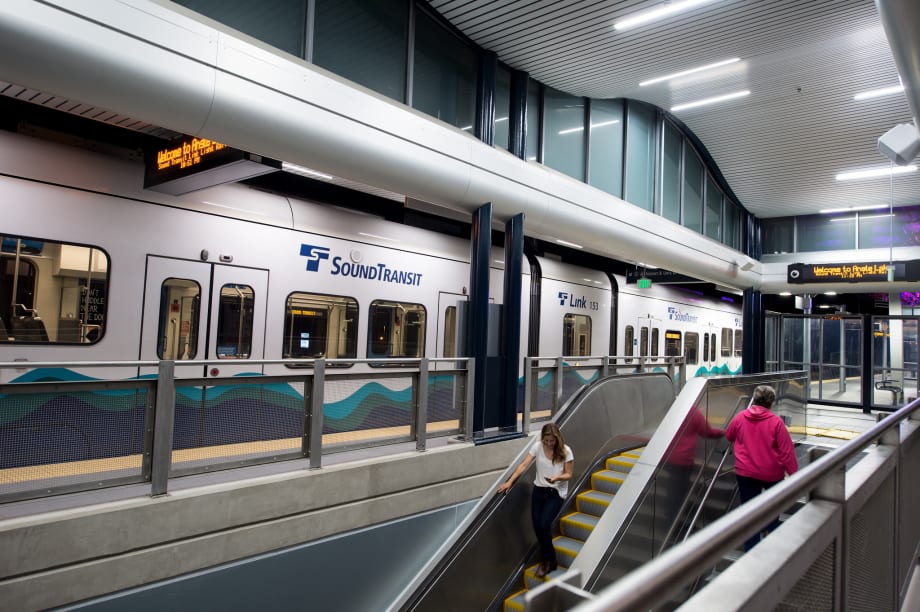
Sound Transit carried 24 million passengers on Link light rail in 2018 as it traveled between the University of Washington through downtown Seattle and to Sea Tac International Airport and Angle Lake.
SoundTransitSpecialSelection
2 min to read
Sound Transit carried 24 million passengers on Link light rail in 2018 as it traveled between the University of Washington through downtown Seattle and to Sea Tac International Airport and Angle Lake.
SoundTransitSpecialSelection
Seattle’s King County Metro and Sound Transit reached an agreement to continue operating and maintaining the Link light rail system for the next four-and-a-half years, and potentially up to 10 years. The agreement was sent to the King County Council and Sound Transit Board’s Executive Committee this week for consideration.
King County Metro has operated and maintained Sound Transit Link light rail since it launched in 2009. If approved, the new agreement will continue the dependable service to the region through Dec. 31, 2023, and potentially through December 2029.
Whether it comes to planning, operations, and vision, the integration of King County Metro and Sound Transit projects and services has been key to serving the region successfully. This new agreement has clearer lines of authority, cost containment, operating rules, data reporting, and other language, which reflects the lessons learned in a decade of joint rail operations.
Sound Transit carried 24 million passengers on Link light rail in 2018 as it traveled between the University of Washington through downtown Seattle and to Sea Tac International Airport and Angle Lake — a 20-mile system with 16 stations. More than 370 King County Metro employees operate and maintain Link light rail service from 5 a.m. to 1 a.m. daily under the current agreement, which totaled $46 million for service in 2018. Link light rail operations and maintenance costs are projected to be $66 million in 2020 as the agency ramps up efforts to open service to Northgate in 2021.
King County Metro’s partnership with Sound Transit to operate light rail during this rapid expansion keeps light rail operation dependable and stable through the demonstrated strength of Metro’s rail division, and offers the best path to seamless operations and a positive experience for customers.
This partnership comes as King County Metro builds on its ridership success and moves toward its long-range vision, Metro Connects, and Sound Transit plans light rail extensions to the University District, Roosevelt, and Northgate in 2021, Bellevue in 2023, and Redmond, Lynnwood, and Federal Way in 2024.
By working together, the agencies hope to find better efficiencies, improve the customer experience, handle emergencies, use public resources wisely, and provide economic prosperity.
More Management

METRO Opens Submissions for 2026 Motorcoach Awards
Nominations are now being accepted for METRO Magazine’s Operator of the Year and Innovative Operator of the Year awards.
Read More →
New York MTA Advances Final Contract for Second Avenue Subway Expansion
Contract Four is the largest in the Second Avenue Subway Phase 2 project and includes construction of station infrastructure, tracks, and signals for the subway expansion, MTA officials said. Work on Contract Four will begin in 2027.
Read More →
Transit Agencies Highlight Safety Gains at National Summit
Leaders from 15 major transit systems shared crime-reduction results and safety initiatives while discussing the role of continued federal support.
Read More →

NITA Names New Leadership, Expands Reduced-Fare Program at First Board Meeting
The new regional transit authority appointed its first board chair and interim executive director while extending reduced fares across CTA, Metra, and Pace for eligible riders.
Read More →
Beyond the Checklist: A Structured Approach to Transit Maintenance
Reliability-Centered Maintenance helps transit agencies move beyond routine checklists to focus limited resources on the assets and failures that have the greatest impact on safety, reliability, and service.
Read More →
APTA 2026 Nominating Committee Selects Leadership Slate, Names Chair and Vice Chair Nominees
Leadership changes will help shape the association’s priorities and its representation of the transportation industry during the 2026–2027 term.
Read More →
DART Launches Major Security, Fare Enforcement Initiative
The 90-day demonstration will deploy coordinated security teams at five light rail stations while testing controlled access and gathering data to guide future investments.
Read More →
Sponsored•September 9, 2026
Advancing Fare Collection Through Technology and Innovation
Learn about delivering 1300 gates at 91 stations while managing fare evasion. Explore the large scale deployment, solution customization and real-world results that affect the region. Prepare for deployment in your region now.
Read More →
Game Day in Motion: Moving Millions During the 2026 World Cup
Between packed transit stations and team motorcoaches, see how agencies and operators across North America tackled the transportation demands of the 2026 FIFA World Cup.
Read More →
Surface Transportation Extension Averts Shutdown, Leaves Transit Funding Gap
The stopgap keeps federal transportation programs moving, but missing advance funding could complicate the transit and rail projects agencies are planning next.
Read More →