




RELATED: Global platform tracks growth of shared micromobility
2020 will see cities develop advanced urban strategies, report says
The concepts of digital twins, urban modeling, resilience, circularity, smart urban spaces, and electric micro-mobility and microtransit...
December 26, 2019
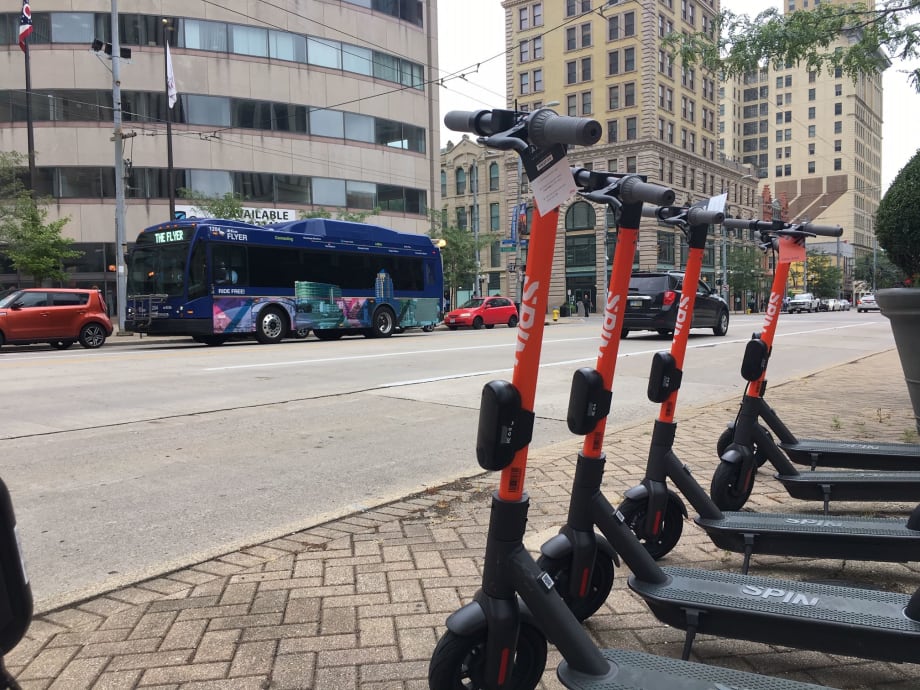
Electric scooters will be one of the mobility concepts integrated into a comprehensive urban agenda in 2020, according to a new report.
Spin
3 min to read
Electric scooters will be one of the mobility concepts integrated into a comprehensive urban agenda in 2020, according to a new report.
Spin
In 2020, the concepts of digital twins, urban modeling, resilience, circularity, smart urban spaces, and electric micromobility and microtransit will be integrated into a comprehensive urban agenda and strategy that will define the character of smart cities of the future, according to a new report.
In its new whitepaper, 54 Technology Trends to Watch in 2020, ABI Research’s analysts identified 35 trends that will shape the technology market and 19 others that, although attracting huge amounts of speculation and commentary, look less likely to move the needle over the next twelve months.
What will happen in 2020:
Cities will develop advanced urban strategies:
Already in 2019, cities have developed deeper insights into high-priority challenges and approaches to address those. Many have started to develop a narrative centered around five holistic focus areas: digital twins and urban modeling, resilience, circularity, electric micromobility and microtransit, and smart urban spaces.
“In 2020, these concepts will be further galvanized and integrated into a comprehensive urban agenda and strategy, very much defining the character of smart cities of the future. But they also help address short-term challenges. The adoption of micromobility in the form of electric bike, scooter, and motorcycle sharing significantly reduces both air pollution and traffic congestion, arguably the two biggest issues cities are grappling with today,” says Dominique Bonte, Smart Cities & Smart Spaces Vice President at ABI Research.
This represents a short-term solution awaiting widespread adoption of electric driverless vehicle sharing by 2030. It does, however, prompt city governments to reorganize public space to accommodate these new smart mobility modes. The wider safety and sustainability questions are starting to be approached in a more structural and fundamental way, respectively focused on resilience (readiness and responsiveness) and an approach based on circular economy concepts (resource self-sufficiency and recycling maximization).
“Finally, the digital twin and wider urban modeling concepts will provide a fertile environment for the mass adoption of basic IoT connectivity technologies, informing and enhancing static 3D models to become real-time replicas of the cities’ physical assets, in turn, enabling further efficiency and resource utilization improvements, scenario analysis, generative design, and preventive and real-time maintenance,” Bonte adds.
What won’t happen in 2020:
Translating strategies into technology solutions and partnerships:
“Translating these high-level paradigms into practical technology implementations will continue to elude all but the most advanced cities, such as Singapore and Dubai. Issues include technology life cycle uncertainty – if or when to adopt new technologies like 5G, LPWA, AI, blockchain, and driverless mobility – anticipating upgrade cycles, repurposing systems across multiple verticals and use cases, and learning how to efficiently implement open IoT platforms,” Bonte explains.
At the same time, the wider ecosystem dynamics toward which smart cities and the overall government technology sector are gravitating are increasingly defined by technology marketplaces (Geotab), open data sharing platforms (Transport for London, HERE’s Open Location Platform), vendor accelerator programs (Qualcomm), public-private partnerships (SharedStreets), sharing economy leverage, and a long tail of smart city technology startups and system integrators. This represents a major challenge for cities in terms of aligning internal organizational structures to enable efficient participation in this new market constellation.
Furthermore, against a background of a continuing challenging economic climate, cities will put more emphasis on ROI or, at the very least, will want to optimize where their investments are going. This will require vendors to provide detailed information on what their solutions can achieve in terms of cost savings and tangible benefits for citizens and enterprises alike through both general awareness building and quantitative tools. More concretely, vendors will have to tailor their business models toward CAPEX-free “as-a-Service” offers, while at the same time providing financing support, either directly through their own financing or Venture Capital (VC) divisions or indirectly, helping discover new funding mechanisms and opportunities.
For more trends that won’t happen in 2020, and the 35 trends that will, download the whitepaper.
More Technology

From Hardware to Digital Partner: Luminator Charts Its Next Chapter
CEO Magnus Friberg discusses Luminator’s shift toward becoming a digital partner, the growing importance of software and interoperability, and how AI can help agencies improve operations and passenger experience.
Read More →
Beyond the Checklist: A Structured Approach to Transit Maintenance
Reliability-Centered Maintenance helps transit agencies move beyond routine checklists to focus limited resources on the assets and failures that have the greatest impact on safety, reliability, and service.
Read More →
NJ TRANSIT Advances Bus Technology Upgrades Across Statewide Fleet
More than 1,500 buses now feature upgraded technology designed to improve arrival predictions and provide free Wi-Fi, with deployment expected to reach nearly 2,000 buses by the end of 2026.
Read More →

Building a Flexible Path to Transit Electrification
John Hroncich discusses BAE Systems’ modular and scalable approach, lessons learned from decades of real-world operations, and how agencies can identify electrification strategies that fit their fleets.
Read More →
Biz Briefs: Alstom Lands Canadian Contract, LYT to Supply California TSP, and More
In METRO's latest installment, we take a look at recent news from Complete Coach Works, Beep, FlixBus, and more partnerships making headlines across the transportation sector.
Read More →
Sponsored•September 8, 2026
From Legacy Silos to Conversational Intelligence
What if transit leaders could ask any operational question and get a trusted answer in seconds? Conversational AI is transforming how agencies use their data.
Read More →
USDOT Announces Rail Vehicle Replacement Grants, Chattanooga AV Shuttle Funding
More than $191 million in federal funding will help three transit agencies replace aging rail vehicles and support a new autonomous shuttle service in Chattanooga.
Read More →
Bus Tech Talk: Keeping Transit Technicians Ahead of the Technology Curve
LA Metro’s Obed Mejia discusses technician training, evolving maintenance technology, fleet replacement, and strategies for getting the most out of today’s transit fleets.
Read More →
Biz Briefs: RIPTA Unveils New Frontrunners, Clevland RTA Adds New Siemens, and More
In METRO's latest installment, we take a look at recent news from Siemens, Prevost, Dodge, and more partnerships making headlines across the transportation sector.
Read More →
Why Simulating Pedestrian Movement Has Become Essential for Modern Rail Stations
Pedestrian microsimulation is helping rail planners identify bottlenecks, test station designs, and prepare complex transit hubs for growing passenger volumes.
Read More →