



ABA Report: Motorcoach Sales Tick Up in Q1 2026 as Market Stabilizes
The Foundation produces the report each quarter, using data collected from surveys of major motorcoach manufacturers that sell vehicles in the US and Canada.

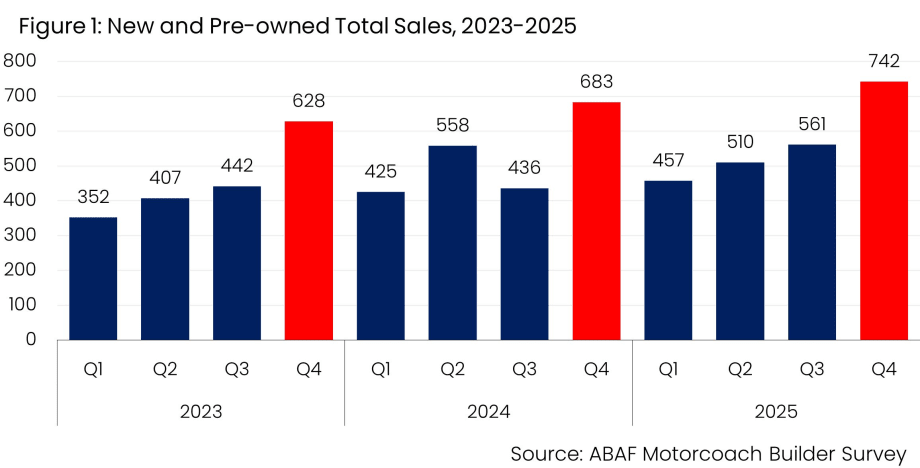
The 493 units sold in Q1, compared with 457 in the first quarter of 2025, represent a 7.9% year-over-year increase.
ABAF Motorcoach Builder Survey
- The ABA report indicates an increase in motorcoach sales in the first quarter of 2026.
- Data for the report is sourced each quarter from surveys conducted with major motorcoach manufacturers.
- The market for motorcoaches in the US and Canada is showing signs of stabilization.
*Summarized by AI
In the first quarter of 2026, participating manufacturers sold 423 new and 70 pre-owned motorcoaches, for a total of 493 units, according to the American Bus Association’s (ABA) First Quarter Motorcoach Builders Survey, which is conducted by the ABA’s research arm, the American Bus Association Foundation.
The Foundation produces the report each quarter, using data collected from surveys of major motorcoach manufacturers that sell vehicles in the US and Canada.
The 493 units sold in Q1, compared with 457 in the first quarter of 2025 (Figure 1), represent a 7.9% year-over-year increase.
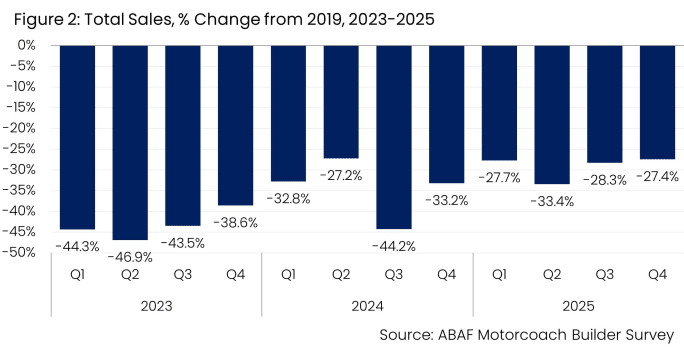
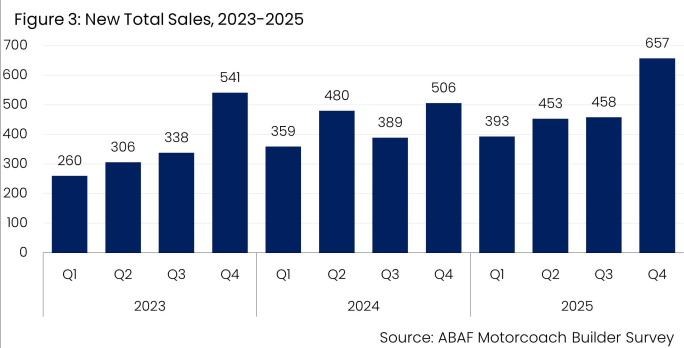
New motorcoach sales increased 7.6% compared to Q1 2025, with moderate growth following stronger gains in late 2025.
ABAF Motorcoach Builder Survey
A Closer Look at the Survey Figures
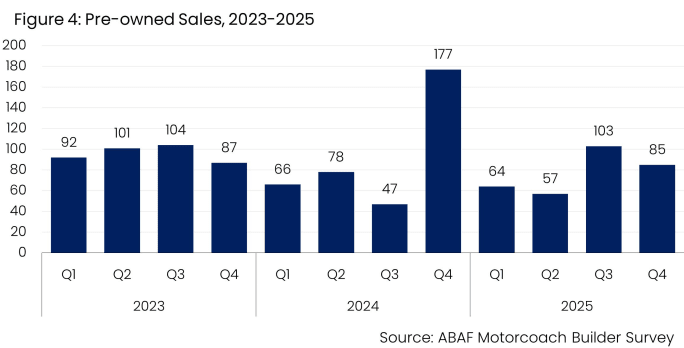
Sales of new motorcoaches increased by 7.6% compared to the same quarter in 2025, while pre-owned motorcoach sales rose by 9.4% (Figures 2 and 3). Both segments posted moderate gains in Q1 following stronger growth in late 2025.
Sales to private entities decreased by 19.4% while sales to public entities increased by 267.6% compared to the first quarter of 2025 (Figure 4).
Pre-owned motorcoach sales rose 9.4% year over year in Q1, continuing moderate gains after a stronger finish to 2025.
ABAF Motorcoach Builder Survey
First-quarter 2026 results indicate a motorcoach manufacturing market continuing to normalize after several years of disruption and volatility, said ABA officials, who added that demand appears to be settling into a more stable operating environment, with manufacturers and operators adjusting to current market conditions.
Sales to private buyers fell 19.4%, while public-sector purchases surged 267.6% compared with the first quarter of 2025.
ABAF Motorcoach Builder Survey
Current Sales Trends, Impact
While sales remain 22% below the same period in 2019 (Figure 5), comparisons to pre-pandemic levels may be less indicative of current market dynamics as the industry adapts to structural changes in demand and operator composition, officials said.
At the same time, the decline in private sector sales will require continued monitoring.
Tariffs, new-model-year engine requirements, insurance costs, and broader operating pressures in the private motorcoach market remain key considerations and may be influencing purchasing behavior. However, it is too early to determine their long-term impact based solely on Q1 data, explained ABA President/CEO Fred Ferguson.
“Overall, the Q1 OEM results are encouraging for the industry and reflect a manufacturing market that is continuing to stabilize despite ongoing economic and regulatory pressures,” said Ferguson. “Manufacturers are facing real uncertainty tied to tariffs, supply chain costs, and broader market conditions, so it is positive to see diversified demand across both public and private sectors helping support these critical partners to America’s private motorcoach industry.”
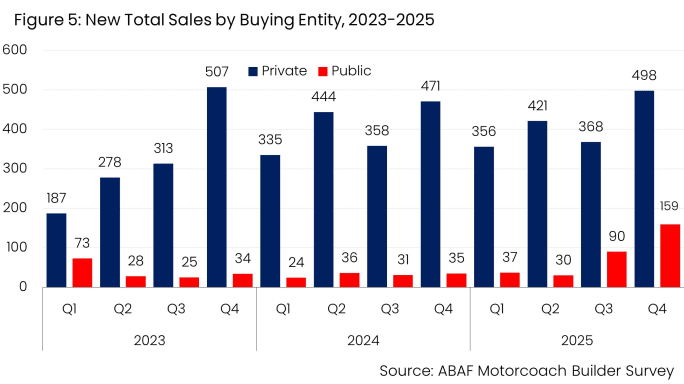
Although sales are still 22% below 2019 levels, officials said pre-pandemic comparisons may no longer fully reflect current conditions as the industry adjusts to shifting demand and changes in operator makeup.
ABAF Motorcoach Builder Survey
Ferguson added that private motorcoach operators are also contending with rising costs and a more challenging regulatory landscape.
Early Q1 data suggest that factors such as tariffs, insurance premiums, fuel volatility, new engine requirements, and other expenses may be shaping purchasing decisions. However, it is too soon to draw firm conclusions.
Those pressures, Ferguson said, underscore the need for continued focus on ABA’s affordability agenda — particularly efforts to push back on strict idling enforcement, review the insurance market, preserve fuel tax fairness, address tolling issues, and ensure greater regulatory and financial parity with public transit systems.
Quick Answers
The ABA report provides insights into motorcoach sales trends and market conditions by collecting and analyzing data from major manufacturers in the US and Canada.
*Summarized by AI
More Motorcoach

From Surviving to Thriving: Building Stronger Transportation Organizations
Bus Business Consultants founder Brian Dickson shares lessons on leadership, organizational health, and creating options for long-term success in a changing transportation industry.
Read More →
Report: Canadian Motorcoach Industry Generates $4.4B in Economic Impact
The 2025 Motorcoach Economic Impact Report finds motorcoach travel supported nearly 25,000 jobs and generated $980 million in federal, provincial, and local taxes.
Read More →
Prevost Opens Expanded Chicago-Area Service Center
The $8.1 million Elk Grove Village investment nearly triples facility space while adding service capacity, parts storage, and customer amenities.
Read More →
People Movement: Dan Dipert Coaches Adds Third-Generation Leader, Keolis Names New Valley Metro VP/GM, and More
In this edition, we also cover recent appointments and announcements at the Wabtec, SilverRide, HNTB, and more, showcasing the individuals helping to shape the future of transportation.
Read More →
METRO Opens Submissions for 2026 Motorcoach Awards
Nominations are now being accepted for METRO Magazine’s Operator of the Year and Innovative Operator of the Year awards.
Read More →
Biz Briefs: Alstom Lands Canadian Contract, LYT to Supply California TSP, and More
In METRO's latest installment, we take a look at recent news from Complete Coach Works, Beep, FlixBus, and more partnerships making headlines across the transportation sector.
Read More →
Biz Briefs: RIPTA Unveils New Frontrunners, Clevland RTA Adds New Siemens, and More
In METRO's latest installment, we take a look at recent news from Siemens, Prevost, Dodge, and more partnerships making headlines across the transportation sector.
Read More →
People Movement: Holly Arnold Joins Transdev and More
In this edition, we also cover recent appointments and announcements at Pace, CamTran, MCI, and more, showcasing the individuals helping to shape the future of transportation.
Read More →
ABA Report: Motorcoach Travel Generates $161.6B Economic Impact
The 2025 analysis finds motorcoach travel supported nearly 900,000 jobs and generated $28 billion in federal, state, and local taxes.
Read More →
CharterUP’s Armir Harris on Technology, AI, and the Future of Group Mobility
In a recent episode of METROspectives, CharterUP Founder/CEO Armir Harris discussed the company’s evolution from an online charter bus marketplace into a technology platform supporting public- and private-sector mobility and much more.
Read More →