




Read More: AC Transit Honors Bus Operators with Safe Driving Award
AC Transit Launches Transbay MCI Bus
The Transbay MCI bus showcases a blend of sustainability, advanced technology, and passenger comfort.
June 28, 2023
The Transbay MCI features 52 seats with embedded headrests; jetliner-styled LED lighting; riders control cabin airflow through overhead air vents and stop request buttons are accessible to each passenger in the overhead panel.
Photo: AC Transit
3 min to read
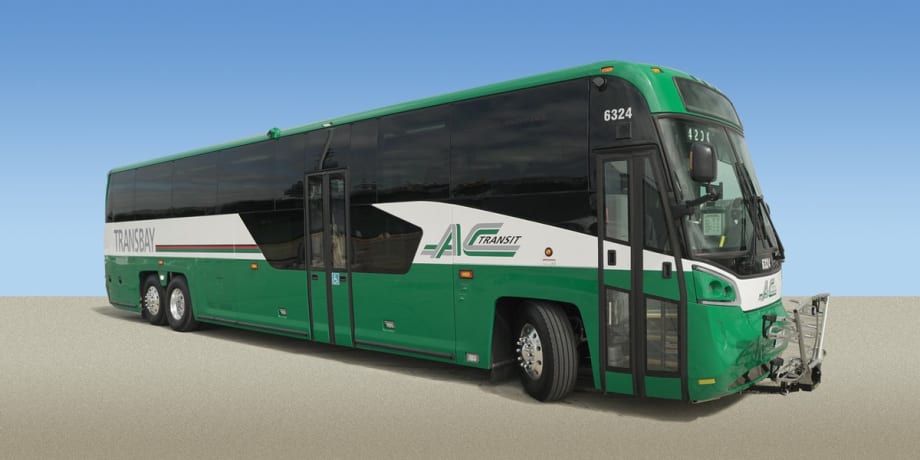
The Alameda-Contra Costa Transit District (AC Transit) announced the launch of the all-new Transbay MCI D45 CRT LE, a bus designed by Motor Coach Industries (MCI).
The bus dubbed the "Transbay MCI", showcases a blend of sustainability, advanced technology, and passenger comfort.
"The Transbay MCI represents a departure from the norm, and by launching this revolutionary new fleet of buses, our transit district is seamlessly combining safety measures with captivating design elements," said Joel Young, AC Transit Board president. "This bus was years in development and, unfortunately, delayed by COVID-induced supply chain issues. Now that it is here, I am confident the Transbay MCI will transform how we commute across San Francisco Bay and chart a new path for an inclusive experience for all riders."
AC Transit's Journey to Launch Transbay MCI Bus
In the pursuit of designing inclusive public transportation, AC Transit has a history of collaborating with disabled riders. As a result, AC Transit launched the Accessibility Advisory Committee in 1991, which now operates as the General Manager's Access Committee (GMAC).
The GMAC examined every aspect of the Transbay MCI Prototype, including hip-to-knee room and narrow seats; excessively reclining seats; a narrow aisle with potential risks at the second set of stairs; inadequate space for luggage and roll bags; and the need for handrails along the top and both sides of the rear staircase, especially for individuals with visual impairments or limited arm mobility.
The committee's insights were sent to the manufacturer's design engineers for changes to amenities and accessibility features.
"The result is a light-filled and low-floor vestibule that is revolutionary in design and breaking barriers for wheelchair accessibility," said Michael Hursh, GM of AC Transit. "The stylized vestibule prioritizes ease of boarding through an all-new mid-cabin door, wider and brawny ADA ramp, enhanced space for maneuverability, one-touch automated securement, and it is built to accommodate the future design of manual or powered wheelchairs, as well as scooters."
Features of the Transbay MCI Bus
Another groundbreaking onboard ADA innovation is the Q'Straint: Quantum Wheelchair Securement Station.
This intelligent technology gives mobility riders complete independence to secure themselves. The mobility rider centers their wheelchair or scooter against the padded backrest; presses the ADA-friendly button to start the automatic locking sequence; and the Q'Straint’s arms safely secure the wheelchair in place – typically, in less than 25 seconds.
The bus operator releases the Q'Straint from the Operator's dashboard control, and the rider can independently exit the bus.
The Transbay MCI features 52 seats with embedded headrests; jetliner-styled LED lighting; riders control cabin airflow through overhead air vents and stop request buttons are accessible to each passenger in the overhead panel.
Two doors and staircases – front and mid-cabin – lead to a broader center aisle with integrated overhead grab rails that increase onboard safety.
Each seat's armrest is fully collapsible by depressing a single release button. Also, like jetliners, the overhead parcel rack stows away packages or bags and creates more legroom.
The new Transbay MCI also features three-point seatbelts.
More Bus

New York MTA Plans Largest Bus Fleet Upgrade in More Than a Decade
The agency is seeking manufacturers for 650 new CNG buses to replace aging vehicles, improve reliability, and advance its broader fleet modernization strategy.
Read More →
Building a Flexible Path to Transit Electrification
John Hroncich discusses BAE Systems’ modular and scalable approach, lessons learned from decades of real-world operations, and how agencies can identify electrification strategies that fit their fleets.
Read More →
Bus Tech Talk: Keeping Transit Technicians Ahead of the Technology Curve
LA Metro’s Obed Mejia discusses technician training, evolving maintenance technology, fleet replacement, and strategies for getting the most out of today’s transit fleets.
Read More →
Biz Briefs: RIPTA Unveils New Frontrunners, Clevland RTA Adds New Siemens, and More
In METRO's latest installment, we take a look at recent news from Siemens, Prevost, Dodge, and more partnerships making headlines across the transportation sector.
Read More →
People Movement: Holly Arnold Joins Transdev and More
In this edition, we also cover recent appointments and announcements at Pace, CamTran, MCI, and more, showcasing the individuals helping to shape the future of transportation.
Read More →
The High Cost of Transit Buses: Industry Leaders Look to Procurement Reform
Transit leaders and policymakers examine how standardized bus designs, streamlined procurement, and predictable funding could help agencies stretch budgets and deliver better service.
Read More →
The Business Voice Behind Public Transportation
As chair of APTA’s Business Members Board of Governors, Ray Melleady explains how more than 850 business members are partnering with transit agencies to advance funding, innovation, and industry-wide collaboration.
Read More →
From Surviving to Thriving: Building Stronger Transportation Organizations
Bus Business Consultants founder Brian Dickson shares lessons on leadership, organizational health, and creating options for long-term success in a changing transportation industry.
Read More →
Finding the ‘Happy Medium’: Optimizing Maintenance Without Sacrificing Reliability
The key to maintenance optimization isn’t doing less work—it’s doing the right work at the right time on the right assets.
Read More →
LA Metro, City of West Hollywood, and Partners Advance Smarter Bus Lane Enforcement
The award-winning partnership combines AI-powered detection with human oversight to improve bus reliability, accessibility, and enforcement efficiency.
Read More →