




RELATED: Nearly 9 in 10 Americans see benefits of public transit
AlphaVu launches new metric for understanding public opinion of public transit
The National Transit LCB™ is the first in a portfolio of metrics that will be released over the summer of 2017 covering ports, airports, electricity, water, and pipeline infrastructure.
July 13, 2017
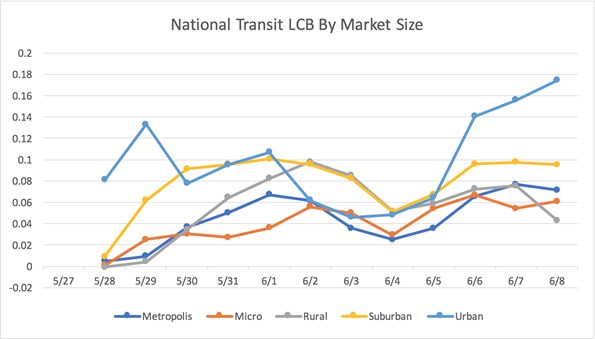
The chart visualizes the trend in National Transit LCB over the past two weeks, segmented by market size--Metropolis, Urban, Suburban, Rural, and Micro. Each point on the graph corresponds to the LCB of each market size segment on that day. Upward trends in LCB are often a result of positive public service announcements, holidays, and service improvements, all conversations that result in significantly higher levels of positive engagement. Other changes in LCB, like a downward trend, signify an increase in negative conversations, usually regarding service complaints or community displeasure with capital construction projects, while a plateau represents an unchanging level of engagement and frequency within a given period of time.
2 min to read
The chart visualizes the trend in National Transit LCB over the past two weeks, segmented by market size--Metropolis, Urban, Suburban, Rural, and Micro. Each point on the graph corresponds to the LCB of each market size segment on that day. Upward trends in LCB are often a result of positive public service announcements, holidays, and service improvements, all conversations that result in significantly higher levels of positive engagement. Other changes in LCB, like a downward trend, signify an increase in negative conversations, usually regarding service complaints or community displeasure with capital construction projects, while a plateau represents an unchanging level of engagement and frequency within a given period of time.
AlphaVu, a leader in social listening, data mining, and public opinion research in the transit and infrastructure industries, introduced National Transit LCB™, a comprehensive metric designed to provide leaders with real-time, actionable insight into public opinion around public transportation safety, operations, and capital construction projects. The National Transit LCB™ is the first in a portfolio of metrics that will be released over the summer of 2017 covering ports, airports, electricity, water, and pipeline infrastructure.
AlphaVu's National Transit LCB™ metric measures the frequency of individuals' engagement on social media with transit agencies across the country and combines that data with audience sentiment, relative to a defined list of specific topics. The National Transit LCB™ can be segmented by a wide range of adjustable variables, including region, industry, market size, and financing.
"Transit agencies, construction companies, project management firms, and private equity firms need actionable data on how the public perceives transportation infrastructure. The National Transit LCB™ gives them an immediate window into public opinion so they can form the best strategies to build, finance, and manage America's bus and rail systems," said Scott Wilkinson, President of AlphaVu.
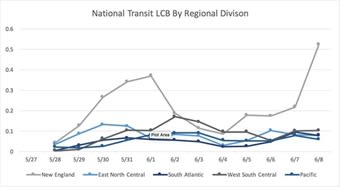
The chart above visualizes the trend in National Transit LCB over the past two weeks, segmented by regional division. Included are five of ten total regional division segments--New England, East North Central, South Atlantic, West South Central, and Pacific. While LCB for four of the regional divisions was generally consistent, the trend in New England's LCB saw more dramatic spikes in the same time period. When users engage with New England transit agencies, their engagement expresses higher levels of positive sentiment resulting in more significant changes in LCB.
Traditional public opinion polling still relies heavily on phone surveys and other outdated methodologies that are ill-suited to today's digital age. By contrast, AlphaVu's LCB measures the conversation right where it's happening and among those most heavily involved, using proprietary algorithms to synthesize vast amounts of data from social media and digital channels. When cross-referenced with voter rolls, Census data, and other third-party data sets, the result is a granular portrait of public opinion that far exceeds the traditional polls in depth, detail, and scale.
The LCB adds a critical new feature to AlphaVu's expanding toolset. From this consolidated metric, AlphaVu can dig deeper into the specific drivers of public sentiment all the way down to the individual influencers shaping the conversation in individual communities across the country.
More Technology

From Hardware to Digital Partner: Luminator Charts Its Next Chapter
CEO Magnus Friberg discusses Luminator’s shift toward becoming a digital partner, the growing importance of software and interoperability, and how AI can help agencies improve operations and passenger experience.
Read More →
Beyond the Checklist: A Structured Approach to Transit Maintenance
Reliability-Centered Maintenance helps transit agencies move beyond routine checklists to focus limited resources on the assets and failures that have the greatest impact on safety, reliability, and service.
Read More →
NJ TRANSIT Advances Bus Technology Upgrades Across Statewide Fleet
More than 1,500 buses now feature upgraded technology designed to improve arrival predictions and provide free Wi-Fi, with deployment expected to reach nearly 2,000 buses by the end of 2026.
Read More →

Building a Flexible Path to Transit Electrification
John Hroncich discusses BAE Systems’ modular and scalable approach, lessons learned from decades of real-world operations, and how agencies can identify electrification strategies that fit their fleets.
Read More →
Biz Briefs: Alstom Lands Canadian Contract, LYT to Supply California TSP, and More
In METRO's latest installment, we take a look at recent news from Complete Coach Works, Beep, FlixBus, and more partnerships making headlines across the transportation sector.
Read More →
Sponsored•September 8, 2026
From Legacy Silos to Conversational Intelligence
What if transit leaders could ask any operational question and get a trusted answer in seconds? Conversational AI is transforming how agencies use their data.
Read More →
USDOT Announces Rail Vehicle Replacement Grants, Chattanooga AV Shuttle Funding
More than $191 million in federal funding will help three transit agencies replace aging rail vehicles and support a new autonomous shuttle service in Chattanooga.
Read More →
Bus Tech Talk: Keeping Transit Technicians Ahead of the Technology Curve
LA Metro’s Obed Mejia discusses technician training, evolving maintenance technology, fleet replacement, and strategies for getting the most out of today’s transit fleets.
Read More →
Biz Briefs: RIPTA Unveils New Frontrunners, Clevland RTA Adds New Siemens, and More
In METRO's latest installment, we take a look at recent news from Siemens, Prevost, Dodge, and more partnerships making headlines across the transportation sector.
Read More →
Why Simulating Pedestrian Movement Has Become Essential for Modern Rail Stations
Pedestrian microsimulation is helping rail planners identify bottlenecks, test station designs, and prepare complex transit hubs for growing passenger volumes.
Read More →