



Artwork for NYC's Second Avenue Subway stations unveiled
The largest permanent public art installation in New York history creates a new museum underground and celebrates the work of legendary artists, including large-scale portraits by Chuck Close.

Photos: Governor Andrew Cuomo/Flickr
Photos: Governor Andrew Cuomo/Flickr
Gov. Andrew M. Cuomo unveiled the largest permanent public art installation in New York State history in conjunction with the grand opening of Phase I of the Second Avenue Subway. The Second Avenue Subway marks the city’s first major expansion project in more than 50 years, with three new handicap-accessible stations along Second Avenue at 96th Street, 86th Street and 72nd Street, and new entrances to the existing Lexington Av/63rd Street Station at 63rdStreet and Third Avenue.
"The Second Avenue subway provides New Yorkers with a museum underground and honors our legacy of building engineering marvels that elevate the human experience," Governor Cuomo said.
The new stations will feature four world-class public art installations:
At 96th Street, “Blueprint for a Landscape” by Sarah Sze profoundly impacts the look of the station as her imagery is applied directly to nearly 4300 unique porcelain wall tiles, spanning approximately 14,000 square feet. The designs feature familiar objects — sheets of paper, scaffolding, birds, trees, and foliage — caught up in a whirlwind velocity that picks up speed and intensity as the composition unfolds throughout the station with references to energy fields and wind patterns. Each entrance features a different shade of blue and a blueprint-style vector line design, a visual theme that is integrated with the architecture.
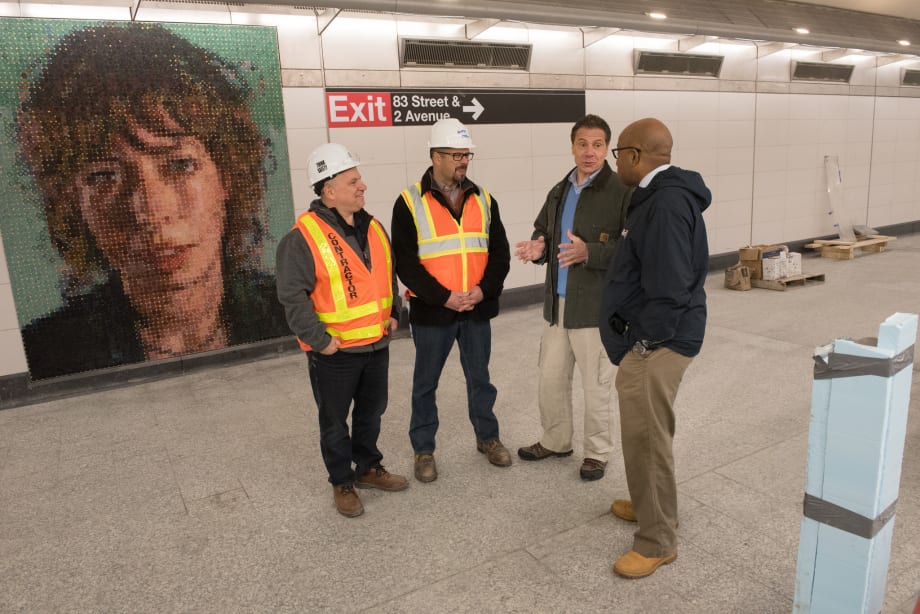
At 86th Street, Chuck Close in “Subway Portraits” created twelve large-scale works that are based on the artist’s painstakingly detailed photo-based portrait paintings. His various painting techniques have been interpreted in ten works as mosaic, and in two as ceramic tile. The artworks measure close to nine feet high and are placed on the walls at the station entrances and the mezzanine concourse. The people portrayed are cultural figures that have frequently been his subjects, including Philip Glass, Zhang Huan, Kara Walker, Alex Katz, Cecily Brown, Cindy Sherman, and Lou Reed, as well as two distinct self-portraits.
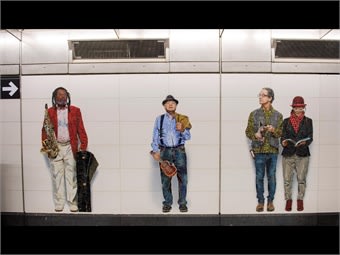
At 72nd Street, Vik Muniz’s installation, “Perfect Strangers” features more than three dozen characters created in mosaic and installed throughout the mezzanine and entrance areas, populating the station with colorful images of all types of New Yorkers. The main station entrance features an etched glass canopy at street level depicting a flock of birds, bringing art and nature to the busy location. Within the expanse of the mezzanine concourse, the life size figures provide bursts of color and visual interest and an opportunity for new discovery with every trip through the station.
Photos: Governor Andrew Cuomo/Flickr
At 63rd Street, Jean Shin’s installation, “Elevated” uses archival photographs of the 2nd and 3rd Avenue Elevated train to create compositions in ceramic tile, glass mosaic, and laminated glass. The imagery is manipulated and re-configured and each station level provides a unique focus, palette and material. At the escalator, the view is filled with ceramic tile depicting construction beams and the cranes that dismantled the El in the 1940s. At the mezzanine, a mosaic reveals the sky where the train had previously been present, and features images of people from the era in this neighborhood transformation. The platform level features semi-transparent and reflective materials showing vintage scenes of the neighborhood, while enabling contemporary viewers to see themselves in the cityscape of the past.
The Second Avenue Subway marks the most significant changes to New York City subway service in recent decades, and will be built in four phases. Phase I will provide service from 96th Street to 63rd Street and will serve more than 200,000 people per day, reducing overcrowding on the Lexington Avenue Line and restoring a transit link to a neighborhood that lost the Second Avenue Elevated in 1940.
Phase I will decrease crowding on the adjacent Lexington Avenue Line by as much as 13 percent, or 23,500 fewer riders on an average weekday. It will also reduce travel times by up to 10 minutes or more for those on the far east side or those traveling from the east side to west midtown. Further phases of the project will extend the line to Hanover Square in the Financial District.
The new stations will also provide transfers to other subway and commuter rail lines. All of the stations will have escalator and elevator access including access for the disabled, and will feature climate control features to maximize customer comfort.
The Second Avenue Subway expansion is part of the Governor’s sweeping statewide initiative to redevelop and rebuild New York’s aging infrastructure from the ground up. The comprehensive plan includes a new LaGuardia Airport, completely redesigned Penn Station, the LIRR 2nd and 3rd Track projects, the New New York Bridge, a major expansion of the Jacob K. Javits Center, as well as a complete overhaul and upgrades to the MTA's seven bridges and two tunnels in the metropolitan region.
More Rail

New York MTA Advances Final Contract for Second Avenue Subway Expansion
Contract Four is the largest in the Second Avenue Subway Phase 2 project and includes construction of station infrastructure, tracks, and signals for the subway expansion, MTA officials said. Work on Contract Four will begin in 2027.
Read More →
San Diego MTS Breaks Monthly Trolley Ridership Record
Agency officials said July’s ridership indicates MTS’s continued recovery from the pandemic.
Read More →
Report Examines NJ TRANSIT Reliability, Funding Challenges
The Garden State Initiative analysis examines the roles of Amtrak infrastructure, fleet management, and agency operations while recommending a more performance-based approach to improving reliability.
Read More →
Stadler, CapMetro Sign Long-Term Rail Fleet Support Agreement
Beginning in 2027, Stadler will provide on-site technical expertise, spare parts support, training, and obsolescence management to help extend the reliability and longevity of CapMetro’s GTW fleet.
Read More →
Biz Briefs: Alstom Lands Canadian Contract, LYT to Supply California TSP, and More
In METRO's latest installment, we take a look at recent news from Complete Coach Works, Beep, FlixBus, and more partnerships making headlines across the transportation sector.
Read More →
CATS Gold Line Marks 5 Years of Service, 2.8M Passenger Trips
With a six-mile expansion planned, the Charlotte streetcar is positioned to connect more neighborhoods and major transit hubs across the region.
Read More →
Why Simulating Pedestrian Movement Has Become Essential for Modern Rail Stations
Pedestrian microsimulation is helping rail planners identify bottlenecks, test station designs, and prepare complex transit hubs for growing passenger volumes.
Read More →
Amtrak Begins Major Construction at New York’s Sunnyside Yard
The new maintenance facility will support Amtrak’s Airo trainsets while improving maintenance efficiency and turnaround times in New York.
Read More →
Chicago Leaders Unveil Plans for O’Hare Airport Express Train
The privately developed project would offer a 15-minute trip between downtown and O’Hare’s Terminal 2, with trains operating every 15 minutes on a dedicated track. The service would use battery-electric trains and three existing freight rail rights-of-way.
Read More →
OCTA Maps Out 30-Year Strategy to Protect Coastal Rail Corridor
The draft feasibility report identifies strategies to protect the coastal rail line for decades as the agency continues near-term stabilization and sand placement efforts.
Read More →