



Autonomous Train to Operate in France
The Regio 2N regional train will be used over the next two years as a prototype that will be tested on the track between Aulnoye and Busigny.
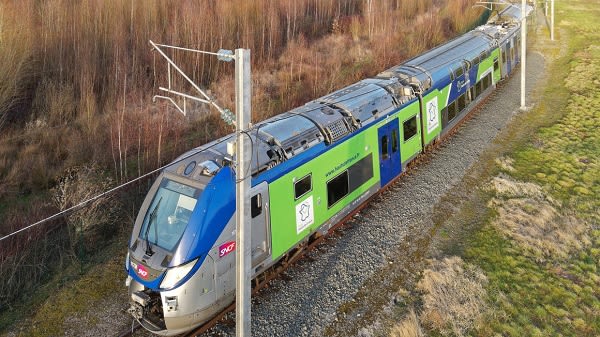
This Regio 2N regional train will be used over the next two years as a prototype that will be tested on the track between Aulnoye and Busigny.
Alstom
Two and a half years after a consortium was launched to develop the prototype of an autonomous regional train in France, SNCF and its partners Alstom, Bosch, Spirops, Thales, and the Railenium Technology Research Institute are putting their test train into operation.
At the start of the year, a Regio 2N regional train was modified and equipped for the purpose of the trials by the Alstom site in Crespin. Various sensors, cameras, radars and lidars (laser detection) were fitted to collect essential data for the project.
Initial trials
The first trials took place over one week, in the beginning of March, between Aulnoye and Busigny and between Busigny and Calais (in the North of France). The Regio 2N regional train prototype ran on a commercial track, with the project's engineers and technicians on board.
The trials included tests of:
The perception and recognition systems for the signals located along the track;
The geolocation system, particularly by satellite, which provides the precise position of the train.
During this first phase of trials, the sensors and equipment of these new systems specially fitted on the train were activated for the purpose of observing how they work but did not interfere with the movement of the train. The Regio 2N regional train prototype was driven by an SNCF driver specialized in operating under test conditions.
At the end of this week of trials, tests were conducted at the CEF railway test centre in Petite-Forêt to test the train's autonomous operation system, which makes it possible to automate the acceleration and braking of the train.
A second trial phase
From May 17 to 21, following the tests carried out at the CEF railway test centre, a second series of trials were scheduled to fine-tune the operating system of the train prototype.
These new trials took place on the national railway network at Busigny (in the North of France) and will lead, in the coming months, to semi-autonomous operation in the trial phase. Semi-autonomous operation makes it possible to automate the acceleration and braking of the train, supervised by a driver.
These trials are a key step towards achieving the consortium's ultimate objective: achieving full autonomy by 2023.
Prototype usage for commercial service, trials
Over the next two years, this Regio 2N regional train will be used as a prototype of the autonomous passenger train. The train will be tested on the track between Aulnoye and Busigny.
Outside the research and test periods, the Regio 2N regional train, an activity of SNCF Voyageurs, will be in regular commercial service transporting passengers. During these commercial trips, in conventional driving mode, it will record data that will improve the performance of the signal recognition algorithms by detecting, for example, the color of the traffic lights and the surrounding environment of the train.
At the same time, laboratory work is being carried out on trial simulators at the sites of all the consortium partners to fine-tune the itineraries of the test train and further develop the automated system.
Potential benefits
Autonomy could provide rail transport with new perspectives: more flexible organization, with the possibility of rapidly changing the number of trains in line with changing needs. These benefits will encourage a modal shift from road to rail, thereby contributing to a more environmental-friendly mode of transport.
"The trials conducted over the last few months represent a significant step towards our goal, that of inventing the transport of the future with the autonomous train,” said Eric Tregoat, CEO of Railenium.
"We are pleased to see the realization of this innovative programme after two and a half years of work by the consortium,” added Heiko Carrie, president of Robert Bosch France. “The success of these trials confirms the pertinence of autonomous vehicle technologies when applied to the railway sector.”
More Rail

New York MTA Advances Final Contract for Second Avenue Subway Expansion
Contract Four is the largest in the Second Avenue Subway Phase 2 project and includes construction of station infrastructure, tracks, and signals for the subway expansion, MTA officials said. Work on Contract Four will begin in 2027.
Read More →
San Diego MTS Breaks Monthly Trolley Ridership Record
Agency officials said July’s ridership indicates MTS’s continued recovery from the pandemic.
Read More →
Report Examines NJ TRANSIT Reliability, Funding Challenges
The Garden State Initiative analysis examines the roles of Amtrak infrastructure, fleet management, and agency operations while recommending a more performance-based approach to improving reliability.
Read More →
Stadler, CapMetro Sign Long-Term Rail Fleet Support Agreement
Beginning in 2027, Stadler will provide on-site technical expertise, spare parts support, training, and obsolescence management to help extend the reliability and longevity of CapMetro’s GTW fleet.
Read More →
Biz Briefs: Alstom Lands Canadian Contract, LYT to Supply California TSP, and More
In METRO's latest installment, we take a look at recent news from Complete Coach Works, Beep, FlixBus, and more partnerships making headlines across the transportation sector.
Read More →
CATS Gold Line Marks 5 Years of Service, 2.8M Passenger Trips
With a six-mile expansion planned, the Charlotte streetcar is positioned to connect more neighborhoods and major transit hubs across the region.
Read More →
Why Simulating Pedestrian Movement Has Become Essential for Modern Rail Stations
Pedestrian microsimulation is helping rail planners identify bottlenecks, test station designs, and prepare complex transit hubs for growing passenger volumes.
Read More →
Amtrak Begins Major Construction at New York’s Sunnyside Yard
The new maintenance facility will support Amtrak’s Airo trainsets while improving maintenance efficiency and turnaround times in New York.
Read More →
Chicago Leaders Unveil Plans for O’Hare Airport Express Train
The privately developed project would offer a 15-minute trip between downtown and O’Hare’s Terminal 2, with trains operating every 15 minutes on a dedicated track. The service would use battery-electric trains and three existing freight rail rights-of-way.
Read More →
OCTA Maps Out 30-Year Strategy to Protect Coastal Rail Corridor
The draft feasibility report identifies strategies to protect the coastal rail line for decades as the agency continues near-term stabilization and sand placement efforts.
Read More →