



Biz Briefs: Alexander Dennis, Tolar, and Wabtec
The latest agency/supplier news from England, California, and France.

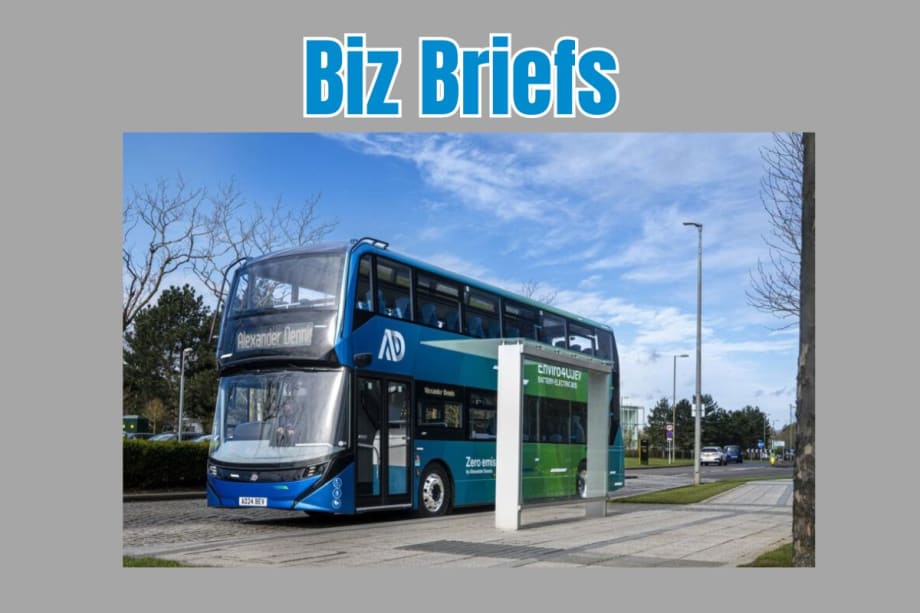
The new buses will remove local exhaust emissions from Reading Buses’ busy routes 17 and 21 when the zero-emission vehicles enter service in 2025.
Photo: Alexander Dennis
Biz Briefs covers the latest in supplier/transit agency news. METRO's latest installment features Alexander Dennis, Tolar Manufacturing Co., and Wabtec.
If you have supplier news to share, contact us.
Alexander Dennis Lands 53 Double-Decker UK Bus Order
English bus operator Reading Buses confirmed new orders for 24 zero-emission and 29 low-emission Alexander Dennis buses.
The 24 next-generation Alexander Dennis Enviro400EV double deckers will be the operator’s first batch of electric buses. They are the result of a successful bid with Reading Borough Council for funding from the second round of the UK Government’s Zero-Emission Regional Bus Areas scheme.
The new buses will remove local exhaust emissions from Reading Buses’ busy routes 17 and 21 when the zero-emission vehicles enter service in 2025. They will be easily able to run for a full day on these services, with charging taking place at the Reading Buses depot, which will be upgraded with 13 fast chargers that can each charge two vehicles at once.
The new zero-emission buses will allow route 17’s current fleet of Enviro400CBG biogas buses to be redeployed on other routes to replace some of the company’s oldest diesel buses.
Tolar Delivers 50 California Bus Shelters
Fifty new Signature Sunset Bus Shelters have been delivered and installed in Stanislaus County as part of an agreement between Modesto, Calif.’s StanRTA and Tolar Manufacturing Co.
The eight- to 16-foot-long shelters feature amenities including comfortable seating, solar lighting, and trash receptacles and were procured utilizing the MBTA/CALACT purchasing catalog.
Tolar delivered eight-, 12- and 16-foot Sunset shelters, selected by StanRTA to meet the needs of their riders. The shelters are made with polycarbonate roof panels featuring a Sunset radius design for optimal coverage and a minimal footprint. They also feature a super durable baked powder coat custom color matched to the agency’s specifications.
Amenities include aluminum framed Mesa benches with HDPE slats, 20-gallon post-mount aluminum trash receptacles, and dusk-to-dawn solar powered illumination systems, providing riders with a comfortable and secure experience.
Wabtec’s Green Friction Begins Commercial Operations
Wabtec Corp.’s Green Friction braking solution is ready to begin commercial fleet operations on the RER A rail line in the greater Paris metropolitan area, in association with Île-de-France Mobilités (IDFM) and RATP.
The innovative brake friction material will improve air quality in the transit authority’s tunnels and underground network by reducing particle emissions from braking.
Green Friction brake linings will be deployed on all MI09 trains operating on the RER A line starting this year, benefiting more than one million daily passengers. This commercial launch follows extensive testing in association with RATP and IDFM. Wabtec tested its Green Friction materials on 10 RER A trains for over a year to confirm its effectiveness.
The solution covered over one million kilometers of testing and demonstrated the capability to reduce emissions from the train braking by an average of 70%, up to 90%. The reductions are achieved without compromising safety or performance, while also minimizing the impact on operating costs.
More Technology

From Hardware to Digital Partner: Luminator Charts Its Next Chapter
CEO Magnus Friberg discusses Luminator’s shift toward becoming a digital partner, the growing importance of software and interoperability, and how AI can help agencies improve operations and passenger experience.
Read More →
Beyond the Checklist: A Structured Approach to Transit Maintenance
Reliability-Centered Maintenance helps transit agencies move beyond routine checklists to focus limited resources on the assets and failures that have the greatest impact on safety, reliability, and service.
Read More →
NJ TRANSIT Advances Bus Technology Upgrades Across Statewide Fleet
More than 1,500 buses now feature upgraded technology designed to improve arrival predictions and provide free Wi-Fi, with deployment expected to reach nearly 2,000 buses by the end of 2026.
Read More →

Building a Flexible Path to Transit Electrification
John Hroncich discusses BAE Systems’ modular and scalable approach, lessons learned from decades of real-world operations, and how agencies can identify electrification strategies that fit their fleets.
Read More →
Biz Briefs: Alstom Lands Canadian Contract, LYT to Supply California TSP, and More
In METRO's latest installment, we take a look at recent news from Complete Coach Works, Beep, FlixBus, and more partnerships making headlines across the transportation sector.
Read More →
From Legacy Silos to Conversational Intelligence
What if transit leaders could ask any operational question and get a trusted answer in seconds? Conversational AI is transforming how agencies use their data.
Read More →
USDOT Announces Rail Vehicle Replacement Grants, Chattanooga AV Shuttle Funding
More than $191 million in federal funding will help three transit agencies replace aging rail vehicles and support a new autonomous shuttle service in Chattanooga.
Read More →
Bus Tech Talk: Keeping Transit Technicians Ahead of the Technology Curve
LA Metro’s Obed Mejia discusses technician training, evolving maintenance technology, fleet replacement, and strategies for getting the most out of today’s transit fleets.
Read More →
Biz Briefs: RIPTA Unveils New Frontrunners, Clevland RTA Adds New Siemens, and More
In METRO's latest installment, we take a look at recent news from Siemens, Prevost, Dodge, and more partnerships making headlines across the transportation sector.
Read More →
Why Simulating Pedestrian Movement Has Become Essential for Modern Rail Stations
Pedestrian microsimulation is helping rail planners identify bottlenecks, test station designs, and prepare complex transit hubs for growing passenger volumes.
Read More →