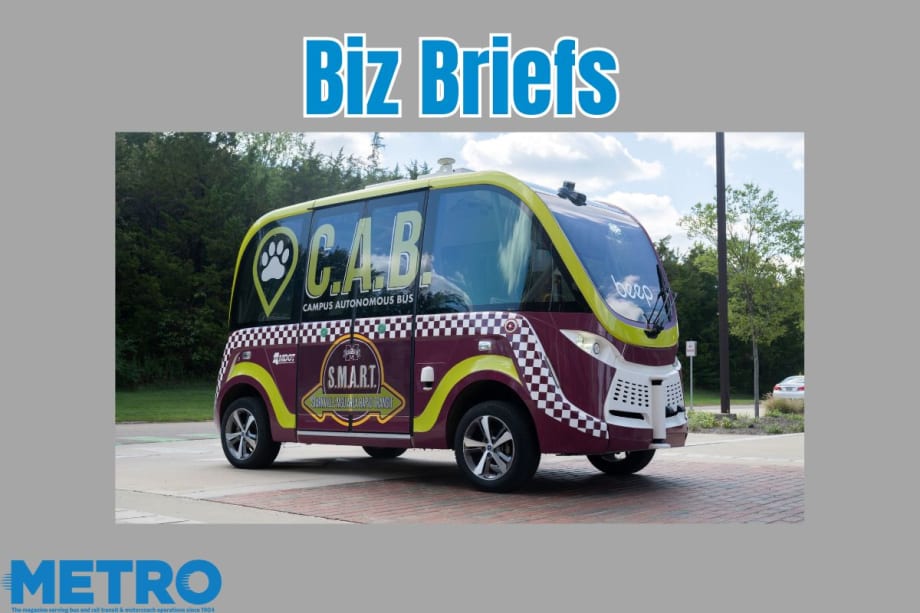
The C.A.B. pilot program consists of two electric autonomous Beep shuttles, with one operating at a time along a 2.4-mile route that includes five different stops at key destinations.
Photo: Beep
3 min to read
Biz Briefs covers the latest supplier partnership news in the motorcoach and public transit industries.
In the latest installment, we cover new announcements in Mississippi, St. Louis, Utah, and California.
Ad Loading...
Beep, Mississippi State Team to Launch AV Pilot
Beep Inc. announced the public launch of C.A.B., or Campus Autonomous Bus, at Mississippi State University (MSU), marking Mississippi’s first-ever autonomous pilot program.
The C.A.B. pilot program consists of two electric autonomous Beep shuttles, with one operating at a time along a 2.4-mile route that includes five different stops at key destinations.
C.A.B. is currently scheduled to operate through the end of the year and will give MSU a chance to evaluate how autonomous transportation systems can be used on campus to diversify its existing fleet of transportation assets.
MSU is also researching how electric and shared autonomous mobility can be used in rural-urban environments.
Transit Sales International Awarded Contract in Utah
Transit Sales International (TSI) was awarded a contract to supply Utah’s High Valley Transit with four 2009 Gillig buses.
Ad Loading...
The buses include two 35-foot and two 40-foot models, which will be integrated into High Valley Transit’s fleet to support their growing public transportation needs.
TSI will conduct a thorough inspection to ensure that all systems are fully operational. In addition, the buses will be repainted in black to match High Valley’s fleet standards.
Once completed, the buses will be ready for High Valley Transit’s daily service, enhancing their fleet’s capacity and performance.
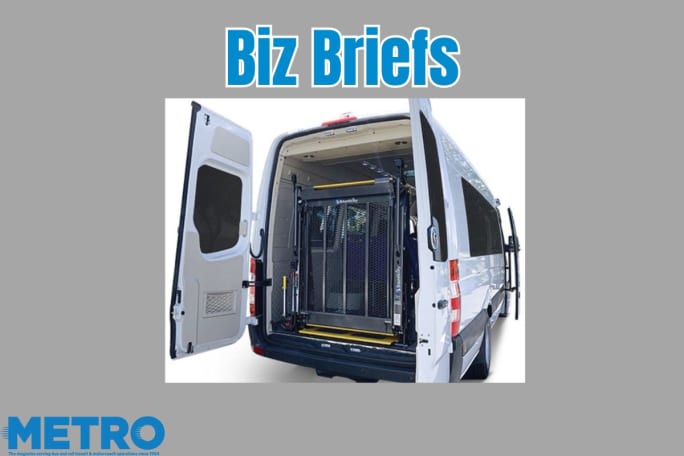
The university ordered 10 GreenPower EV Star Passenger Vans with rear ADA BraunAbility lifts and Q’STRAINT wheelchair securements, along with front end bike racks for maximum student transportation and mobility options on campus.
Photo: GreenPower
GreenPower Receives Order for 10 Passenger vans in St. Louis
GreenPower Motor Company Inc. received an order for 10 EV Star Passenger Vans to be delivered to Washington University in St. Louis for on-campus student transportation.
The university ordered 10 GreenPower EV Star Passenger Vans with rear ADA BraunAbility lifts and Q’STRAINT wheelchair securements, along with front end bike racks for maximum student transportation and mobility options on campus.
Ad Loading...
The EV Star Passenger Vans as ordered by Washington University in St. Louis will be equipped with rear BraunAbility ADA lifts and Q’STRAINT wheelchair securement positions.
The WashU vehicles also include an optional bike rack on the front of each van to provide further mobility options for the students.
Routing Company Lands Microtransit Contract in California
The Routing Company (TRC) landed a new, three-year contract from California’s City of Vacaville to provide microtransit with up to 10 vehicles.
The contract includes options to extend the contract for up to two additional years, for a total of five years.
The new contract will enhance the on-demand transit service for City Coach Direct, with a focus on improving and extending Vacaville’s existing City Coach transit network with more efficient, flexible, and responsive transportation. The service includes on-demand transit but will also accommodate commingled paratransit rides.
Ad Loading...
The partnership marks TRC’s sixth partnership in California, following those with FAST, Sonoma-Marin Area Rail Transit, Solano Transportation Authority, Plumas Transit Systems, and Lassen Transit. Service is anticipated to start late 2024.
CEO Magnus Friberg discusses Luminator’s shift toward becoming a digital partner, the growing importance of software and interoperability, and how AI can help agencies improve operations and passenger experience.
Reliability-Centered Maintenance helps transit agencies move beyond routine checklists to focus limited resources on the assets and failures that have the greatest impact on safety, reliability, and service.
More than 1,500 buses now feature upgraded technology designed to improve arrival predictions and provide free Wi-Fi, with deployment expected to reach nearly 2,000 buses by the end of 2026.
John Hroncich discusses BAE Systems’ modular and scalable approach, lessons learned from decades of real-world operations, and how agencies can identify electrification strategies that fit their fleets.
In METRO's latest installment, we take a look at recent news from Complete Coach Works, Beep, FlixBus, and more partnerships making headlines across the transportation sector.
What if transit leaders could ask any operational question and get a trusted answer in seconds? Conversational AI is transforming how agencies use their data.
More than $191 million in federal funding will help three transit agencies replace aging rail vehicles and support a new autonomous shuttle service in Chattanooga.
LA Metro’s Obed Mejia discusses technician training, evolving maintenance technology, fleet replacement, and strategies for getting the most out of today’s transit fleets.
In METRO's latest installment, we take a look at recent news from Siemens, Prevost, Dodge, and more partnerships making headlines across the transportation sector.
Pedestrian microsimulation is helping rail planners identify bottlenecks, test station designs, and prepare complex transit hubs for growing passenger volumes.