CCTA, Beep Launching AV Shuttle Service at Senior Community Site
With this launch, residents of the active senior Rossmoor 55-plus community can now take advantage of the free pilot shuttle program aimed at providing easy, stress- and emission-free transportation.
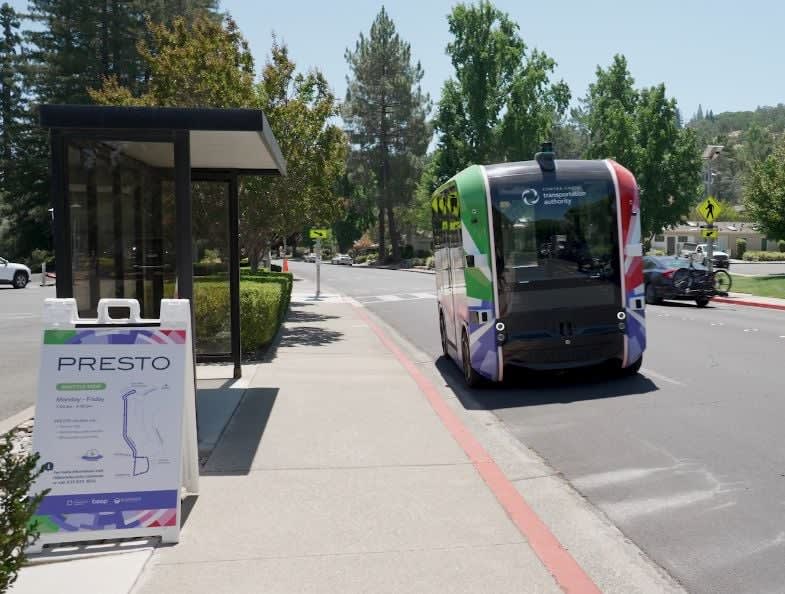
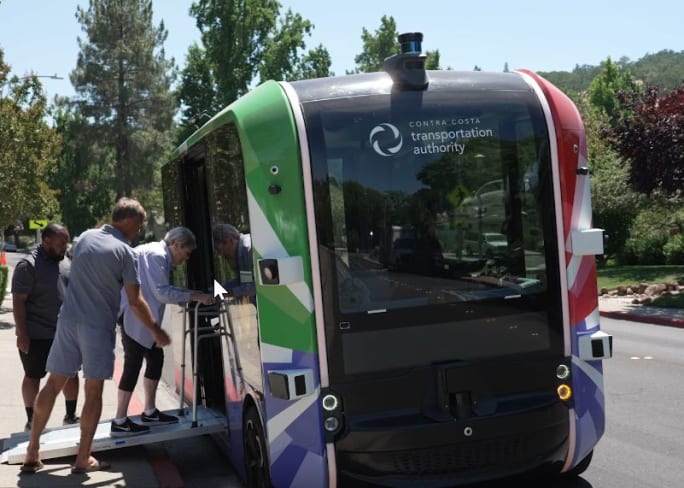
The CCTA's AV shuttle will run on a pre-programmed loop with a trained attendant on board.
Photo: CCTA/Beep
2 min to read
California’s Contra Costa Transportation Authority (CCTA) launched its second PRESTO autonomous shuttle service, which increases transportation access for seniors with Beep Inc.
With this launch, residents of the active senior Rossmoor 55-plus community can now take advantage of the free pilot shuttle program aimed at providing easy, stress- and emission-free transportation.
Ad Loading...
CCTA’s New AV Service
The AV shuttle will run on a pre-programmed loop with a trained attendant on board.
“CCTA is proud to offer nationally recognized mobility solutions, while also championing local communities, making it easier and safer to travel,” said CCTA Chair Newell Arnerich said. “CCTA is committed to making transportation accessible for all. We chose Rossmoor to pilot an alternative to driving so residents can maintain activities that keep them socially connected while experiencing a cutting-edge transportation network.”
As a spacious gated community, Rossmoor is an ideal testing ground for an autonomous vehicle program.
Driven by Oxa, a provider of self-driving vehicle software, the shuttles carry seven seated and secured passengers, plus a trained attendant to provide riders with a safe and informed experience.
The shuttle network is also remotely monitored by the Beep Command Center to ensure operational safety at all times.
Ad Loading...
By demonstrating at Rossmoor, CCTA can learn what works best for the 55-plus community.
Photo: CCTA/Beep
Building for Future Deployments
By demonstrating at Rossmoor, CCTA can learn what works best for the 55-plus community.
Passenger feedback will help shape the future of this technology, as federal transportation officials plan to use PRESTO pilot data to advance standards in automated mobility.
The pilot is funded by a grant from the U.S. Department of Transportation.
“We are excited to partner with CCTA again, bringing the PRESTO autonomous mobility network to Rossmoor,” said Beep CEO Joe Moye. “This collaboration underscores our shared vision of leveraging innovative technologies and services to enhance community access to first- and last-mile transportation. Beep autonomous shuttles in Rossmoor will provide reliable and safe transit options, connecting residents to key destinations, people, and opportunities within the community.”
Rossmoor is the second site where CCTA has launched an autonomous vehicle pilot. The first of four proposed pilots was launched in 2023 by CCTA at Bishop Ranch business park in San Ramon.
Ad Loading...
To date, the Bishop Ranch autonomous shuttles have safely transported more than 1,600 passengers. CCTA is expected to introduce a future autonomous vehicle program in the City of Martinez this summer.
CEO Magnus Friberg discusses Luminator’s shift toward becoming a digital partner, the growing importance of software and interoperability, and how AI can help agencies improve operations and passenger experience.
Reliability-Centered Maintenance helps transit agencies move beyond routine checklists to focus limited resources on the assets and failures that have the greatest impact on safety, reliability, and service.
More than 1,500 buses now feature upgraded technology designed to improve arrival predictions and provide free Wi-Fi, with deployment expected to reach nearly 2,000 buses by the end of 2026.
John Hroncich discusses BAE Systems’ modular and scalable approach, lessons learned from decades of real-world operations, and how agencies can identify electrification strategies that fit their fleets.
In METRO's latest installment, we take a look at recent news from Complete Coach Works, Beep, FlixBus, and more partnerships making headlines across the transportation sector.
What if transit leaders could ask any operational question and get a trusted answer in seconds? Conversational AI is transforming how agencies use their data.
More than $191 million in federal funding will help three transit agencies replace aging rail vehicles and support a new autonomous shuttle service in Chattanooga.
LA Metro’s Obed Mejia discusses technician training, evolving maintenance technology, fleet replacement, and strategies for getting the most out of today’s transit fleets.
In METRO's latest installment, we take a look at recent news from Siemens, Prevost, Dodge, and more partnerships making headlines across the transportation sector.
Pedestrian microsimulation is helping rail planners identify bottlenecks, test station designs, and prepare complex transit hubs for growing passenger volumes.