



Biz Briefs: STV, New Flyer, and Genetec
Biz Briefs covers the latest supplier news in the motorcoach and public transit industries.

Biz Briefs covers the latest supplier news in the motorcoach and public transit industries.
Photo: METRO
Biz Briefs covers the latest supplier news in the motorcoach and public transit industries.
In METRO's latest installment, we take a look at the latest news from suppliers including STV, New Flyer, and more.
STV Leveraging AI Solutions for CTA Pilot
STV was selected by the Chicago Transit Authority (CTA) to provide new digital solutions to enhance right-of-way safety as part of a unique CTA pilot program.
Using software developed by Derq, an award-winning artificial intelligence (AI) and predictive analytics platform, the pilot program will leverage AI-equipped cameras to provide real-time data so CTA can better monitor and respond to track right-of-way intrusions by people or large objects.
The camera detection system uses a computer vision algorithm to identify intrusions and send details to CTA staff at its Control Center so action can be taken. The new system has the potential to improve safety by enabling swift intervention when unauthorized people are on the tracks.
The pilot, which will be conducted over the next 12 months, was initiated by CTA’s Innovation Studio, a program launched last year to test new and state-of-the-art solutions to a wide range of issues impacting all aspects of the agency and its ridership.
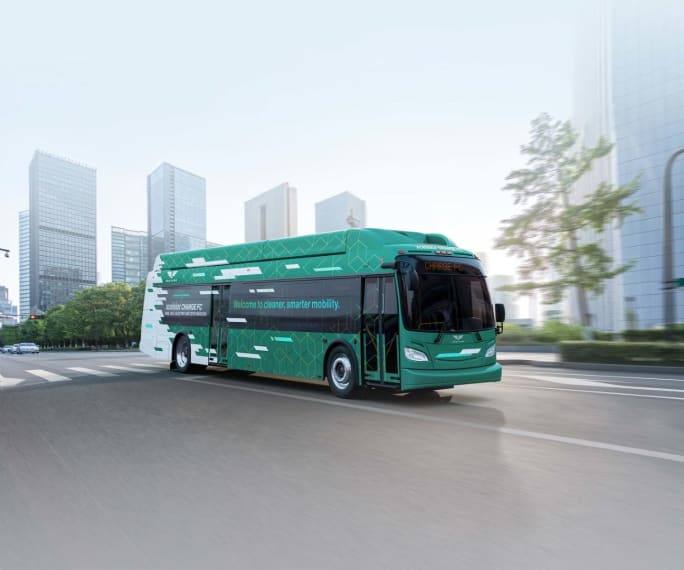
OCTA first launched a hydrogen fuel cell-electric pilot program in 2020 and a battery-electric pilot in 2022 — both powered by New Flyer buses.
Photo: New Flyer
California’s OCTA Adding 50 New Flyer ZEBs
New Flyer of America Inc., a subsidiary of NFI, announced a contract from the Orange County Transportation Authority (OCTA) for 50 zero-emission buses.
The order consists of 40 Xcelsior CHARGE FC 40-foot hydrogen fuel cell-electric buses and 10 Xcelsior CHARGE NG 40-foot battery-electric buses. The units were added to NFI’s Q4 2024 backlog and are supported by a combination of Federal Transit Administration (FTA) and local funding.
OCTA first launched a hydrogen fuel cell-electric pilot program in 2020 and a battery-electric pilot in 2022 — both powered by New Flyer buses. As part of this initiative, OCTA constructed the largest hydrogen fueling station for transit buses in the U.S., demonstrating a strong commitment to next-generation technology.

The intrusion panel feature for Security Center SaaS will be available globally in mid-2025 through the Genetec network of accredited channel partners.
Photo: Genetec
Genetec Enhances Security Center SaaS
Genetec Inc. announced the addition of intrusion management to Security Center SaaS, the company’s unified physical security solution that can be deployed in the cloud or as a hybrid solution.
By unifying intrusion detection with video surveillance, access control, identity, and visitor management, Security Center SaaS now delivers a fully unified, open, cloud-managed platform supported by the Genetec Cloudlink line of appliances.
Security Center SaaS will support a wide range of intrusion devices from multiple vendors, starting with Bosch intrusion panels.
The intrusion panel feature for Security Center SaaS will be available globally in mid-2025 through the Genetec network of accredited channel partners.
More Technology

From Hardware to Digital Partner: Luminator Charts Its Next Chapter
CEO Magnus Friberg discusses Luminator’s shift toward becoming a digital partner, the growing importance of software and interoperability, and how AI can help agencies improve operations and passenger experience.
Read More →
Beyond the Checklist: A Structured Approach to Transit Maintenance
Reliability-Centered Maintenance helps transit agencies move beyond routine checklists to focus limited resources on the assets and failures that have the greatest impact on safety, reliability, and service.
Read More →
NJ TRANSIT Advances Bus Technology Upgrades Across Statewide Fleet
More than 1,500 buses now feature upgraded technology designed to improve arrival predictions and provide free Wi-Fi, with deployment expected to reach nearly 2,000 buses by the end of 2026.
Read More →

Building a Flexible Path to Transit Electrification
John Hroncich discusses BAE Systems’ modular and scalable approach, lessons learned from decades of real-world operations, and how agencies can identify electrification strategies that fit their fleets.
Read More →
Biz Briefs: Alstom Lands Canadian Contract, LYT to Supply California TSP, and More
In METRO's latest installment, we take a look at recent news from Complete Coach Works, Beep, FlixBus, and more partnerships making headlines across the transportation sector.
Read More →
From Legacy Silos to Conversational Intelligence
What if transit leaders could ask any operational question and get a trusted answer in seconds? Conversational AI is transforming how agencies use their data.
Read More →
USDOT Announces Rail Vehicle Replacement Grants, Chattanooga AV Shuttle Funding
More than $191 million in federal funding will help three transit agencies replace aging rail vehicles and support a new autonomous shuttle service in Chattanooga.
Read More →
Bus Tech Talk: Keeping Transit Technicians Ahead of the Technology Curve
LA Metro’s Obed Mejia discusses technician training, evolving maintenance technology, fleet replacement, and strategies for getting the most out of today’s transit fleets.
Read More →
Biz Briefs: RIPTA Unveils New Frontrunners, Clevland RTA Adds New Siemens, and More
In METRO's latest installment, we take a look at recent news from Siemens, Prevost, Dodge, and more partnerships making headlines across the transportation sector.
Read More →
Why Simulating Pedestrian Movement Has Become Essential for Modern Rail Stations
Pedestrian microsimulation is helping rail planners identify bottlenecks, test station designs, and prepare complex transit hubs for growing passenger volumes.
Read More →