



Bombardier partner wins Chinese order
The trams for the capital of China’s Jiangsu Province, home to over eight million people, will serve two lines in its downtown districts.

Bombardier partner CSR Nanjing Puzhen Rolling Stock Co. Ltd. (CSR Puzhen), a subsidiary of China South Locomotive and Rolling Stock Corp. Ltd., won an order for 15 catenary-free low-floor trams for the city of Nanjing.
The trams for the capital of China’s Jiangsu Province, home to over eight million people, will serve two lines in its downtown districts. The new order follows an order for 18 low-floor trams won by CSR Puzhen in January 2013 for the city of Suzhou.
CSR Puzhen will build the trams, based on Bombardier’s Flexity 2 technology, at its site in Nanjing. Bombardier will supply the propulsion and controls equipment, the bogies and battery systems as well as support the project under a 10-year technology license agreement signed in 2012 for CSR Puzhen to sell and manufacture 100% low-floor trams using Bombardier’s technology in China, including Hong Kong and Macao.
The new trams for Nanjing will operate without overhead cables on 90% of the lines based on Bombardier’s new high-power Primove lithium-ion battery systems. They are due to enter revenue service in 2014 in Hexi New City, which is in the south-west of Nanjing, and in Qilin Science and Technology Innovation Park, which is in the east of Nanjing.
The Hexi line will receive eight vehicles to serve 13 stations, connecting two stops on metro lines 1 and 2 with the venues of the Youth Olympic Games. The Qilin line, which features steep sections and a partly elevated route across highways, will receive seven vehicles. On this demanding route, the reliable and efficient catenary-free operation (CFO) based on Primove batteries will prove the suitability of these batteries for CFO tram systems for almost any line worldwide.
Each of the trams for Nanjing will be equipped with two Primove battery systems. The new modular traction batteries have been specifically designed for the integration on trams and electric buses. They have been optimized in energy and power density while featuring high-power recharging at the lowest weight and volume currently on the market. The batteries will be recharged via the pantograph during acceleration as well as during the normal dwell times at terminal stops and tram stations while passengers get on and off.
In the last 10 months, Bombardier has already signed three contracts with the cities of Brunswick and Mannheim, Germany, and Bruges, Belgium, to integrate zero-emission electric buses using Primove inductive opportunity charging and Primove batteries.
The trams for Nanjing will be powered by Bombardier Mitrac 500 propulsion and controls equipment, which is ideally suited to catenary-free solutions and battery assisted propulsion like Primove. Mitrac 500 is the most competitive and reliable propulsion portfolio combining the best power-to-weight ratio and highly efficient intelligent control system with low energy consumption. In addition, its modular and compact converter product portfolio and modern drive solutions enable great reliability, flexibility and low lifecycle costs.
The vehicles will also be equipped with the leading edge Bombardier Flexx Urban 3000 bogies. Their design combines 100% low-floor vehicle architecture with the robustness of standard axle bogie technology. The bogies ensure low noise and high comfort, reliability and high levels of safety. Thanks to their high technical reliability and significant lifecycle cost reduction, Flexx Urban 3000 bogies are the most environmentally friendly low-floor bogies available in the market.
More Rail

LA Metro Breaks Ground on East San Fernando Valley Light Rail Project
The 6.7-mile line will add 11 stations along Van Nuys Boulevard, expand access to jobs and regional transit connections, and support Metro’s broader efforts to improve mobility as rail ridership grows.
Read More →
CSA Group Releases Climate Resilience Standard for Transit, Passenger Rail
Developed with support from the Standards Council of Canada, CSA D700 guides assessing climate-related risks and planning adaptation measures for transit and passenger rail systems.
Read More →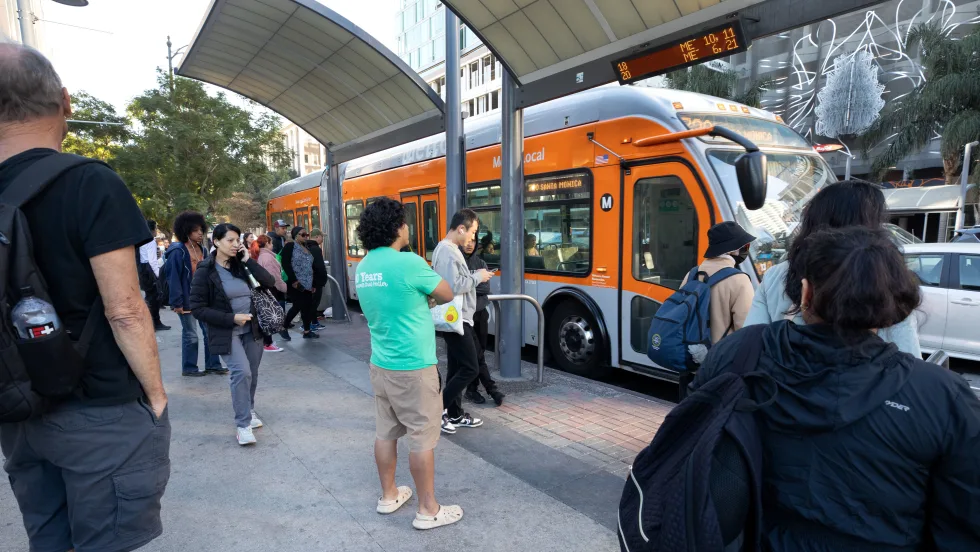
LA Metro September Ridership Climbs 3.9%, Led by Rail Growth
The agency recorded more than 27.2 million boardings, with rail ridership increasing 12.4% year over year and the D Line posting the largest gains.
Read More →
First Full MetroLink Rail Expansion Completed in 20 Years with $192M Airport Project
The project links two St. Louis-area airports by light rail while adding roadway and bike trail connections to improve regional access and mobility.
Read More →
Utilimarc Launches SmartReplace to Optimize Fleet Replacement Decisions
AI-powered SmartReplace helps fleets prioritize vehicle replacements, model budget scenarios, and build more defensible long-term strategies.
Read More →
Scenes from APTA TRANSform & EXPO 2026
Transit leaders, manufacturers, and industry professionals gathered in Chicago to explore new technologies, share ideas, and discuss the future of public transportation.
Read More →
USDOT Awards $416 Million for Florida Rail Crossing Safety Upgrades, New Brightline Station
The projects aim to reduce risks for motorists and pedestrians at rail crossings while expanding passenger rail access along Florida’s Space Coast.
Read More →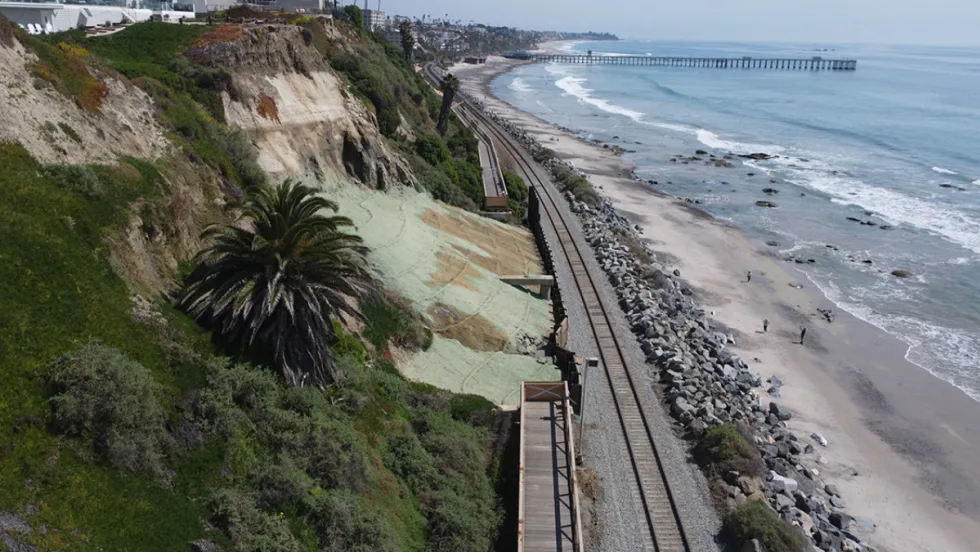
OCTA Declares Emergency to Protect Rail Corridor From Coastal Erosion
The California agency is accelerating shoreline protection and plans to place approximately 690,000 cubic yards of sand along the San Clemente coast to protect a key passenger and freight rail link.
Read More →
More Than a Summer Job: Building the Next Generation of Transit Talent
The Delaware River Port Authority and PATCO have transformed their internship program into a hands-on professional development experience that introduces students to the breadth of transportation careers — and creates a pipeline for future employees.
Read More →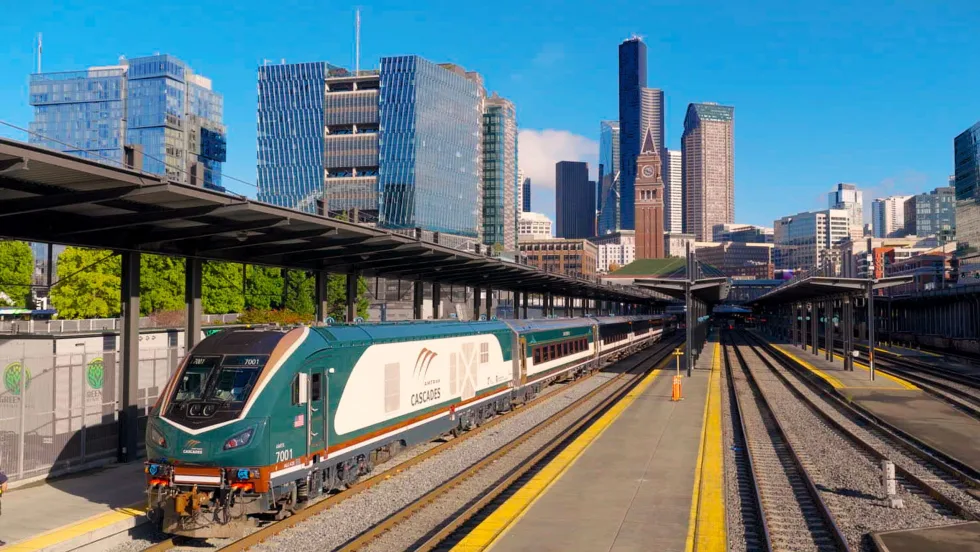
Airo Trains Make Their Amtrak Cascades Debut in the Pacific Northwest
Effective immediately, two cutting-edge Airo trainsets will join the Amtrak Cascades route, operating four daily trips between Vancouver, B.C., Seattle, Portland, and Eugene, Oregon, marking the first introduction of Airo trains into passenger service anywhere in the country.
Read More →