




RELATED: Bombardier signs people mover contract with Denver airport
Bombardier to provide 9 more double-deck French trains
The order is valued at approximately $120 million, including price escalations based on best faith assessment of assumptions, and is an option contained in a 2010 contract for a maximum of 860 trains signed with SNCF on behalf of the regions.
February 21, 2018
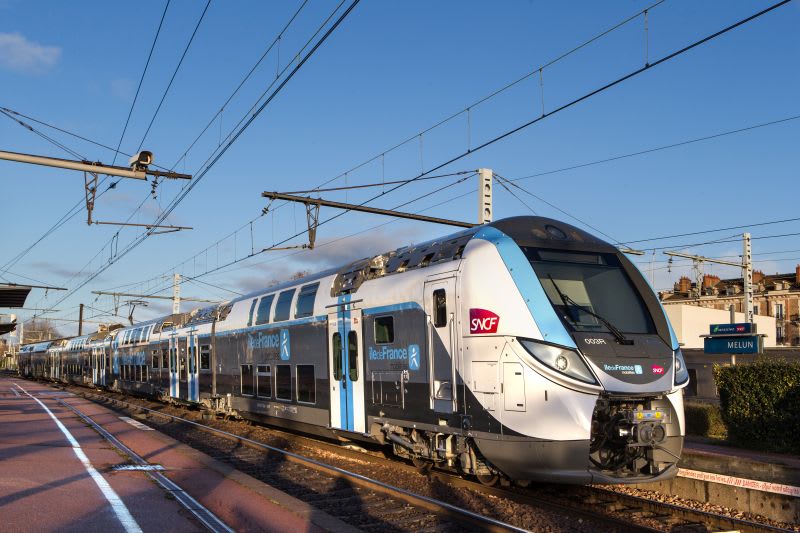
The Regio 2N, a spacious double-deck train, was designed to meet the expectations of passengers on lines serving the suburbs about 62 miles beyond the center of Paris.
Bombardier
2 min to read
The Regio 2N, a spacious double-deck train, was designed to meet the expectations of passengers on lines serving the suburbs about 62 miles beyond the center of Paris.
Bombardier
Bombardier Transportation received an order for nine Regio 2N trainsets from the French National Railway Corp. Société nationale des chemins de fer français Mobilités (SNCF) on behalf of the Greater Paris public transport authority, Ile-de-France Mobilités. The order is valued at approximately $120 million, including price escalations based on best faith assessment of assumptions, and is an option contained in a 2010 contract for a maximum of 860 trains signed with SNCF on behalf of the regions.
After launching the “Transportation Revolution,” Valérie Pécresse, president of the Ile-de-France Region, continues to invest heavily in new, better performing, and more comfortable rolling stock, to improve the daily travel conditions for Greater Paris' passengers.
"Bombardier teams based in the North of France are committed to designing reliable, highly automated trains that integrate state-of-the-art technologies to contribute to the smooth operation on the SNCF Transilien network. Our engineers have also developed an in-depth knowledge of the network's special requirements," stated Laurent Bouyer, president of Bombardier Transport France. "Such massive investments from Ile-de-France Mobility toward the purchase of modern, comfortable trains which are praised by passengers, will quickly enhance the quality of daily rail journeys."
The Regio 2N, a spacious double-deck train, was designed to meet the expectations of passengers on lines serving the suburbs about 62 miles beyond the center of Paris. It features level accessibility at all stations, uncluttered onboard access platforms enhancing passenger flow to seating areas, air conditioning, a dynamic travel information system, and power outlets for mobile devices. It also offers a lively interior color scheme to brighten up daily commutes.
With these extra nine train sets, a total of 134 Regio 2N will be rolled out on the SNCF Transilien network on lines R, N, and D. The first trains were commissioned in December 2017 on line R.
Ile-de-France Mobilités continues to consolidate its fleet of Francilien trains, a tailor-made train for the region. With a high level of performance, it clearly improves the punctuality of the lines where it operates. So far, Ile-de-France Mobilités has ordered a total of 277 Francilien trains for lines H, J, K, L & P.
More Rail

New York MTA Advances Final Contract for Second Avenue Subway Expansion
Contract Four is the largest in the Second Avenue Subway Phase 2 project and includes construction of station infrastructure, tracks, and signals for the subway expansion, MTA officials said. Work on Contract Four will begin in 2027.
Read More →
San Diego MTS Breaks Monthly Trolley Ridership Record
Agency officials said July’s ridership indicates MTS’s continued recovery from the pandemic.
Read More →
Report Examines NJ TRANSIT Reliability, Funding Challenges
The Garden State Initiative analysis examines the roles of Amtrak infrastructure, fleet management, and agency operations while recommending a more performance-based approach to improving reliability.
Read More →
Stadler, CapMetro Sign Long-Term Rail Fleet Support Agreement
Beginning in 2027, Stadler will provide on-site technical expertise, spare parts support, training, and obsolescence management to help extend the reliability and longevity of CapMetro’s GTW fleet.
Read More →
Biz Briefs: Alstom Lands Canadian Contract, LYT to Supply California TSP, and More
In METRO's latest installment, we take a look at recent news from Complete Coach Works, Beep, FlixBus, and more partnerships making headlines across the transportation sector.
Read More →
CATS Gold Line Marks 5 Years of Service, 2.8M Passenger Trips
With a six-mile expansion planned, the Charlotte streetcar is positioned to connect more neighborhoods and major transit hubs across the region.
Read More →
Why Simulating Pedestrian Movement Has Become Essential for Modern Rail Stations
Pedestrian microsimulation is helping rail planners identify bottlenecks, test station designs, and prepare complex transit hubs for growing passenger volumes.
Read More →
Amtrak Begins Major Construction at New York’s Sunnyside Yard
The new maintenance facility will support Amtrak’s Airo trainsets while improving maintenance efficiency and turnaround times in New York.
Read More →
Chicago Leaders Unveil Plans for O’Hare Airport Express Train
The privately developed project would offer a 15-minute trip between downtown and O’Hare’s Terminal 2, with trains operating every 15 minutes on a dedicated track. The service would use battery-electric trains and three existing freight rail rights-of-way.
Read More →
OCTA Maps Out 30-Year Strategy to Protect Coastal Rail Corridor
The draft feasibility report identifies strategies to protect the coastal rail line for decades as the agency continues near-term stabilization and sand placement efforts.
Read More →