Brightline West Selects Siemens for High-Speed Trainsets
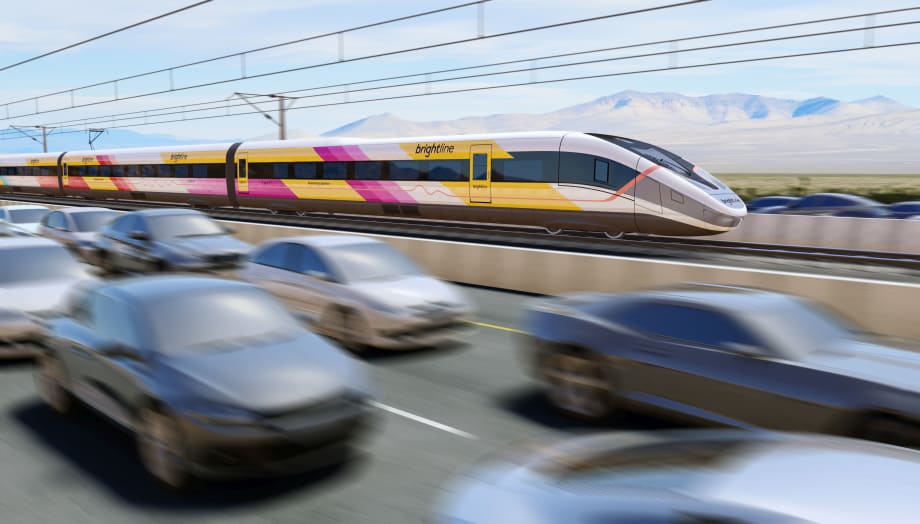
The contract will include a fleet of ten “American Pioneer 220” (AP 220) trainsets to be manufactured, delivered to Nevada, and tested to support Brightline West’s timeline of initiating service in 2028.
The Siemens selection includes a 30-year rolling stock maintenance contract that will be performed at Brightline West’s Vehicle Maintenance Facility in Sloan, Nev.
Photo: Brightline West
3 min to read
Brightline tapped Siemens Mobility (Siemens) as the “preferred bidder” to build trainsets for the Brightline West high-speed rail project, which will connect Las Vegas and Southern California.
The contract will include a fleet of ten “American Pioneer 220” (AP 220) trainsets to be manufactured, delivered to Nevada, and tested to support Brightline West’s timeline of initiating service in 2028.
Ad Loading...
Brightline West’s Procurement Process
The announcement came after a multi-year competitive procurement process conducted among multiple global competitors.
The selection, which is subject to the conclusion of definitive agreements, is based on specific criteria that included price, manufacturing schedule, train performance (e.g. speed and travel time), ADA compliance, passenger amenities, and total passenger capacity.
In addition, the criteria considered future interoperability with the California High-Speed Rail project. The trains will be built in accordance with all applicable “Buy America” requirements.
Contract with Siemens
The selection includes a 30-year rolling stock maintenance contract that will be performed at Brightline West’s Vehicle Maintenance Facility in Sloan, Nev. At this site, crews will perform routine daily maintenance, as well as long-term overhauls and repairs.
With the selection, Siemens will introduce the AP220 trainsets, which represent a new generation of innovative high-speed technology, featuring the latest in passenger experience, cutting-edge digital technology, and a revolutionary propulsion system, built specifically for the U.S. market.
Ad Loading...
The trains are an evolution of the Velaro platform, currently operating in Europe. The AP220 will introduce state-of-the-art technology through an American supply chain spurring the U.S. to establish a new industry rivaling countries that have had high-speed rail for decades, according to the company.
Siemens will establish a new facility to build the AP220 and will announce the location of America’s first true high-speed rail production center when the contract is finalized.
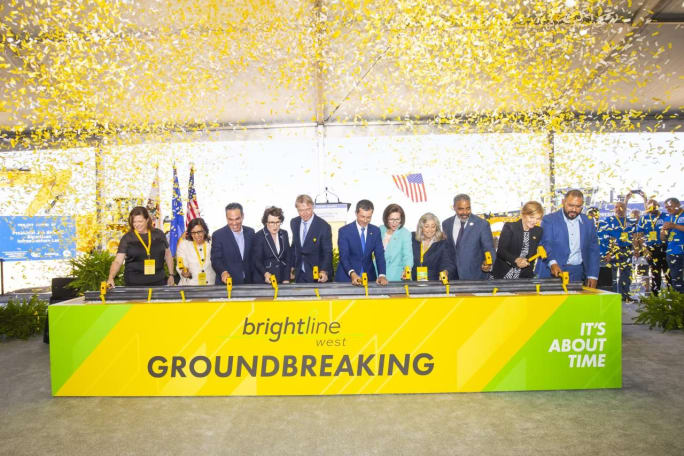
In April, Brightline West celebrated its groundbreaking.
Photo: Brightline West
Bringing True High-Speed Rail to U.S.
The AP 220 will be the first true high-speed train sets to be built in America and are designed for operational speeds of up to 220 miles per hour. The propulsion system, lighter weight, and aerodynamic shape makes it more efficient than other high-speed trains.
The AP220 features an ultrawide carbody designed for unparalleled passenger comfort and designed to be the most accessible train on the market, exceeding ADA requirements and allowing for guests in wheelchairs to move with ease from car to car. The seven-car trains will carry between 434 to 450 passengers, depending on final configuration and can make the trip in less than two hours.
In April, Brightline West celebrated its groundbreaking. The 218-mile system will be constructed in the median of the I-15 and is based on Brightline’s vision to connect city pairs that are too short to fly and too far to drive.
Ad Loading...
The system will have stops in Las Vegas, as well as Victor Valley, Hesperia, and Rancho Cucamonga, Calif. The $12 billion project was recently awarded $3 billion in funding from President Biden’s Bipartisan Infrastructure Bill. The rest of the project will be privately funded.
Brightline partnered with Siemens Mobility to develop the Venture series train sets, which debuted in 2018 on the company’s Florida system.
Contract Four is the largest in the Second Avenue Subway Phase 2 project and includes construction of station infrastructure, tracks, and signals for the subway expansion, MTA officials said. Work on Contract Four will begin in 2027.
The Garden State Initiative analysis examines the roles of Amtrak infrastructure, fleet management, and agency operations while recommending a more performance-based approach to improving reliability.
Beginning in 2027, Stadler will provide on-site technical expertise, spare parts support, training, and obsolescence management to help extend the reliability and longevity of CapMetro’s GTW fleet.
In METRO's latest installment, we take a look at recent news from Complete Coach Works, Beep, FlixBus, and more partnerships making headlines across the transportation sector.
Pedestrian microsimulation is helping rail planners identify bottlenecks, test station designs, and prepare complex transit hubs for growing passenger volumes.
The privately developed project would offer a 15-minute trip between downtown and O’Hare’s Terminal 2, with trains operating every 15 minutes on a dedicated track. The service would use battery-electric trains and three existing freight rail rights-of-way.
The draft feasibility report identifies strategies to protect the coastal rail line for decades as the agency continues near-term stabilization and sand placement efforts.