



Capital Metro, Valley Metro, HART recognized for sustainability
Public transit agencies and businesses voluntarily choose to join the APTA Sustainability Commitment program and pledge to implement processes and actions that create continuous improvements in sustainability.


The American Public Transportation Association (APTA) recognized six of its member organizations for continued achievements in sustainability during APTA's Sustainability & Multimodal Planning Workshop in Vancouver, Canada. Public transit agencies and businesses voluntarily choose to join the APTA Sustainability Commitment program and pledge to implement processes and actions that create continuous improvements in environmental, social, and economic sustainability. Based on specific measurable achievements, organizations are given Platinum, Gold, Silver, and Bronze Level recognition.
The most recent signatories of APTA's Sustainability Commitment are Capital Metro (Austin, Texas) receiving Gold Level status, Valley Metro (Phoenix) receiving Silver Level status, and the Honolulu Authority for Rapid Transportation receiving Bronze Level status.
Earlier this year, APTA recognized the Metropolitan Atlanta Rapid Transit Authority, Caltrain, and SamTrans (San Carlos, Calif.) for achieving Silver Level status.
"Sustainability and public transportation go hand in hand with each other," said APTA President/CEO Paul P. Skoutelas. "Thanks to the voluntary commitments that these public transit systems have made to environmental, social, and economic sustainability, communities across America are now more livable. I commend this year's public transit system's Sustainability Commitment recipients located in Austin, Honolulu, and Phoenix. Their leadership in sustainability and the successful results of their actions should serve as an inspiration to other organizations."
First started in 2009, 146 public transit agencies and businesses have signed on to the APTA Sustainability Commitment. Currently, 46 signatories have received higher level recognition.
Below are some examples of the sustainable accomplishments achieved by the most recent signatories of APTA's Sustainability Commitment.
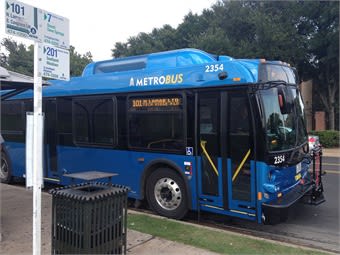
Capital Metro launched an electric vehicle program, purchased electric fleet vehicles, and installed charging stations for its fleet vehicles for employee use.
JseVse
GOLD Level – Capital Metro – Austin
Capital Metro is committed to being the most sustainable transportation option available to Central Texans. Between 2012 and 2016, Capital Metro reduced energy use by 13.4%, the equivalent of more than 250,000 kilowatt hours per year. Specific activities such as converting outdoor lighting to LED and upgrading building air conditioning to more efficient systems, contributes to cost and energy savings. Recently, Capital Metro partnered with the State Energy Conservation office to audit and analyze all facilities and identify even more ways to reduce the agency's energy load.
The agency also reduced its water consumption by more than 800,000 gallons per year, a reduction of 13.6%. Installation of more efficient bus wash systems and landscaping with native and adapted plants help to save water. Moreover, more than nine percent of the agency's total waste is recycled.
Capital Metro also launched an electric vehicle program, purchased electric fleet vehicles, and installed charging stations for its fleet vehicles for employee use. There are plans for a large scale electric bus deployment within the next few years.
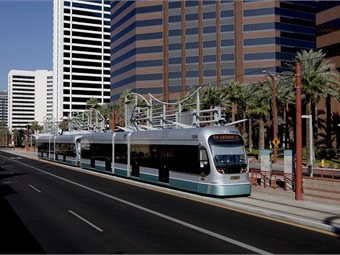
In the past three years, the rail operations and maintenance center has saved 3,000 tons of greenhouse gases and $230,000 in energy costs.
HDR Inc.
SILVER Level – Valley Metro – Phoenix
Valley Metro is committed to operating an environmentally responsible public transit system and is involved in a variety of initiatives to help enhance air quality and protect the local environment. Solar energy powers the rail operations and maintenance center and one of its bus facilities. In the past three years, the rail operations and maintenance center has saved 3,000 tons of greenhouse gases and $230,000 in energy costs. Facilities also recycle batteries, oil and water as trains are powered by electricity and the body paint and window tint are solar reflective.
Additionally, 95% of the bus fleet runs on alternative fuels and seats on Express Buses are made from recycled plastics and bottle caps. Installation of recycling bins in employee common areas has also contributed to a 2% increase in recycling for the agency.
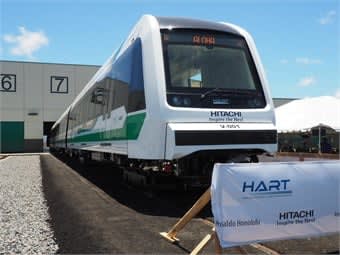
HART plans to open up the first stations for revenue service in 2020, and will complete the full 20-mile system by 2025.
Ansaldo
BRONZE Level – Honolulu Authority for Rapid Transportation (HART) – Honolulu
HART is building the first large-scale driverless rail system in the United States. To fully realize the community-wide benefits from sustainability, HART's approach builds on the Native Hawaiian host culture – one which has deep roots in the principles of sustainability. HART convened elders and scholars from the Native Hawaiian community to develop authentic and culturally appropriate station names. These names serve to perpetuate the traditions, culture, and history of Hawaii. HART plans to open up the first stations for revenue service in 2020, and will complete the full 20-mile system by 2025.
More Technology

From Hardware to Digital Partner: Luminator Charts Its Next Chapter
CEO Magnus Friberg discusses Luminator’s shift toward becoming a digital partner, the growing importance of software and interoperability, and how AI can help agencies improve operations and passenger experience.
Read More →
Beyond the Checklist: A Structured Approach to Transit Maintenance
Reliability-Centered Maintenance helps transit agencies move beyond routine checklists to focus limited resources on the assets and failures that have the greatest impact on safety, reliability, and service.
Read More →
NJ TRANSIT Advances Bus Technology Upgrades Across Statewide Fleet
More than 1,500 buses now feature upgraded technology designed to improve arrival predictions and provide free Wi-Fi, with deployment expected to reach nearly 2,000 buses by the end of 2026.
Read More →

Building a Flexible Path to Transit Electrification
John Hroncich discusses BAE Systems’ modular and scalable approach, lessons learned from decades of real-world operations, and how agencies can identify electrification strategies that fit their fleets.
Read More →
Biz Briefs: Alstom Lands Canadian Contract, LYT to Supply California TSP, and More
In METRO's latest installment, we take a look at recent news from Complete Coach Works, Beep, FlixBus, and more partnerships making headlines across the transportation sector.
Read More →
From Legacy Silos to Conversational Intelligence
What if transit leaders could ask any operational question and get a trusted answer in seconds? Conversational AI is transforming how agencies use their data.
Read More →
USDOT Announces Rail Vehicle Replacement Grants, Chattanooga AV Shuttle Funding
More than $191 million in federal funding will help three transit agencies replace aging rail vehicles and support a new autonomous shuttle service in Chattanooga.
Read More →
Bus Tech Talk: Keeping Transit Technicians Ahead of the Technology Curve
LA Metro’s Obed Mejia discusses technician training, evolving maintenance technology, fleet replacement, and strategies for getting the most out of today’s transit fleets.
Read More →
Biz Briefs: RIPTA Unveils New Frontrunners, Clevland RTA Adds New Siemens, and More
In METRO's latest installment, we take a look at recent news from Siemens, Prevost, Dodge, and more partnerships making headlines across the transportation sector.
Read More →
Why Simulating Pedestrian Movement Has Become Essential for Modern Rail Stations
Pedestrian microsimulation is helping rail planners identify bottlenecks, test station designs, and prepare complex transit hubs for growing passenger volumes.
Read More →