



Chicago unveils proposed BRT lane configurations
Plans for the Central Loop East-West Transit Corridor include designated bus-priority lanes on two miles of streets The Loop BRT corridor will serve Union Station, Ogilvie Transportation Center, CTA subways and Navy Pier with more than 1,700 buses per day, making it one of the busiest bus routes in the nation. Expected to start service in 2014.

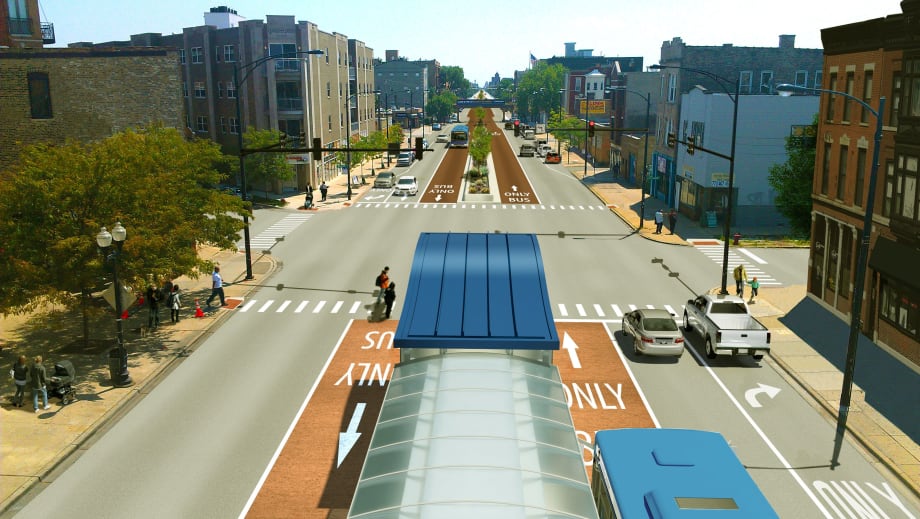
A rendering of the Western Ashland BRT. Photo courtesy Chicago Transit Authority.

The Chicago Department of Transportation (CDOT) and the Chicago Transit Authority (CTA) unveiled the proposed lane configurations for the Loop streets to be used by the planned bus rapid transit (BRT) system that is scheduled to start service in 2014. Through careful planning and design, the lanes will provide a balanced separation of bus, bike and regular traffic lanes.
The agencies also unveiled renderings of the design for the new off-street transportation center just south of Union Station, which will provide key connections with other modes of transport to the BRT system.
BRT plans for the Central Loop East-West Transit Corridor include designated bus-priority lanes on two miles of streets: Madison, Washington, Canal and Clinton. The Loop BRT corridor will serve Union Station, Ogilvie Transportation Center, CTA subways and Navy Pier with more than 1,700 buses per day, making it one of the busiest bus routes in the nation.
BRT improvements designed to make bus travel more reliable and appealing to customers include: colored pavement markings and enhanced signage clearly delineating the bus lanes; level-boarding; queue jumps for buses at key intersections; distinct bus shelters; bus tracker digital displays; sidewalk improvements and protected bike lanes.
“By using a balanced approach to configuring the roadways for BRT, we will make cost-effective improvements without dramatically changing the current traffic setup,” said CDOT Commissioner Gabe Klein. “At the same time, we will provide transit connections to downtown businesses and major destinations more reliable, fast and easy.”
Under the proposed lanes configuration, eastbound Washington will feature a colored bus-only lane that will be serviced with island bus-boarding platforms. Two auto lanes will remain for traffic through the Loop. A bike lane against the southern curb would be protected from auto traffic by the bus lane and boarding platforms.
On westbound Madison, the bus-only and auto lanes would be similar to the current configuration with curbside bus-boarding platforms. The westbound protected bike lane would be relocated to Randolph Street.
“Washington and Madison are two of CTA’s most traveled bus corridors with buses arriving every two to three minutes,” said CTA President Forrest Claypool. “The new configuration will speed up six routes on these busy streets and 15 total routes throughout the entire Central Loop BRT corridor, providing more efficient service for those making east-west connections in the Loop.”
CDOT will construct and manage the Central Loop BRT project, which is being financed by a $24.6 million Federal Transit Administration grant and $7.3 million in local Tax Increment Financing funds.
CDOT is in the process of acquiring a surface parking lot located south of Jackson between Canal and Clinton to build the transportation center. It will provide sheltered staging areas for CTA buses and a vertical connection to an existing Amtrak underground passageway, allowing commuters to access Union Station without crossing at street level.
BRT improvements could improve overall bus travel times through the Central Loop corridor by three to nine minutes per trip. While buses are only 4% of the vehicles traveling through the corridor, they carry more than 47% of the commuters making trips in vehicles.
More Bus

LA Metro, City of West Hollywood, and Partners Advance Smarter Bus Lane Enforcement
The award-winning partnership combines AI-powered detection with human oversight to improve bus reliability, accessibility, and enforcement efficiency.
Read More →
PSTA Modernizes Workforce Management with Digital Bidding System
The award-winning Workforce Transit Modernization project replaced paper bidding with a transparent digital platform, cutting administrative effort while improving access for operators.
Read More →
Washington's Community Transit Sets Six-Year Roadmap for Growth, Expansion
Approved TDP targets more bus service, new mobility options, Swift BRT expansion, and a potential Everett Transit annexation.
Read More →
DART Customer Satisfaction Reaches Six-Year High
Overall satisfaction rose to 74.9%, while the agency’s Net Promoter Score reached a record 33.7.
Read More →
How DART's GoPass Is Redefining Regional Mobility
Serving 14 transit agencies, GoPass simplifies multimodal travel by allowing riders to plan, pay for, and manage an entire trip through one app.
Read More →
Biz Briefs: OCTA Taps Clean Energy for Hydrogen Station, Stadler to Supply Via Rail Vehicles, and More
From manufacturers and suppliers to transit agencies and motorcoach operators, these updates offer a snapshot of the projects, partnerships and business moves driving the industry forward.
Read More →
METRO Magazine Announces 2026 Innovative Solutions Awards Winners
Projects Recognized for Advancing Mobility Through Technology, Accessibility, Workforce Innovation, and Operational Excellence
Read More →
Biz Briefs: STV teams with Amtrak, Motorcoach Operators Boost Fleet and Land Contracts, and More
From manufacturers and suppliers to transit agencies and motorcoach operators, these updates offer a snapshot of the projects, partnerships and business moves driving the industry forward.
Read More →
LA Metro Marks Banner Year, Sets Ambitious Goals for New Fiscal Year
Incoming LA Metro Board Chair and Los Angeles Mayor Karen Bass joined outgoing Board Chair Fernando Dutra and LA Metro CEO Stephanie Wiggins to review accomplishments from fiscal year 2026, which included the opening of new rail extensions, advancement of major transit projects, expanded safety programs, and new rider amenities.
Read More →
DART Taps Nathaniel P. Ford Sr. as Next President/CEO
Since 2012, Ford has served as the CEO of the Jacksonville Transportation Authority
Read More →