



City of Inglewood, Calif., Issues RFI for Transit Connector Project
The project will consist of a 1.6-mile-long fixed-guideway rail system providing direct connections between L.A. Metro’s Crenshaw/LAX Line and the city’s major housing and employment centers.
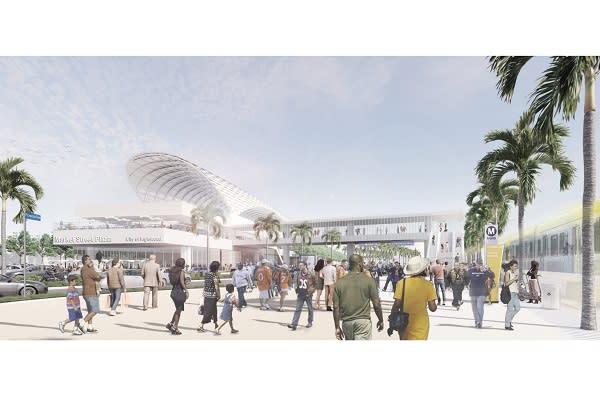
The $1 billion project will consist of a fixed-guideway rail system providing direct connections between L.A. Metro’s Crenshaw/LAX Line and Inglewood’s major housing and employment centers.
Rendering via City of Inglewood
The City of Inglewood, California, announced the release of a Request for Information (RFI) for its Inglewood Transit Connector (ITC) Project, an estimated $1 billion transit project designed to improve mobility for existing residents and provide significant economic benefits for the city.
As proposed, the 1.6-mile-long ITC Project will consist of an elevated, fixed-guideway rail system providing direct connections between the Los Angeles County Metropolitan Transit Authority’s (L.A. Metro) Crenshaw/LAX Line and Inglewood’s new major employment, commercial, housing, sports, and entertainment centers.
Issuance of the RFI is the first step of the city’s two-phase market sounding process, which will take place over the coming months. During the first phase, the city will solicit industry feedback on transit technologies potentially suitable for development of the ITC Project, while also educating the market about the project’s proposed governance structure and the anticipated procurement process. The second phase, expected to launch in May of this year with the release of a supplemental RFI, will focus on sharing additional details with the market including the project’s funding and finance planning efforts, risk mitigation/allocation, right-of-way acquisition, and small business and diversity and inclusion policies.
Industry participants will have a number of opportunities for input and information exchange during the initial RFI phase. On March 17, the city will hold an industry forum to provide background on the project and topics included in the RFI. From March 24 through March 26, the city will be available for virtual one-on-one meetings with teams and transit technology suppliers that have demonstrated the requisite experience delivering large-scale transit projects similar to the ITC Project. All interested members of the industry are encouraged to offer their insights by submitting responses to the questions included in the RFI by April 2.
“We have made significant progress on the ITC Project, including releasing the Draft EIR in December and securing over $328 million, or roughly one-third of the overall project costs in state grant funding and county Measure R funds,” said Inglewood Mayor James Butts. “Today marks another significant milestone in the development of the project with the release of the RFI to the industry. This will give us the opportunity to work closely with the market to inform our procurement process and I look forward to hearing from the industry about cost-effective technology options the project can benefit from.”
More Rail

New York MTA Advances Final Contract for Second Avenue Subway Expansion
Contract Four is the largest in the Second Avenue Subway Phase 2 project and includes construction of station infrastructure, tracks, and signals for the subway expansion, MTA officials said. Work on Contract Four will begin in 2027.
Read More →
San Diego MTS Breaks Monthly Trolley Ridership Record
Agency officials said July’s ridership indicates MTS’s continued recovery from the pandemic.
Read More →
Report Examines NJ TRANSIT Reliability, Funding Challenges
The Garden State Initiative analysis examines the roles of Amtrak infrastructure, fleet management, and agency operations while recommending a more performance-based approach to improving reliability.
Read More →
Stadler, CapMetro Sign Long-Term Rail Fleet Support Agreement
Beginning in 2027, Stadler will provide on-site technical expertise, spare parts support, training, and obsolescence management to help extend the reliability and longevity of CapMetro’s GTW fleet.
Read More →
Biz Briefs: Alstom Lands Canadian Contract, LYT to Supply California TSP, and More
In METRO's latest installment, we take a look at recent news from Complete Coach Works, Beep, FlixBus, and more partnerships making headlines across the transportation sector.
Read More →
CATS Gold Line Marks 5 Years of Service, 2.8M Passenger Trips
With a six-mile expansion planned, the Charlotte streetcar is positioned to connect more neighborhoods and major transit hubs across the region.
Read More →
Why Simulating Pedestrian Movement Has Become Essential for Modern Rail Stations
Pedestrian microsimulation is helping rail planners identify bottlenecks, test station designs, and prepare complex transit hubs for growing passenger volumes.
Read More →
Amtrak Begins Major Construction at New York’s Sunnyside Yard
The new maintenance facility will support Amtrak’s Airo trainsets while improving maintenance efficiency and turnaround times in New York.
Read More →
Chicago Leaders Unveil Plans for O’Hare Airport Express Train
The privately developed project would offer a 15-minute trip between downtown and O’Hare’s Terminal 2, with trains operating every 15 minutes on a dedicated track. The service would use battery-electric trains and three existing freight rail rights-of-way.
Read More →
OCTA Maps Out 30-Year Strategy to Protect Coastal Rail Corridor
The draft feasibility report identifies strategies to protect the coastal rail line for decades as the agency continues near-term stabilization and sand placement efforts.
Read More →