



DART Approves Plan to Align Mobility Across 13 Cities
If adopted by the city councils of all 13 member cities, the plan would provide the requested funding from DART to the cities.

Recently, the Regional Transportation Council of the North Central Texas Council of Governments approved $75 million to fund transportation-related projects in DART member cities.
DART
- Dallas Area Rapid Transit (DART) approved a General Mobility Plan designed to address cities' concerns and benefit agency and regional collaborations.
- The plan requires city council approval from 13 member cities and involves reallocating part of DART's 1% sales tax revenue to participating cities.
- Initial funding allocates 5% of sales tax revenue to cities, increasing to 7.5% over six years.
*Summarized by AI
Dallas Area Rapid Transit (DART) approved a General Mobility Plan and interlocal agreement compromise that they said answers cities’ concerns and provides a path forward for the agency, member cities, and regional partners.
If adopted by the city councils of all 13 member cities, the plan would provide the requested funding from DART to the cities.
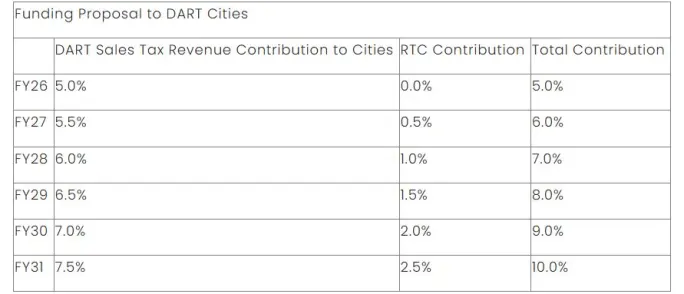
The funding model proposed by DART relies on a mix of DART and Regional Transportation Council funding and seeks future funding initiatives. Under this agreement, DART would send part of its 1% sales tax revenue, which currently funds the agency, to member cities. In year one, each participating city would receive 5%, increasing by 0.5% annually to 7.5% in year six.
“This solution is a victory for North Texans,” said Randall Bryant, chairman of the DART board. “When the DART Board, DART staff, member cities, and regional partners work together to find common ground, we can focus on solutions.”
Funding Transit in Dallas
Recently, the Regional Transportation Council of the North Central Texas Council of Governments approved $75 million to fund transportation-related projects in DART member cities. Combined with DART’s contribution, the total guaranteed city funding would be 10% in year six.
Cities have until mid-March to rescind elections. DART is hosting a series of community education meetings leading up to a public hearing on March 24. A public hearing is required by law for any major service changes.
DART
The agreement also creates a list of funding priorities that DART, member cities, and regional partners would work to advance at the state level. These items would include the governance structure along with:
- Transferring management of commuter rail (Trinity Railway Express and Silver Line) to a regional transportation authority.
- Finding additional non-tax-based funding.
“We are seeing positive response to this proposal from all our member cities, not just those with withdrawal elections on the ballot,” said DART President/CEO Nadine Lee. “The compromise benefits all member cities and is truly regional at its core. This provides a path forward and reunites us all toward a common goal: a regional transit system that moves North Texas forward.”
What’s Next?
Cities have until mid-March to rescind elections. DART is hosting a series of community education meetings leading up to a public hearing on March 24. A public hearing is required by law for any major service changes.
If voters in any city elect to withdraw from DART, services in that city would cease immediately after the election is canvassed.
Quick Answers
The purpose of DART's General Mobility Plan is to address the concerns of member cities and provide a viable path forward for the agency, member cities, and regional partners by aligning mobility efforts across 13 cities.
*Summarized by AI
More Management

METRO Opens Submissions for 2026 Motorcoach Awards
Nominations are now being accepted for METRO Magazine’s Operator of the Year and Innovative Operator of the Year awards.
Read More →
New York MTA Advances Final Contract for Second Avenue Subway Expansion
Contract Four is the largest in the Second Avenue Subway Phase 2 project and includes construction of station infrastructure, tracks, and signals for the subway expansion, MTA officials said. Work on Contract Four will begin in 2027.
Read More →
Transit Agencies Highlight Safety Gains at National Summit
Leaders from 15 major transit systems shared crime-reduction results and safety initiatives while discussing the role of continued federal support.
Read More →

NITA Names New Leadership, Expands Reduced-Fare Program at First Board Meeting
The new regional transit authority appointed its first board chair and interim executive director while extending reduced fares across CTA, Metra, and Pace for eligible riders.
Read More →
Beyond the Checklist: A Structured Approach to Transit Maintenance
Reliability-Centered Maintenance helps transit agencies move beyond routine checklists to focus limited resources on the assets and failures that have the greatest impact on safety, reliability, and service.
Read More →
APTA 2026 Nominating Committee Selects Leadership Slate, Names Chair and Vice Chair Nominees
Leadership changes will help shape the association’s priorities and its representation of the transportation industry during the 2026–2027 term.
Read More →
DART Launches Major Security, Fare Enforcement Initiative
The 90-day demonstration will deploy coordinated security teams at five light rail stations while testing controlled access and gathering data to guide future investments.
Read More →
Advancing Fare Collection Through Technology and Innovation
Learn about delivering 1300 gates at 91 stations while managing fare evasion. Explore the large scale deployment, solution customization and real-world results that affect the region. Prepare for deployment in your region now.
Read More →
Game Day in Motion: Moving Millions During the 2026 World Cup
Between packed transit stations and team motorcoaches, see how agencies and operators across North America tackled the transportation demands of the 2026 FIFA World Cup.
Read More →
Surface Transportation Extension Averts Shutdown, Leaves Transit Funding Gap
The stopgap keeps federal transportation programs moving, but missing advance funding could complicate the transit and rail projects agencies are planning next.
Read More →