




Miss This? DART Unveils Point B Strategic Plan Report
Transit-Oriented Development Drives Housing, Mobility, and Economic Growth Across U.S. Cities
See how VTA and DART are turning station-area land into housing, mobility hubs, and long-term economic value.
January 26, 2026
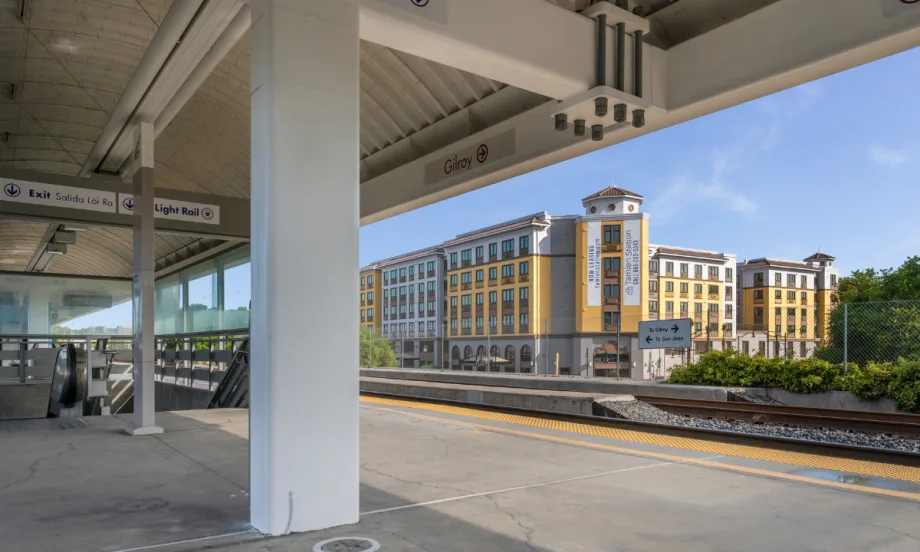
Santa Clara VTA is planning to enable more than 2,500 homes near transit across Santa Clara County in the coming years.
Photo: Santa Clara Valley Transportation Authority
3 min to read
Transit agencies across the country are increasingly using transit-oriented development (TOD) to do more than move people from place to place. By transforming underutilized land near rail stations into housing, parking, and mixed-use communities, agencies are advancing affordability and long-term economic growth.
Recent milestones in San Jose and Dallas highlight how this strategy is taking shape in different markets with shared goals.
VTA and The Core Companies Open Affordable Homes at Tamien Station
Santa Clara Valley Transportation Authority (VTA) and The Core Companies celebrated the grand opening of Tamien Station Apartments, delivering 135 new affordable homes directly adjacent to Tamien Light Rail and Caltrain stations in San Jose.
The project marks VTA’s first transit-oriented development to welcome residents and the first TOD housing to open under VTA’s portfolio in more than 20 years.
Built on a former VTA-owned parking lot, the 1.6-acre site is now leased to Urban Co Tamien LLC, a partnership between The Core Companies and Republic Urban Properties.
All apartments (reserved for households earning less than 60% of the Area Median Income) are fully occupied, with residents receiving transit passes and immediate access to regional transit, jobs, and services.
“We need to leverage our public land for maximum public good,” said San Jose Mayor Matt Mahan. “I look forward to seeing our transit agency break ground on more projects like this so that people can live, work, and play near transit services that reduce congestion and improve our environment for everyone.”

Built on a former VTA-owned parking lot, the 1.6-acre site is now leased to Urban Co Tamien LLC, a partnership between The Core Companies and Republic Urban Properties.
Photo: Santa Clara Valley Transportation Authority
Half of the units are dedicated to rapid rehousing to help prevent homelessness. The development includes family-focused amenities such as an on-site daycare, rooftop playground, food pantry, fitness room, and community spaces, along with improvements to the surrounding transit plaza that strengthen Tamien Station as a key transportation hub.
VTA leaders emphasized the project’s role in advancing affordable housing and sustainability goals, while generating long-term revenue to support transit services. The Tamien project is the first phase of a larger mixed-income neighborhood that will ultimately deliver 555 homes on the site.
Santa Clara VTA is planning to enable more than 2,500 homes near transit across Santa Clara County in the coming years.
DART and Trammell Crow Company Break Ground on Transit-Oriented Development at SMU/Mockingbird Station
Dallas Area Rapid Transit (DART) and Trammell Crow Company marked the groundbreaking of a major transit-oriented development at SMU/Mockingbird Station, launching the first phase of redevelopment on 16 acres of DART-owned land near downtown Dallas. The project includes a 394-unit apartment community and a new 500-space underground parking garage for DART riders.
The seven-story apartment building will rise on a former surface parking lot and feature studios and one- and two-bedroom units, along with amenities such as a resort-style pool, fitness center, co-working spaces, EV chargers, dog park, and a skydeck overlooking the Dallas skyline. The underground garage preserves parking for riders while freeing surface land for higher-value development.
The SMU/Mockingbird TOD is the result of a long-term partnership between DART and Trammell Crow Company, sustained through economic uncertainty to ensure the site’s redevelopment remained viable. Residents and visitors will benefit from direct access to DART’s 93-mile light rail system, multiple bus routes, nearby retail, and Dallas’ urban trail network.
“We are thrilled to break ground on this transformational project at SMU/Mockingbird,” said Nadine Lee, DART CEO and president. “Developments like these promote the economic and social activity that underpins vibrant and prosperous communities, all centered on a critical regional mobility hub.”
Future phases of the master-planned development include an office tower, hotel, and additional retail, supported by the City of Dallas TOD Tax Increment Financing District and regional transportation funding. The project is designed to enhance economic activity around a critical mobility hub.
Recent research underscores the value of this approach: a 2025 University of North Texas study found that transit-oriented development has generated $18.1 billion in direct economic impact across North Texas, reinforcing its role in strengthening local economies.
More Management

METRO Opens Submissions for 2026 Motorcoach Awards
Nominations are now being accepted for METRO Magazine’s Operator of the Year and Innovative Operator of the Year awards.
Read More →
New York MTA Advances Final Contract for Second Avenue Subway Expansion
Contract Four is the largest in the Second Avenue Subway Phase 2 project and includes construction of station infrastructure, tracks, and signals for the subway expansion, MTA officials said. Work on Contract Four will begin in 2027.
Read More →
Transit Agencies Highlight Safety Gains at National Summit
Leaders from 15 major transit systems shared crime-reduction results and safety initiatives while discussing the role of continued federal support.
Read More →

NITA Names New Leadership, Expands Reduced-Fare Program at First Board Meeting
The new regional transit authority appointed its first board chair and interim executive director while extending reduced fares across CTA, Metra, and Pace for eligible riders.
Read More →
Beyond the Checklist: A Structured Approach to Transit Maintenance
Reliability-Centered Maintenance helps transit agencies move beyond routine checklists to focus limited resources on the assets and failures that have the greatest impact on safety, reliability, and service.
Read More →
APTA 2026 Nominating Committee Selects Leadership Slate, Names Chair and Vice Chair Nominees
Leadership changes will help shape the association’s priorities and its representation of the transportation industry during the 2026–2027 term.
Read More →
DART Launches Major Security, Fare Enforcement Initiative
The 90-day demonstration will deploy coordinated security teams at five light rail stations while testing controlled access and gathering data to guide future investments.
Read More →
Sponsored•September 9, 2026
Advancing Fare Collection Through Technology and Innovation
Learn about delivering 1300 gates at 91 stations while managing fare evasion. Explore the large scale deployment, solution customization and real-world results that affect the region. Prepare for deployment in your region now.
Read More →
Game Day in Motion: Moving Millions During the 2026 World Cup
Between packed transit stations and team motorcoaches, see how agencies and operators across North America tackled the transportation demands of the 2026 FIFA World Cup.
Read More →
Surface Transportation Extension Averts Shutdown, Leaves Transit Funding Gap
The stopgap keeps federal transportation programs moving, but missing advance funding could complicate the transit and rail projects agencies are planning next.
Read More →