



ElDorado launches 2 new buses, updates model for 2020
New offerings will be built on Ford Transit and F550 chassis.

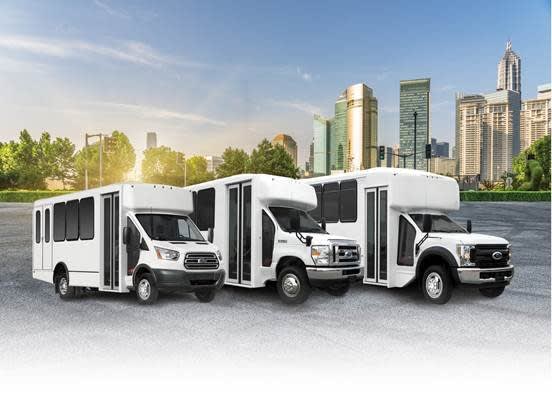
Marking 40 years of manufacturing expertise and performance, ElDorado is expanding its product range to a total of six models.
ElDorado
Marking 40 years of manufacturing expertise and performance, ElDorado is expanding its product range to a total of six models.
ElDorado
ElDorado launched two new steel cage construction models this year, adding to its existing steel cage product — the Advantage. Marking 40 years of manufacturing expertise and performance, ElDorado is expanding its product range to a total of six models, all which exceed the seven-year/100,000-mile durability, side impact, and rollover testing standards.
Taking to the roads in 2020 is the new Advance, a narrow body, steel-cage bus built on a Ford Transit chassis. The Advance features superior front-end visibility, which reduces blind spots and improves safety. Available in non-CDL configurations, the Advance has dual rear wheels that allow for more stability than a van. And for outstanding durability, the floor, roof and walls are all made with a high-strength rust-proofed steel.
Also new to ElDorado is the heavy-duty Atlas, the largest and first ever steel bus to be built on the Ford F550 chassis. The Atlas offers an array of floor plans to choose from, due to the flat floors without wheel well interference. Atlas’ interior is designed with the new standard FRP wall and ceiling materials, which create a clean and modern appearance.
The Advantage, a favorite since its launch in 2012 and ElDorado’s first steel cage bus, has an updated look for 2020 with a newly styled front cap and one-piece snap-lock rub rail molding. The all stainless-steel door and lift frames cover the screws, which avoids rust and ensures durability by resisting sagging. An updated rear wheelchair door location allows more room on the rear wall for versatile seating arrangements.
The Advance, Atlas, and Advantage will be built in REV’s Salina, Kan., manufacturing plant, and the new Advance and Advantage will have first deliveries in March 2020, with the orders opening for the Atlas in March 2020 and deliveries in July 2020.
More Bus

New York MTA Plans Largest Bus Fleet Upgrade in More Than a Decade
The agency is seeking manufacturers for 650 new CNG buses to replace aging vehicles, improve reliability, and advance its broader fleet modernization strategy.
Read More →
Building a Flexible Path to Transit Electrification
John Hroncich discusses BAE Systems’ modular and scalable approach, lessons learned from decades of real-world operations, and how agencies can identify electrification strategies that fit their fleets.
Read More →
Bus Tech Talk: Keeping Transit Technicians Ahead of the Technology Curve
LA Metro’s Obed Mejia discusses technician training, evolving maintenance technology, fleet replacement, and strategies for getting the most out of today’s transit fleets.
Read More →
Biz Briefs: RIPTA Unveils New Frontrunners, Clevland RTA Adds New Siemens, and More
In METRO's latest installment, we take a look at recent news from Siemens, Prevost, Dodge, and more partnerships making headlines across the transportation sector.
Read More →
People Movement: Holly Arnold Joins Transdev and More
In this edition, we also cover recent appointments and announcements at Pace, CamTran, MCI, and more, showcasing the individuals helping to shape the future of transportation.
Read More →
The High Cost of Transit Buses: Industry Leaders Look to Procurement Reform
Transit leaders and policymakers examine how standardized bus designs, streamlined procurement, and predictable funding could help agencies stretch budgets and deliver better service.
Read More →
The Business Voice Behind Public Transportation
As chair of APTA’s Business Members Board of Governors, Ray Melleady explains how more than 850 business members are partnering with transit agencies to advance funding, innovation, and industry-wide collaboration.
Read More →
From Surviving to Thriving: Building Stronger Transportation Organizations
Bus Business Consultants founder Brian Dickson shares lessons on leadership, organizational health, and creating options for long-term success in a changing transportation industry.
Read More →
Finding the ‘Happy Medium’: Optimizing Maintenance Without Sacrificing Reliability
The key to maintenance optimization isn’t doing less work—it’s doing the right work at the right time on the right assets.
Read More →
LA Metro, City of West Hollywood, and Partners Advance Smarter Bus Lane Enforcement
The award-winning partnership combines AI-powered detection with human oversight to improve bus reliability, accessibility, and enforcement efficiency.
Read More →