The Tampa Bay region’s first-of-its-kind bus rapid transit service runs along PSTA's most heavily used corridor and connects St. Pete Beach to Downtown St. Petersburg.
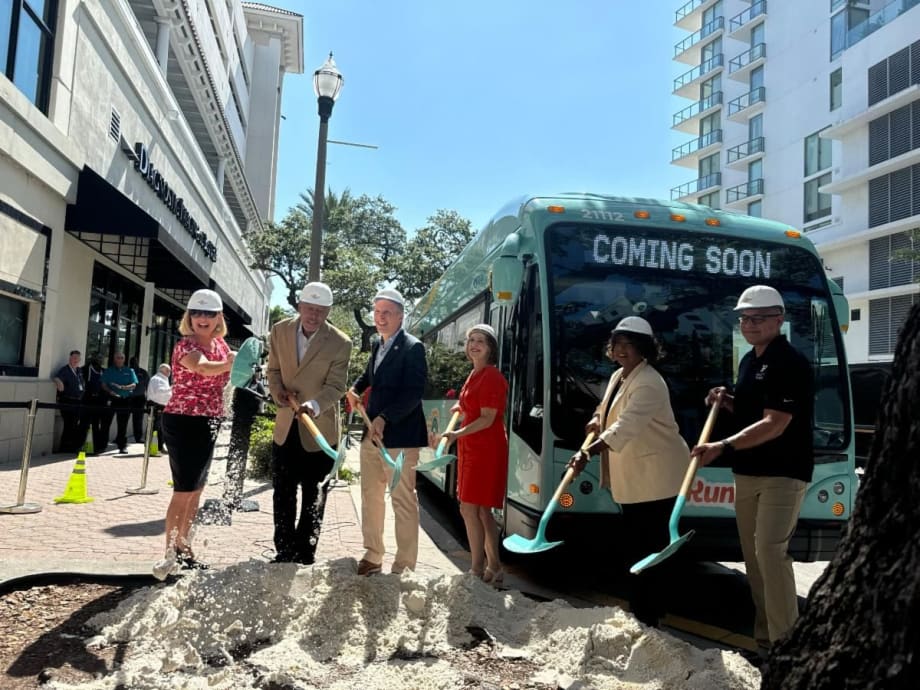
With shovels in hand, PSTA CEO Brad Miller, U.S. Rep. Kathy Castor, State Sen. Darryl Rouson, and other leaders took the first steps to expand the hugely popular transit line and grow its footprint in Downtown.
Photo: PSTA
3 min to read
Florida’s Pinellas Suncoast Transit Authority (PSTA) broke ground on a new SunRunner station that will give residents and visitors closer access to the St. Pete Pier; Beach Drive; the Cross Bay Ferry; and the array of restaurants, businesses, and hotels along the Downtown St. Petersburg waterfront.
With shovels in hand, PSTA CEO Brad Miller, U.S. Rep. Kathy Castor, State Sen. Darryl Rouson, and other leaders took the first steps to expand the hugely popular transit line and grow its footprint in Downtown.
Ad Loading...
“We are fulfilling our promise to the community by continuing to improve the SunRunner,” said PSTA CEO Brad Miller. “We’ve heard the requests from citizens, riders, staff, and elected officials to connect this service to the beautiful waterfront district of St. Petersburg. Today we are starting the process of turning those requests into a reality.”
BRT in Tampa Bay
The Tampa Bay region’s first-of-its-kind bus rapid transit (BRT) service runs along PSTA's most heavily used corridor and connects St. Pete Beach to Downtown St. Petersburg.
The new station will improve mobility and accessibility to jobs, healthcare, education, and activity centers.
“The SunRunner has been a game-changer for our region, providing strong transportation options that benefit everyone,” said State Senator Darryl Rouson. “PSTA’s dedication to connectivity is evident in their efforts to get new people to try transit and the positive impact it has on our community. It’s a testament to what can be achieved when we invest in our transit infrastructure.”
PSTA’s SunRunner Success
The SunRunner launched in October 2022 with the goals of attracting new riders to transit; making life better for residents, businesses, and visitors; and contributing to a safer, cleaner community.
Ad Loading...
Within its first year, the SunRunner surpassed one million riders and remains one of PSTA’s top-performing fixed routes. It recently celebrated its highest ridership ever on June 22.
The transit line has limited stops and gets riders “from the Beach to the ’Burg” — and vice-versa — in about 40 minutes.
Riders do not have long waits thanks to frequent service every 15 minutes during peak times.
The new Downtown station, along with three new SunRunner buses, will keep the promised 15-minute frequency.
The SunRunner launched in October 2022 with the goals of attracting new riders to transit; making life better for residents, businesses, and visitors; and contributing to a safer, cleaner community.
Photo: PSTA
The SunRunner's Impact
The SunRunner corridor has witnessed dynamic redevelopment activity since construction on the project began.
Ad Loading...
A tracking report reveals $9 billion in development along the corridor. The route serves more than 50,000 jobs and 40,000 residents within a half-mile radius.
“A huge thank you to the PSTA staff, our partners both public and private, the PSTA Board members, and our federal and state elected officials who have embraced the vision of how quality mass transit can literally transform our community and improve our quality of life,” said Miller.
Crews completed the original SunRunner project $5 million under budget, allowing the remaining funds to be invested into this expansion.
The new station is expected to be open by the end of 2024.
The agency is seeking manufacturers for 650 new CNG buses to replace aging vehicles, improve reliability, and advance its broader fleet modernization strategy.
John Hroncich discusses BAE Systems’ modular and scalable approach, lessons learned from decades of real-world operations, and how agencies can identify electrification strategies that fit their fleets.
LA Metro’s Obed Mejia discusses technician training, evolving maintenance technology, fleet replacement, and strategies for getting the most out of today’s transit fleets.
In METRO's latest installment, we take a look at recent news from Siemens, Prevost, Dodge, and more partnerships making headlines across the transportation sector.
In this edition, we also cover recent appointments and announcements at Pace, CamTran, MCI, and more, showcasing the individuals helping to shape the future of transportation.
Transit leaders and policymakers examine how standardized bus designs, streamlined procurement, and predictable funding could help agencies stretch budgets and deliver better service.
As chair of APTA’s Business Members Board of Governors, Ray Melleady explains how more than 850 business members are partnering with transit agencies to advance funding, innovation, and industry-wide collaboration.
Bus Business Consultants founder Brian Dickson shares lessons on leadership, organizational health, and creating options for long-term success in a changing transportation industry.
The award-winning partnership combines AI-powered detection with human oversight to improve bus reliability, accessibility, and enforcement efficiency.