



IBM venture to help commuters avoid congestion using predictive data
Partnership with Caltrans and UC Berkeley will analyze real-time traffic patterns and individual commuter travel history to forecast faster and safer routes.

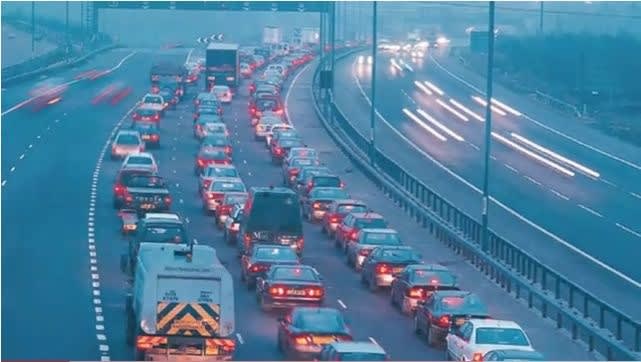
[IMAGE]Calif-traffic-2.jpg[/IMAGE]IBM announced a new collaboration with the California Department of Transportation (Caltrans) and California Center for Innovative Transportation (CCIT), a research institute at the University of California, Berkeley, to help commuters avoid congestion before their trip begins and enable transportation agencies to better understand, predict and manage traffic flow.
In a technology advance that will ultimately help drivers around the world avoid rush hour traffic jams, IBM Research has developed a new predictive modeling tool that will let drivers quickly access personalized travel recommendations to help them avoid congestion and save time and fuel.
By joining forces, IBM, Caltrans and the Mobile Millennium team within the CCIT hope to provide drivers with valuable predictive information on what traffic patterns are likely to look like — even before they leave work or home and get in their vehicles — rather than discover what has already happened and is being reported.
Using this predictive and analytic traffic tool, transportation agencies and city planners in the future will be able to proactively design, manage and optimize transportation systems to deal with ever-increasing traffic due to population growth and increasing urbanization.
Traffic delays caused by highway incidents such as work zones, crashes or simply by morning and evening rush hours routinely stymie frustrated drivers. Even with advances in GPS navigation, real-time traffic alerts and mapping, daily commute times are often unreliable, and relevant updates on how to avoid congestion often reach commuters when they are already stuck in traffic and it is too late to change course.
This inability to avoid traffic congestion has led to commuters across the U.S. wasting on average almost a week's worth of time, 28 gallons of gas and $808 over the course of a year. (Source: http://mobility.tamu.edu/ums/report/congestion_cost.pdf )
In Silicon Valley, the problem is especially acute. In comparison with cities of a similar size in population, drivers in the city of San Jose waste a cumulative of 10 million more annual hours sitting in traffic jams and suffer a 15 percent higher commute delay per peak-time traveler. (Source: http://mobility.tamu.edu/ums/congestion_data/)
Spanning the San Francisco Bay Area Region, the new Smarter Traveler research initiative collects and analyzes traffic data generated from existing sensors in roads, toll booths, bridges and intersections. This unique project combines that data with locations based on GPS sensors in participant’s cell phones to learn their preferred travel days and routes. Alerts are then automatically delivered via email or text message on the status of the driver’s typical commute before the trip begins, which eliminates potential distraction once a driver is on the road.
[IMAGE]IBM-SmarterTraveler-Multiple-Routes-2.jpg[/IMAGE]
These alerts will enable drivers to plan and share alternative travel routes, improve traveler safety and help transportation authorities better predict and reduce bumper-to-bumper traffic before it occurs through improved traffic signal timing, ramp metering and route planning.
The researchers will leverage a first-of-its-kind learning and predictive analytics tool called the IBM Traffic Prediction Tool (TPT), developed by IBM Research, which continuously analyzes congestion data, commuter locations and expected travel start times throughout a metropolitan region that can affect commuters on highways, rail-lines and urban roads.
Through this Smarter Traveler research initiative, scientists could eventually recommend better ways to get to a destination, including directions to a nearby mass transit station, whether a train is predicted to be on time and whether parking may be available at the station.
“Unlike existing traffic alert solutions, we’re helping take the guesswork out of commuting,” said Stefan Nusser, Functional Manager, Almaden Services Research, IBM. “By actively capturing and analyzing the massive amount of data already being collected, we’re blending the automated learning of travel routes with state-of-the-art traffic prediction of those routes to give travelers timely information that can help them make decisions about the best way to get to their destination.”
METRO TV: To watch the IBM Research Smarter Traveler video, click here.
More Bus

New York MTA Plans Largest Bus Fleet Upgrade in More Than a Decade
The agency is seeking manufacturers for 650 new CNG buses to replace aging vehicles, improve reliability, and advance its broader fleet modernization strategy.
Read More →
Building a Flexible Path to Transit Electrification
John Hroncich discusses BAE Systems’ modular and scalable approach, lessons learned from decades of real-world operations, and how agencies can identify electrification strategies that fit their fleets.
Read More →
Bus Tech Talk: Keeping Transit Technicians Ahead of the Technology Curve
LA Metro’s Obed Mejia discusses technician training, evolving maintenance technology, fleet replacement, and strategies for getting the most out of today’s transit fleets.
Read More →
Biz Briefs: RIPTA Unveils New Frontrunners, Clevland RTA Adds New Siemens, and More
In METRO's latest installment, we take a look at recent news from Siemens, Prevost, Dodge, and more partnerships making headlines across the transportation sector.
Read More →
People Movement: Holly Arnold Joins Transdev and More
In this edition, we also cover recent appointments and announcements at Pace, CamTran, MCI, and more, showcasing the individuals helping to shape the future of transportation.
Read More →
The High Cost of Transit Buses: Industry Leaders Look to Procurement Reform
Transit leaders and policymakers examine how standardized bus designs, streamlined procurement, and predictable funding could help agencies stretch budgets and deliver better service.
Read More →
The Business Voice Behind Public Transportation
As chair of APTA’s Business Members Board of Governors, Ray Melleady explains how more than 850 business members are partnering with transit agencies to advance funding, innovation, and industry-wide collaboration.
Read More →
From Surviving to Thriving: Building Stronger Transportation Organizations
Bus Business Consultants founder Brian Dickson shares lessons on leadership, organizational health, and creating options for long-term success in a changing transportation industry.
Read More →
Finding the ‘Happy Medium’: Optimizing Maintenance Without Sacrificing Reliability
The key to maintenance optimization isn’t doing less work—it’s doing the right work at the right time on the right assets.
Read More →
LA Metro, City of West Hollywood, and Partners Advance Smarter Bus Lane Enforcement
The award-winning partnership combines AI-powered detection with human oversight to improve bus reliability, accessibility, and enforcement efficiency.
Read More →