



Joint venture celebrates Stage 1 of Ottawa's Confederation Line
A team including STV and AECOM played a critical part in the design and construction of the line.

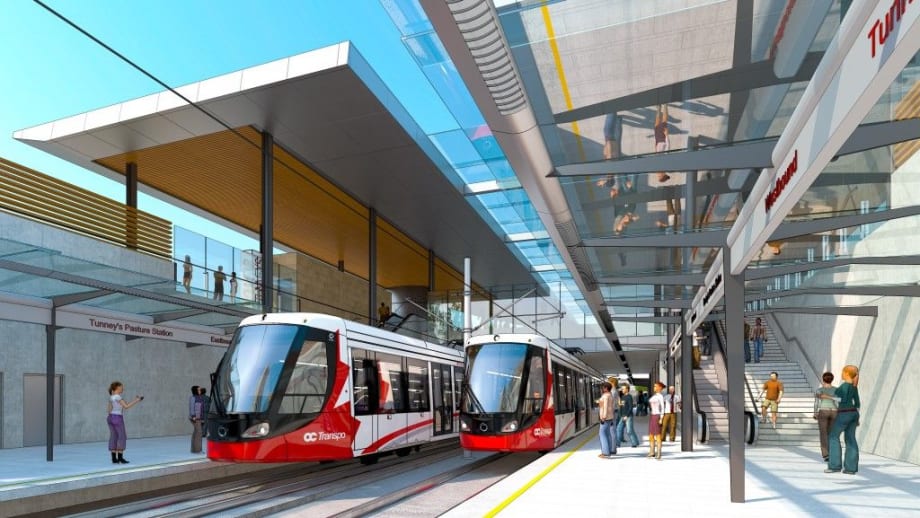
The Confederation Line runs about eight miles and connects Ottawa’s Tunney’s Pasture and Blair Stations.
City of Ottawa
The Confederation Line runs about eight miles and connects Ottawa’s Tunney’s Pasture and Blair Stations.
City of Ottawa
Stage 1 of the Confederation Line, the first conversion of an exclusive bus rapid transit (BRT) system into a light rail transit in North America, recently made its debut in Canada’s capital city. STV led the Capital Transit Partners joint venture, which included AECOM, Morrison Hershfield, and McMillen Jacobs Associates.
The team played a critical part of the Confederation Line’s design and construction by performing program management, preliminary engineering, scheduling and construction staging support services, and developing performance-based specifications.
The Confederation Line runs about eight miles and connects Ottawa’s Tunney’s Pasture and Blair Stations. The project consists of 13 stations — three of which are located within a 1.5-mile twin-track tunnel under downtown Ottawa — a new vehicle maintenance and storage facility, new light rail transit vehicles, traction power substations, and other associated infrastructure. The contract was procured by the City of Ottawa through the design-build-finance-maintain delivery method with the Rideau Transit Group and OC Transpo, the operator.
Initial ridership forecasts determined the Confederation Line would serve upwards of 10,700 passengers per hour in each direction during peak travel times. With Ottawa’s population expected to increase by at least 30% by 2031, it was critical for the system to be developed so that existing infrastructure could meet current demand while remaining responsive and adaptable to the anticipated surge in ridership growth. Additionally, Ottawa’s existing BRT service remained operational and fully functional during the construction of the light rail network.
To help meet these needs, Capital Transit Partners utilized a design to operate/maintain approach during the preliminary design phase which found operational efficiencies, while also saving the client costs. Station platform length were optimized to minimize the project’s physical footprint while a higher capacity signal and traction power system was designed to meet ridership demand during peak travel periods. The strategic relocation of interlockings and track crossovers allowed the client to have a wider window for system maintenance, which will benefit the Confederation Line over the long-term.
To address concerns with the existing BRT network, the joint venture worked with the client to structure its contract with the construction team so that no bus lanes were closed until a new alternative lane was designed and built. In Ottawa’s downtown, where buses still intermingle with vehicular traffic, a new twin-track tunnel was designed and built to alleviate congestion.
The Confederation Line program also stands to benefit the city and its environment in other ways. The service runs zero-emission electric trains that reduce carbon dioxide emissions and are significantly quieter than diesel-powered buses. The Confederation Line was designed and built to better integrate with Ottawa’s bicycle infrastructure network — which was also expanded as part of this larger transportation improvement plan. New cycling and pedestrian pathways connect to the line’s stations, and both the stations and vehicles accommodate commuters who bike to work.
More Rail

New York MTA Advances Final Contract for Second Avenue Subway Expansion
Contract Four is the largest in the Second Avenue Subway Phase 2 project and includes construction of station infrastructure, tracks, and signals for the subway expansion, MTA officials said. Work on Contract Four will begin in 2027.
Read More →
San Diego MTS Breaks Monthly Trolley Ridership Record
Agency officials said July’s ridership indicates MTS’s continued recovery from the pandemic.
Read More →
Report Examines NJ TRANSIT Reliability, Funding Challenges
The Garden State Initiative analysis examines the roles of Amtrak infrastructure, fleet management, and agency operations while recommending a more performance-based approach to improving reliability.
Read More →
Stadler, CapMetro Sign Long-Term Rail Fleet Support Agreement
Beginning in 2027, Stadler will provide on-site technical expertise, spare parts support, training, and obsolescence management to help extend the reliability and longevity of CapMetro’s GTW fleet.
Read More →
Biz Briefs: Alstom Lands Canadian Contract, LYT to Supply California TSP, and More
In METRO's latest installment, we take a look at recent news from Complete Coach Works, Beep, FlixBus, and more partnerships making headlines across the transportation sector.
Read More →
CATS Gold Line Marks 5 Years of Service, 2.8M Passenger Trips
With a six-mile expansion planned, the Charlotte streetcar is positioned to connect more neighborhoods and major transit hubs across the region.
Read More →
Why Simulating Pedestrian Movement Has Become Essential for Modern Rail Stations
Pedestrian microsimulation is helping rail planners identify bottlenecks, test station designs, and prepare complex transit hubs for growing passenger volumes.
Read More →
Amtrak Begins Major Construction at New York’s Sunnyside Yard
The new maintenance facility will support Amtrak’s Airo trainsets while improving maintenance efficiency and turnaround times in New York.
Read More →
Chicago Leaders Unveil Plans for O’Hare Airport Express Train
The privately developed project would offer a 15-minute trip between downtown and O’Hare’s Terminal 2, with trains operating every 15 minutes on a dedicated track. The service would use battery-electric trains and three existing freight rail rights-of-way.
Read More →
OCTA Maps Out 30-Year Strategy to Protect Coastal Rail Corridor
The draft feasibility report identifies strategies to protect the coastal rail line for decades as the agency continues near-term stabilization and sand placement efforts.
Read More →