



King County Metro To Install Operator Safety Partitions Fleetwide
The Seattle agency has committed to adding safety partitions to its fleet of roughly 1,400 buses to improve safety conditions for bus operators.

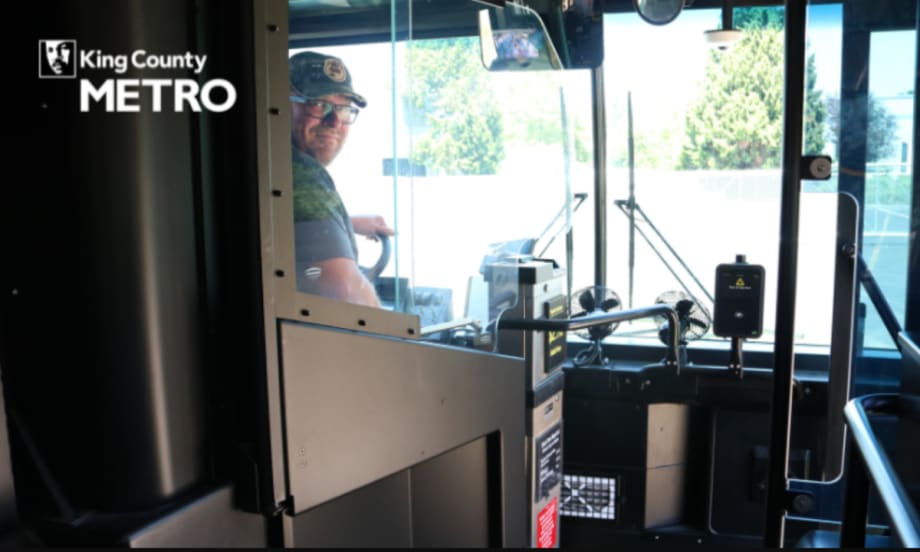
From 2023 to 2024, the agency's Care and Presence safety approach led to a 56% reduction in operator assaults.
Photo: King County Metro
Seattle’s King County Metro bus operators are evaluating safety partition designs as part of the planning process for retrofitting up to 1,300 of the agency’s 1,400 buses.
Existing buses not being upgraded will be replaced by a recent order for 89 new buses with a partition already installed.
Starting July 5, four buses, each with a different partition style currently available on the market, will be touring the agency’s bases. The safety partitions, which riders will begin seeing on new and existing buses later this year, offer increased size and durability to protect King County bus operators better.
“King County is moving forward as quickly as possible to select and install operator safety partitions on every Metro bus, fulfilling our commitment to enhance transit safety for operators and riders,” said King County Executive Shannon Braddock. “We listened to our operators’ feedback, which led to improved, larger partition designs and the installation of safety partitions on the 89 new buses arriving next year.”
Operator Partition Rollout Aiming for 100% by 2026
More people are taking transit throughout the region, and the agency serves well over 300,000 daily passengers every weekday.
From 2023 to 2024, the agency's Care and Presence safety approach led to a 56% reduction in operator assaults. Operator assaults decreased by 20% from the first quarter of 2024 to the first quarter of 2025.
“While ridership and safety trends are very encouraging, our goal will always be zero incidents,” said Braddock. “King County continues to expand our comprehensive approach to transit safety — including 24/7 cleaning crews, behavioral health specialists, Metro Transit Police, Metro Transit Security Officers, safety partitions, and more — to ensure every trip is safe and welcoming.”
“Safety is absolutely paramount, and our bus operators often share with me how important these partitions are to them,” said King County Metro GM Michelle Allison. “Operator safety partitions have been a multi-year effort across our agency. I want to thank the many teams involved for getting us to this point and for accelerating the procurement and installation timelines. We’re now on track to begin installation later this year and to reach 100% of buses by 2026. That completion date is an improvement of roughly two years from an earlier estimate.”
Following operators’ feedback on the potential safety partition features, King County Metro will proceed with a procurement process to obtain the equipment for retrofitting its existing buses.
More Security and Safety

Transit Agencies Highlight Safety Gains at National Summit
Leaders from 15 major transit systems shared crime-reduction results and safety initiatives while discussing the role of continued federal support.
Read More →
DART Launches Major Security, Fare Enforcement Initiative
The 90-day demonstration will deploy coordinated security teams at five light rail stations while testing controlled access and gathering data to guide future investments.
Read More →
RTD Launches NextRide App to Consolidate Trip Planning, Fares, Security Reporting
The app expands on RTD’s existing NextRide web application and allows customers to view real-time vehicle locations and service alerts, purchase and store digital fares, and access customer support.
Read More →

TAPTCO Updates OSHA Compliance Training for Transit Maintenance Operations
The revamped program addresses 26 OSHA standards for maintenance facilities, with TAPTCO pointing to training, documentation, and everyday shop hazards as continuing challenges for transit operations.
Read More →
How VaporVision Adds Value to Transit Door Systems
Wabtec engineers explain how the system improves doorway detection, strengthens diagnostics and gives transit agencies and OEMs greater operating flexibility.
Read More →
FRA Announces $5.3B in Rail Investments, Including $2B for Amtrak
Funding will support grade-crossing improvements, infrastructure upgrades, and new Amtrak equipment in 23 states.
Read More →
Chicago, Maryland Expand Non-Law-Enforcement Safety, Rider Support
The CTA and MTA are launching new programs aimed at de-escalation, crisis response, rider assistance, and greater transparency.
Read More →
LA Metro, City of West Hollywood, and Partners Advance Smarter Bus Lane Enforcement
The award-winning partnership combines AI-powered detection with human oversight to improve bus reliability, accessibility, and enforcement efficiency.
Read More →
LA Metro Reports 57% Decline in Homelessness on Transit System Since 2024
The agency's latest homelessness count offers new data on how care-based services and cross-sector partnerships can complement traditional transit security strategies.
Read More →
FTA Launches 'Transit Moves America' Dashboard to Highlight Agency Safety and Performance
The online dashboard transforms National Transit Database information into a public-facing resource that allows users to compare transit agencies on key operational and safety metrics.
Read More →