




Check Out: The Latest in Fare Collection Technology
King County Metro Fully Resumes Fare Enforcement
See why the agency will resume fare enforcement with warnings and fines while expanding access to reduced and free fare programs.
May 28, 2025
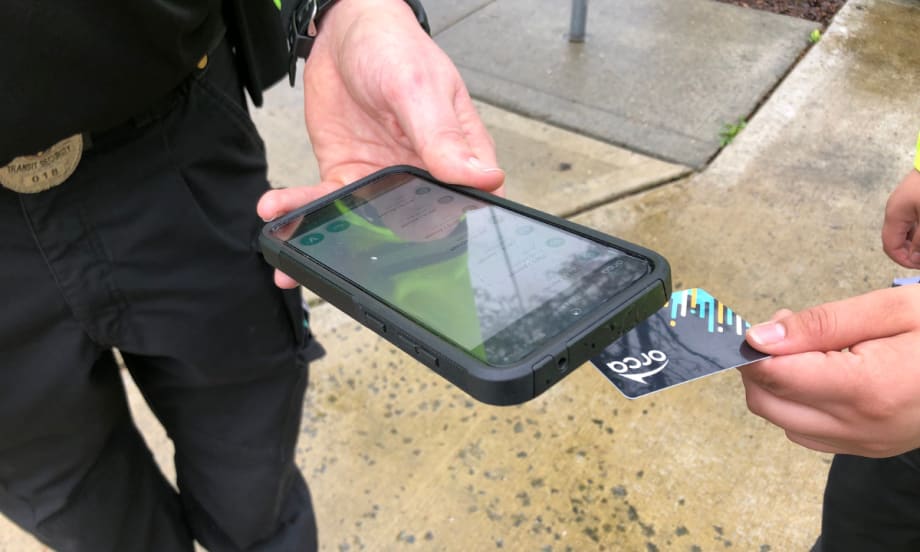
In 2020, King County Metro paused fare enforcement to reassess Safety, Security, and Fare Enforcement (SaFE) to make the transit system more equitable.
Photo: King County Metro
3 min to read
For the past two months, Seattle’s King County Metro has focused on educating and reminding riders of the requirement to pay proper fare. This education leads to May 31, when fare enforcement officers will begin issuing printed warnings and citations to riders who cannot provide proof of fare payment on buses and streetcars.
During the initial fare education phase in April and May, the agency found that 76% of riders contacted had proof of payment. Fare enforcement officers provided information to the remaining riders on the expectation to pay the fare, reduced fare programs, and ways to show proof of payment.
"We see riders are getting back into the habit of tapping their cards and paying at the farebox, which funds essential bus service in our communities," King County Metro's Chief Safety Officer Rebecca Frankhouser said. "As we shift toward issuing warnings and potential citations, we are again reminding riders that there are free and reduced transit fares to ensure everyone can take transit."
In 2020, King County Metro paused fare enforcement to reassess Safety, Security, and Fare Enforcement (SaFE) to make the transit system more equitable.
Currently, the agency often provides more than 300,000 rides each weekday. However, bus ridership in 2024 was about 90 million systemwide, with an estimated $73 million in revenue.
What Riders Need to Know
The agency system continues to deploy 30 fare enforcement officers across 220 transit security officers.
King County Metro's adult fare is currently $2.75. Fare enforcement officers will accept proof of payment in the form of:
A recently tapped ORCA fare card.
An activated Transit GO Ticket on their phone.
A tapped ORCA card in Google Wallet.
A transfer slip issued to someone who paid cash or used a human service bus ticket at the farebox.
According to an agency statement, paying with an ORCA card provides information about riders to help the agency retain ridership data that maintains state funding and helps them serve riders better.
Although many businesses provide their employees with ORCA cards, employees are still required to tap their company-issued cards. The agency encourages everyone to tap their ORCA card, including youth 18 and under who travel for free.
Warnings, Fines, and Alternative Resolutions
Riders who do not have valid proof of payment will first receive a printed warning, which they can receive two of without consequence. Third and subsequent violations may result in a fine or an "alternative resolution."
For third and subsequent violations, the rider may choose from the following:
Pay a fine of $20 within 30 days or $40 within 90 days.
Load $20 onto an ORCA card or, if eligible, $10 onto a reduced fare program card.
Enroll in a reduced fare program if eligible.
Perform two hours of community service.
Appeal to the Fare Adjudication Program Manager or request a customized resolution.
Youth who do not have proof of payment will not face a fine or alternative resolution and will instead receive information on how to enroll in the Free Youth Transit Pass.
More Bus

New York MTA Plans Largest Bus Fleet Upgrade in More Than a Decade
The agency is seeking manufacturers for 650 new CNG buses to replace aging vehicles, improve reliability, and advance its broader fleet modernization strategy.
Read More →
Building a Flexible Path to Transit Electrification
John Hroncich discusses BAE Systems’ modular and scalable approach, lessons learned from decades of real-world operations, and how agencies can identify electrification strategies that fit their fleets.
Read More →
Bus Tech Talk: Keeping Transit Technicians Ahead of the Technology Curve
LA Metro’s Obed Mejia discusses technician training, evolving maintenance technology, fleet replacement, and strategies for getting the most out of today’s transit fleets.
Read More →
Biz Briefs: RIPTA Unveils New Frontrunners, Clevland RTA Adds New Siemens, and More
In METRO's latest installment, we take a look at recent news from Siemens, Prevost, Dodge, and more partnerships making headlines across the transportation sector.
Read More →
People Movement: Holly Arnold Joins Transdev and More
In this edition, we also cover recent appointments and announcements at Pace, CamTran, MCI, and more, showcasing the individuals helping to shape the future of transportation.
Read More →
The High Cost of Transit Buses: Industry Leaders Look to Procurement Reform
Transit leaders and policymakers examine how standardized bus designs, streamlined procurement, and predictable funding could help agencies stretch budgets and deliver better service.
Read More →
The Business Voice Behind Public Transportation
As chair of APTA’s Business Members Board of Governors, Ray Melleady explains how more than 850 business members are partnering with transit agencies to advance funding, innovation, and industry-wide collaboration.
Read More →
From Surviving to Thriving: Building Stronger Transportation Organizations
Bus Business Consultants founder Brian Dickson shares lessons on leadership, organizational health, and creating options for long-term success in a changing transportation industry.
Read More →
Finding the ‘Happy Medium’: Optimizing Maintenance Without Sacrificing Reliability
The key to maintenance optimization isn’t doing less work—it’s doing the right work at the right time on the right assets.
Read More →
LA Metro, City of West Hollywood, and Partners Advance Smarter Bus Lane Enforcement
The award-winning partnership combines AI-powered detection with human oversight to improve bus reliability, accessibility, and enforcement efficiency.
Read More →