




Staying in Cali: L.A. Metro Taps Partner for Transit Ambassador Program
L.A. Metro Officially Opens the K Line
The opening of the K Line — previously known as the Crenshaw/LAX Line — marks the official return of rail service on Crenshaw Boulevard.
October 10, 2022
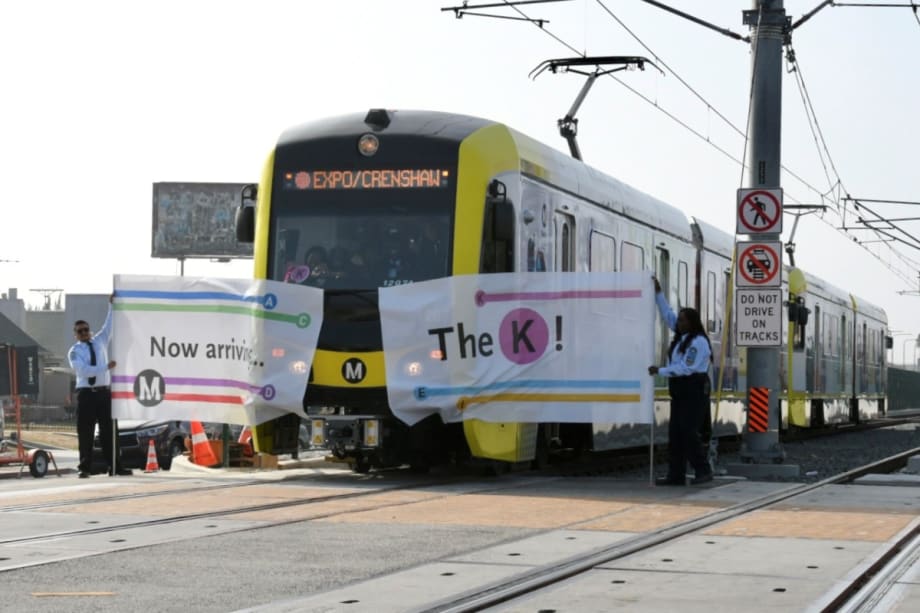
Metro said the K Line is anticipated to open new access to opportunity for numerous South L.A. communities.
Photo: L.A. Metro
3 min to read
Transportation officials from the Los Angeles County Metropolitan Transportation Authority (Metro) commemorated the grand opening of the K Line, Los Angeles’ newest light rail line, with a burst through a banner at the intersection of Crenshaw Boulevard and 48th Street in South Los Angeles.
The opening of the K Line — previously known as the Crenshaw/LAX Line — marks the official return of rail service on Crenshaw Boulevard since the last Los Angeles Railway Line 5 yellow street cars trundled down the street in 1955, according to Metro's news release.
To mark its historic milestone, Metro provided free rides on the K Line and all other Metro bus and rail lines and bike share services.
The new line represents Metro’s single largest transportation investment in the South Los Angeles region since the construction of the Metro A Line (Blue) and C Line (Green) more than 20 years ago, according to the agency. Metro said the K Line is anticipated to open new access to opportunity for numerous South L.A. communities, including the Crenshaw Corridor, Hyde Park, Leimert Park, Fairview Heights, Inglewood, and Westchester, by connecting these communities with new local destinations as well as the rest of Los Angeles County’s expanding Metro Rail system.
"What was conceived decades ago as only lines on a map and a hopeful dream have today been made a reality thanks to county taxpayers’ investment in Metro," said Ara J. Najarian, Metro Board chair. "We now have a train that Angelenos can take to reach destinations they never could before via Metro Rail. The K Line is the perfect example of how Metro is continuing to transform public transportation for the better in Los Angeles County."
The $2.1 billion K Line was funded by local tax dollars, according to Metro. The agency’s Measure R transportation sales tax measure was approved by voters back in 2008. The line also included federal funding grants and loans that helped ensure the timely start of construction. Prior to Measure R’s 2008 passage, however, earlier plans for a train service along the Crenshaw Corridor languished due to the lack of local funding.
"Residents and businesses along the route of the new K Line have been looking forward to the expanded access this rail line will provide to work, school, shopping, entertainment, and LAX," said Congressmember Maxine Waters. "I worked very hard to ensure federal support for this corridor, which resulted in $233 million in grants and a $546 million loan, and I am proud to see it finally coming to fruition."
The K Line is a part of Metro’s rail expansion plan in Los Angeles County. With Metro’s other Measure M voter-approved transportation tax measure in 2016, the agency said it now has the biggest rail expansion program in the U.S.
Metro added that it anticipates the line will carry more than 32,000 daily boardings by the year 2035. During this time, ridership is expected to continue to grow once Metro’s new Regional Connector line opens to the public early next year, the K Line’s two remaining stations open in the next couple of years, and all bus lines and bus stations that serve the line are fully integrated.
By 2024, Metro said it will complete a new station to connect the K Line with Los Angeles International Airport via its People Mover to airport terminals.
"After decades of going without rail transit, I’m proud to lead Metro as it delivers the K Line to Crenshaw, Inglewood, and all the other south Los Angeles communities," said Stephanie Wiggins, CEO of Metro. "We’re eternally grateful to the area’s residents and businesses for hosting us in the community during a long and technically complex construction period. I know the K Line will be well used and well-loved by these communities and the rest of Los Angeles County for decades to come."
Metro said it now plans to expand the K Line north. The agency is now developing a draft environmental impact report that will explore alternatives for extending the K Line to reach Hollywood.
More Rail

New York MTA Advances Final Contract for Second Avenue Subway Expansion
Contract Four is the largest in the Second Avenue Subway Phase 2 project and includes construction of station infrastructure, tracks, and signals for the subway expansion, MTA officials said. Work on Contract Four will begin in 2027.
Read More →
San Diego MTS Breaks Monthly Trolley Ridership Record
Agency officials said July’s ridership indicates MTS’s continued recovery from the pandemic.
Read More →
Report Examines NJ TRANSIT Reliability, Funding Challenges
The Garden State Initiative analysis examines the roles of Amtrak infrastructure, fleet management, and agency operations while recommending a more performance-based approach to improving reliability.
Read More →
Stadler, CapMetro Sign Long-Term Rail Fleet Support Agreement
Beginning in 2027, Stadler will provide on-site technical expertise, spare parts support, training, and obsolescence management to help extend the reliability and longevity of CapMetro’s GTW fleet.
Read More →
Biz Briefs: Alstom Lands Canadian Contract, LYT to Supply California TSP, and More
In METRO's latest installment, we take a look at recent news from Complete Coach Works, Beep, FlixBus, and more partnerships making headlines across the transportation sector.
Read More →
CATS Gold Line Marks 5 Years of Service, 2.8M Passenger Trips
With a six-mile expansion planned, the Charlotte streetcar is positioned to connect more neighborhoods and major transit hubs across the region.
Read More →
Why Simulating Pedestrian Movement Has Become Essential for Modern Rail Stations
Pedestrian microsimulation is helping rail planners identify bottlenecks, test station designs, and prepare complex transit hubs for growing passenger volumes.
Read More →
Amtrak Begins Major Construction at New York’s Sunnyside Yard
The new maintenance facility will support Amtrak’s Airo trainsets while improving maintenance efficiency and turnaround times in New York.
Read More →
Chicago Leaders Unveil Plans for O’Hare Airport Express Train
The privately developed project would offer a 15-minute trip between downtown and O’Hare’s Terminal 2, with trains operating every 15 minutes on a dedicated track. The service would use battery-electric trains and three existing freight rail rights-of-way.
Read More →
OCTA Maps Out 30-Year Strategy to Protect Coastal Rail Corridor
The draft feasibility report identifies strategies to protect the coastal rail line for decades as the agency continues near-term stabilization and sand placement efforts.
Read More →