



LA Metro Breaks Ground on BRT Improvements
Project improvements will enhance safety for buses, cars, pedestrians, and cyclists alike on the dedicated BRT Line that travels between North Hollywood and Chatsworth.

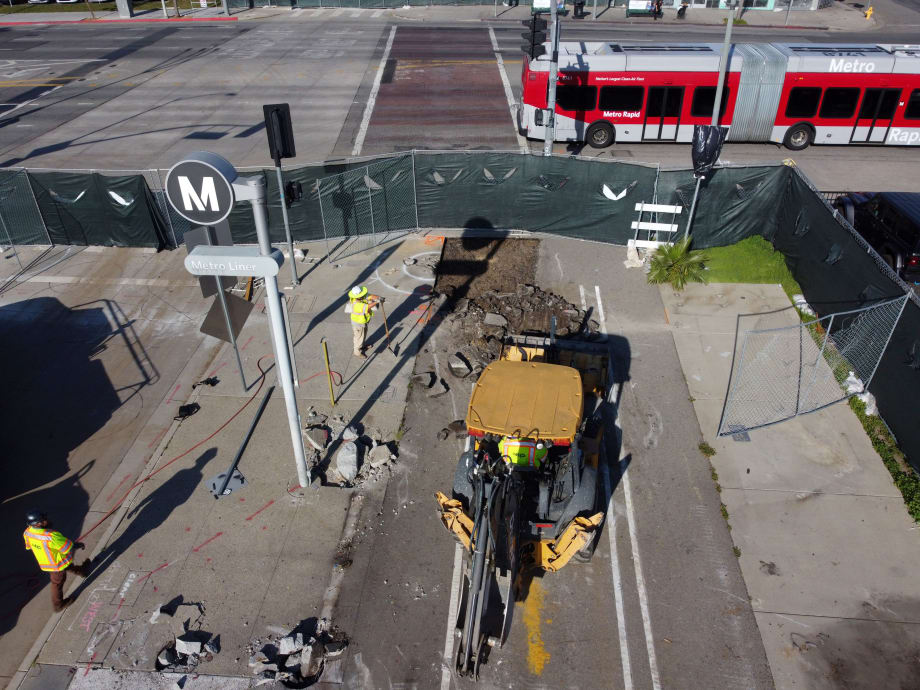
Scheduled to be completed in 2027 in advance of the 2028 Olympic and Paralympic games, the project will advance Metro’s commitment to improve mobility and foster economic vitality in the San Fernando Valley.
Photo: LA Metro
The Los Angeles County Metropolitan Transportation Authority (Metro) celebrated the groundbreaking of major construction for the Metro G (Orange) Line Improvements Project, a series of bus rapid transit (BRT) enhancements projected to reduce average end-to-end bus travel times by 12 minutes or nearly 22%, allowing for five-minute bus headways and eliminating the potential for motorist intrusions onto the busway.
Project improvements will enhance safety for buses, cars, pedestrians, and cyclists alike on the dedicated BRT Line that travels between North Hollywood and Chatsworth.
Metro G Line Improvements
Scheduled to be completed in 2027 in advance of the 2028 Olympic and Paralympic games, the project will advance Metro’s commitment to improve mobility and foster economic vitality in the San Fernando Valley.
In the coming years, Metro expects to build several Valley transit projects, including the East San Fernando Valley Light Rail Transit Project, the North San Fernando Transit Corridor Project, the North Hollywood to Pasadena Transit Corridor Project, and the Sepulveda Transit Corridor Project.
Over the course of the next two years, the project will result in the following improvements to the G Line:
Installation of four-quadrant gates at 13 busy Metro G Line intersections between North Hollywood and Van Nuys — the G Line’s busiest section. Enhanced safety features will include flashing lights and bells, raised medians, and pedestrian/bicyclist crosswalk gates.
Implementation of more sophisticated transit signal priority and preemption in conjunction with the Los Angeles Department of Transportation (LADOT). This implementation will extend the signal phase to favor Metro’s electric buses and give them the next green light in an intersection’s phasing cycle for faster service.
Construction of three bridges at Van Nuys Boulevard, Sepulveda Boulevard, and Vesper Avenue to physically separate buses from cars, thus improving bus travel times and eliminating intersection bottlenecks on local streets.
Building a new aerial station on the Van Nuys Boulevard bridge, making room for a new street-level station for Metro’s new East San Fernando Valley Light Rail Transit Project, which will travel along Van Nuys Boulevard to connect the cities of Van Nuys, Panorama City, Arleta, and Pacoima for greater regional mobility.
Resurfacing the adjacent bike path, painting new striping and installing new lighting, signage, and fencing to improve safety and the user experience.
Adding bike lockers and bike parking at selected Metro G Line Stations to further encourage multimodal trips.
In late February, Metro began detouring buses and cyclists off the bus right-of-way and adjacent bike path between Woodman and Sepulveda G Line Stations to facilitate construction work at Van Nuys Station. Demolition activities of the existing Van Nuys Station are expected to begin and will require that the station remain closed throughout the construction period.
Funds for the Project
The $668 million transit project is funded by Metro’s 2016 Measure M and Prop C voter-approved sales taxes, among others.
Approximately $64 million of the project cost has been made available by SB-1, the state’s gas tax and vehicle fee transportation funding program. It will be built by Valley Transit Partners — a Joint Venture of Stacy and Witbeck, Inc., Flatiron West, and Modern Railway Systems.
“These improvements to the G Line will save people time and facilitate better connections to our growing transit network in the San Fernando Valley,” said Metro CEO Stephanie Wiggins. “The G Line will also be an important part of our transit network for the 2028 Olympic and Paralympic Games, and we look forward to delivering this project in 2027, well before the Games begin.”
More Bus

New York MTA Plans Largest Bus Fleet Upgrade in More Than a Decade
The agency is seeking manufacturers for 650 new CNG buses to replace aging vehicles, improve reliability, and advance its broader fleet modernization strategy.
Read More →
Building a Flexible Path to Transit Electrification
John Hroncich discusses BAE Systems’ modular and scalable approach, lessons learned from decades of real-world operations, and how agencies can identify electrification strategies that fit their fleets.
Read More →
Bus Tech Talk: Keeping Transit Technicians Ahead of the Technology Curve
LA Metro’s Obed Mejia discusses technician training, evolving maintenance technology, fleet replacement, and strategies for getting the most out of today’s transit fleets.
Read More →
Biz Briefs: RIPTA Unveils New Frontrunners, Clevland RTA Adds New Siemens, and More
In METRO's latest installment, we take a look at recent news from Siemens, Prevost, Dodge, and more partnerships making headlines across the transportation sector.
Read More →
People Movement: Holly Arnold Joins Transdev and More
In this edition, we also cover recent appointments and announcements at Pace, CamTran, MCI, and more, showcasing the individuals helping to shape the future of transportation.
Read More →
The High Cost of Transit Buses: Industry Leaders Look to Procurement Reform
Transit leaders and policymakers examine how standardized bus designs, streamlined procurement, and predictable funding could help agencies stretch budgets and deliver better service.
Read More →
The Business Voice Behind Public Transportation
As chair of APTA’s Business Members Board of Governors, Ray Melleady explains how more than 850 business members are partnering with transit agencies to advance funding, innovation, and industry-wide collaboration.
Read More →
From Surviving to Thriving: Building Stronger Transportation Organizations
Bus Business Consultants founder Brian Dickson shares lessons on leadership, organizational health, and creating options for long-term success in a changing transportation industry.
Read More →
Finding the ‘Happy Medium’: Optimizing Maintenance Without Sacrificing Reliability
The key to maintenance optimization isn’t doing less work—it’s doing the right work at the right time on the right assets.
Read More →
LA Metro, City of West Hollywood, and Partners Advance Smarter Bus Lane Enforcement
The award-winning partnership combines AI-powered detection with human oversight to improve bus reliability, accessibility, and enforcement efficiency.
Read More →