




RELATED: Is Your Garage Ready for Alt Fuels?
Laketran opens $1.6M propane autogas fueling station, new buses
The three-phase capital project included engineering, construction of the fueling station, and installation of indoor propane detectors for safety inside Laketran’s 122,000 square foot vehicle storage and maintenance area.
May 18, 2017
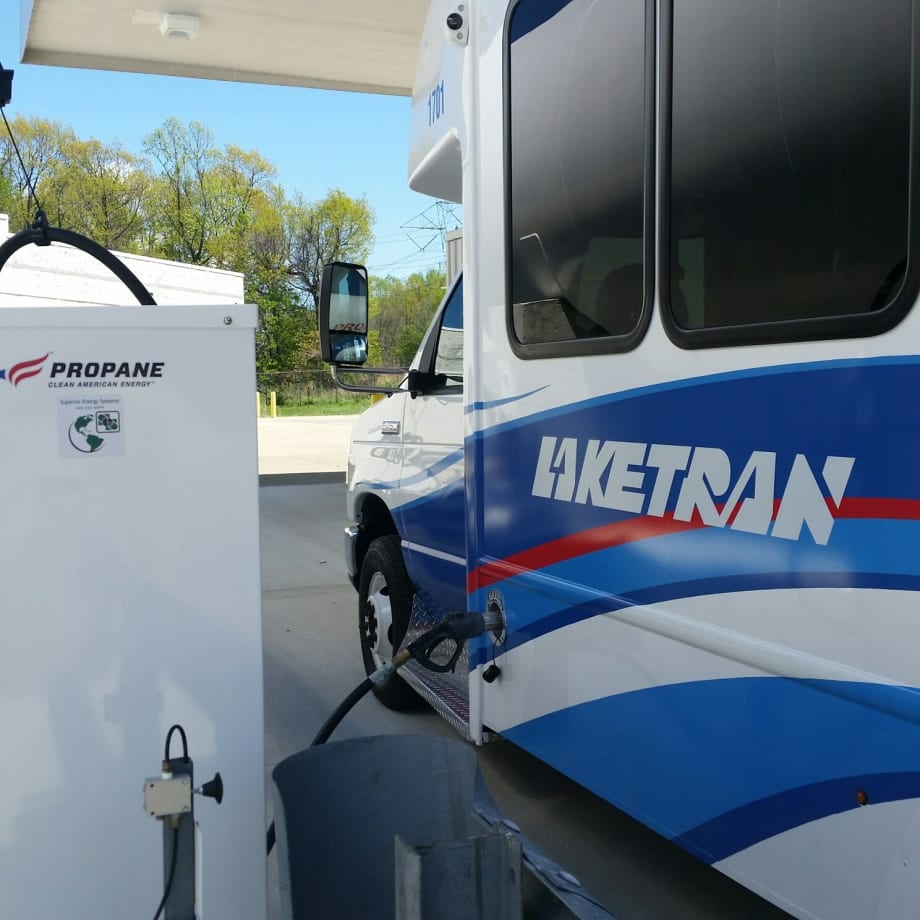
Laketran recently added new propane fueling infrastructure and new vehicles.
2 min to read
Laketran recently added new propane fueling infrastructure and new vehicles.
Officials from Lake County, Ohio’s Laketran commemorated a new 30,000 gallon propane fueling station and propane autogas-fueled public transit buses, which will be used for the agency’s Dial-a-Ride door-to-door, demand-response service.
Laketran will be saving green and going green — the $1.6 million infrastructure investment will bring long term environmental and economic benefit to both Laketran and Lake County, according to the agency’s estimates.
“Tightening standards for emissions and shrinking budgets have been driving the transportation industry toward alternative fuels now more than ever before,” explained Ben Capelle, Laketran’s deputy GM. “Laketran is always looking for more efficient ways to operate and reduce cost. Right now it costs about $64 a day per vehicle to fuel a Dial-a-Ride bus on diesel. We will reduce the cost to about $40 a day per vehicle running on propane.”
The three-phase capital project included engineering, construction of the fueling station, and installation of indoor propane detectors for safety inside Laketran’s 122,000 square foot vehicle storage and maintenance area.
Mentor-based CT Consultants led the engineering effort and the construction of the fueling station was completed by Superior Energy Systems based in Columbia Station, Ohio.
Laketran would not be able to make this transition or maintain its Dial-a-Ride fleet without the support of federal funding. A $416,000 federal investment from the FTA’s Bus and Bus Facilities grant and a $754,000 Congestion Mitigation Air Quality federal grant funds paid for 80% of the cost of the fueling station and vehicles. Laketran provided a local 20% match funded by the agency’s 0.25% local sales tax revenue.
While the agency expects to reduce air pollutants, the low cost and stability of propane fuel helps manage costs during a time when the demand of service continues to grow.
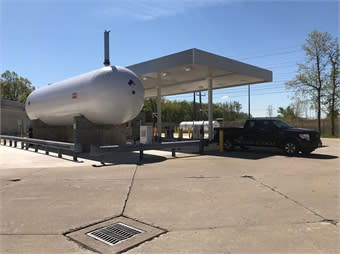
Laketran's newly opened propane autogas fueling station.
Laketran’s Dial-a-Ride ridership has increased 14% over the last three years and has no sign of slowing down. To date, the 2017 Dial-a-Ride ridership is up 3% over 2016 ridership.
The new fleet is made up of Turtle Top’s VT3 and Terra Transit buses that seat either eight or 10 passengers and can accommodate up to three wheelchairs. The entire fleet is ADA accessible and each bus is equipped with a wheelchair lift, fold-up seats to accommodate wheelchairs, slip-resistant flooring, an electronic transit door, and a central heating and cooling unit in response to customer concerns about vehicles being too hot or too cold. To assist with operations each bus as an automatic vehicle locator systems and electronic fareboxes installed along with additional safety amenities include retractable seat belts, clearance lights, and safety cameras.
More Technology

Roman Cornell on ABC Companies’ Evolution and the Future of Passenger Transportation
The company’s CEO discusses carrying forward a third-generation family legacy, ABC’s continued evolution in passenger transportation, support for increasingly complex fleets, and how technology and continued investment could help operators improve uptime.
Read More →
ETA CEO John Maglio on Transit Technology, Innovation, and Building Agency Trust
ETA founder and CEO John Maglio explores the evolution of transit technology, the importance of reliable systems, and how stronger partnerships can help agencies improve operations and the passenger experience.
Read More →
Frontrunner Bus Group Introduces XF Low-Floor Bus with Enhanced Accessibility
The new mid-sized bus features a full flat-floor design, eight-inch curbside step-in height, and zero-entry rear ramp to improve passenger access and operational flexibility.
Read More →
Building a Flexible Path to Transit Electrification with BAE's John Hroncich
John Hroncich discusses BAE Systems’ modular and scalable approach, lessons learned from decades of real-world operations, and how agencies can identify electrification strategies that fit their fleets.
Read More →
Scenes from APTA TRANSform & EXPO 2026
Transit leaders, manufacturers, and industry professionals gathered in Chicago to explore new technologies, share ideas, and discuss the future of public transportation.
Read More →
Biz Briefs: New Flyer Secures Additional 100-Bus Order from WMATA and More
In METRO's latest installment, we also take a look at recent news from Masabi, MCI, Samsara, and more partnerships making headlines across the transportation sector.
Read More →
MTA Fare Gate Pilot Reduces Fare Evasion by 35%
Following a 20-station pilot, the agency plans to install new fare gates at 20 additional subway stations as part of a $1.1 billion modernization initiative.
Read More →
California Law Extends AC Transit’s Bus Lane Camera Enforcement
The new law allows AC Transit to continue using forward-facing bus cameras to enforce parking violations in bus-only lanes and at bus stops.
Read More →
Biz Briefs: Luminator Launches AI Technology to Monitor Bus Stop Conditions and More
In METRO's latest installment, we also take a look at recent news from Masabi, Troman Industries, ioki, CCW, and more partnerships making headlines across the transportation sector.
Read More →
Public Transit Conference Returning to GFX in 2027, Call for Papers Now Open
The Call for Papers is now open, allowing transit agency professionals and industry experts to help shape the PTC educational program by submitting session ideas for consideration.
Read More →