




Read More: New York MTA Highlights Ridership Gains on LIRR, Metro-North Railroad
MTA Announces Preliminary Investigation Findings of LIRR Derailment
The investigation indicates that the train derailed after traveling eastbound over a switch intended for a straight move that was in fact misaligned for a diverging route.
August 14, 2023
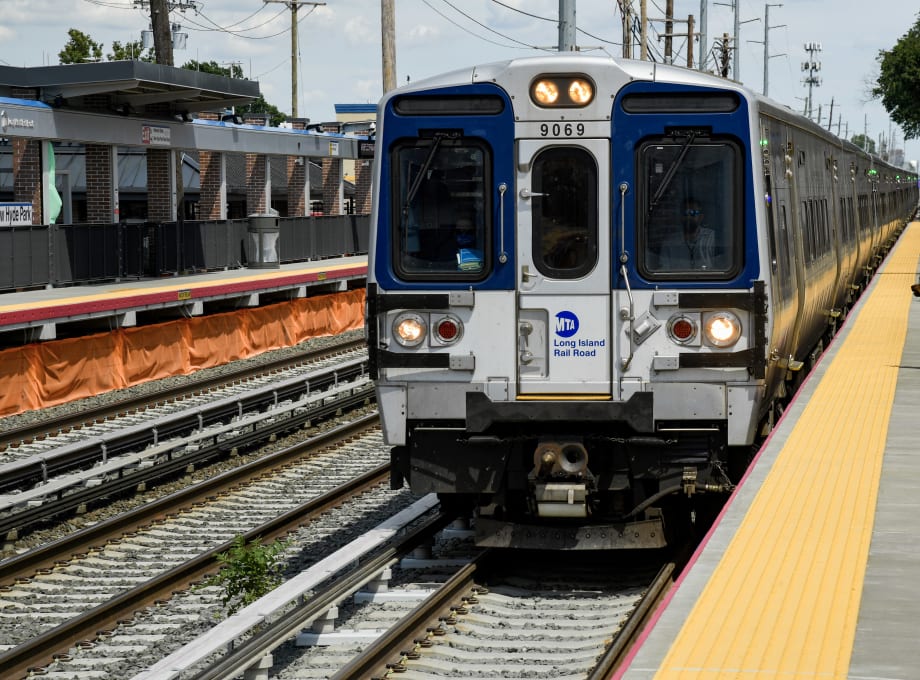
The MTA and LIRR continue to investigate the incident as does the Federal Railroad Administration.
Photo: MTA
2 min to read
The New York Metropolitan Transportation Authority (MTA) announced that Long Island Rail Road (LIRR) officials provided an update on the ongoing investigation into the Aug. 3 derailment of an eight-car passenger train east of Jamaica that resulted in 13 non-life-threatening injuries.
The investigation indicates that the train, which was carrying 55 customers as it navigated a complex set of switches known as Hall Interlocking, derailed after traveling eastbound over a switch intended for a straight move that was in fact misaligned for a diverging route.
Prior to the derailment, LIRR conducted a required monthly inspection of the switch, and it is believed that the switch did not properly realign upon completion of the inspection.
This condition was not detected prior to the derailment because of a previously unknown vulnerability in the switch’s wiring configuration, which resulted in the train dispatcher’s display showing that the route was properly aligned when it was, in fact, not.
The MTA and LIRR continue to investigate the incident as does the Federal Railroad Administration.
The first train to travel across the misaligned switch came through at 11:12 a.m. It was train number 722, which was the 10:43 a.m. departure from Grand Central Madison due to terminate at Hempstead at 11:37 a.m. Traveling 54 miles per hour with signals aligned for a straight route, the train was traveling six miles per hour slower than the maximum allowable speed.
“Safety is the bedrock principle for everything we do at LIRR, and our core value as transportation professionals,” said Catherine Rinaldi, interim president of the Long Island Rail Road. “This incident has exposed a unique and previously unknown localized vulnerability that has been rectified. This incident has prompted us to enhance our switch inspection processes to improve the safety of the railroad going forward.”
Actions Taken After Derailment
Following the derailment, the switch was rebuilt and reconfigured to correct the wiring configuration issue.
The LIRR took immediate steps to ensure the systemwide safety of the railroad by immediately conducting thorough assessments of all 1,045 switches on the property and determined that this wiring and switch configuration was unique to the specific location.
Enhanced routine inspection procedures were also developed and implemented as a result of the incident.
More Rail

New York MTA Advances Final Contract for Second Avenue Subway Expansion
Contract Four is the largest in the Second Avenue Subway Phase 2 project and includes construction of station infrastructure, tracks, and signals for the subway expansion, MTA officials said. Work on Contract Four will begin in 2027.
Read More →
San Diego MTS Breaks Monthly Trolley Ridership Record
Agency officials said July’s ridership indicates MTS’s continued recovery from the pandemic.
Read More →
Report Examines NJ TRANSIT Reliability, Funding Challenges
The Garden State Initiative analysis examines the roles of Amtrak infrastructure, fleet management, and agency operations while recommending a more performance-based approach to improving reliability.
Read More →
Stadler, CapMetro Sign Long-Term Rail Fleet Support Agreement
Beginning in 2027, Stadler will provide on-site technical expertise, spare parts support, training, and obsolescence management to help extend the reliability and longevity of CapMetro’s GTW fleet.
Read More →
Biz Briefs: Alstom Lands Canadian Contract, LYT to Supply California TSP, and More
In METRO's latest installment, we take a look at recent news from Complete Coach Works, Beep, FlixBus, and more partnerships making headlines across the transportation sector.
Read More →
CATS Gold Line Marks 5 Years of Service, 2.8M Passenger Trips
With a six-mile expansion planned, the Charlotte streetcar is positioned to connect more neighborhoods and major transit hubs across the region.
Read More →
Why Simulating Pedestrian Movement Has Become Essential for Modern Rail Stations
Pedestrian microsimulation is helping rail planners identify bottlenecks, test station designs, and prepare complex transit hubs for growing passenger volumes.
Read More →
Amtrak Begins Major Construction at New York’s Sunnyside Yard
The new maintenance facility will support Amtrak’s Airo trainsets while improving maintenance efficiency and turnaround times in New York.
Read More →
Chicago Leaders Unveil Plans for O’Hare Airport Express Train
The privately developed project would offer a 15-minute trip between downtown and O’Hare’s Terminal 2, with trains operating every 15 minutes on a dedicated track. The service would use battery-electric trains and three existing freight rail rights-of-way.
Read More →
OCTA Maps Out 30-Year Strategy to Protect Coastal Rail Corridor
The draft feasibility report identifies strategies to protect the coastal rail line for decades as the agency continues near-term stabilization and sand placement efforts.
Read More →