



N.Y. MTA reaches 2 milestones on East Side Access project
Workers have completed construction of a subterranean ventilation facility below East 55th Street in Manhattan, and $56.2 million in infrastructure improvements to Harold Interlocking, in Sunnyside, Queens, the busiest passenger train junction in the U.S. and the place where the tracks for the connection to Grand Central will meet with the LIRR.

Parsons Brinckerhoff
Parsons Brinckerhoff
The New York Metropolitan Transportation Authority (MTA) announced substantial completion of two significant contracts on East Side Access, the megaproject that will bring Long Island Rail Road (LIRR) service to Grand Central Terminal. Workers have completed construction of a subterranean ventilation facility below East 55th Street in Manhattan, and $56.2 million in infrastructure improvements to Harold Interlocking, in Sunnyside, Queens, the busiest passenger train junction in the U.S. and the place where the tracks for the connection to Grand Central will meet with the LIRR.
“The completion of these two contracts underscores the magnitude of the behind-the-scenes work that must take place for East Side Access to function,” said Dr. Michael Horodniceanu, president of MTA Capital Construction. “Most of the work has been going on outside of public view, spanning Manhattan and Queens. Even when the project is completed, the new infrastructure will remain largely out of sight. But it is nonetheless critically important for the project. You can’t have LIRR service to Grand Central without the components we’ve just finished building.”
East 55th Street Ventilation Facility
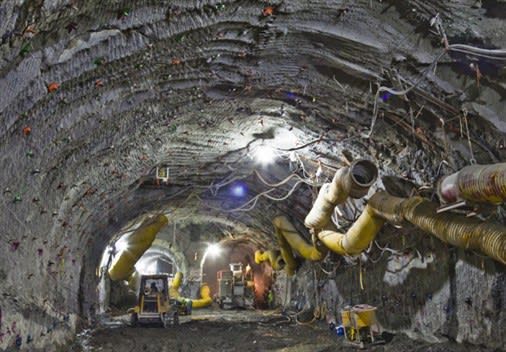
Construction of the ventilation facility began in November 2012. It was built beneath the roadway of 55th Street between Park and Madison Avenues and will provide ventilation for the tunnels under Park Avenue that will carry LIRR trains to Grand Central.
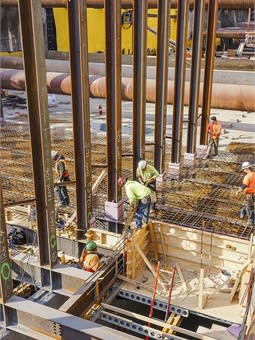
To allow the construction of the facility below the surface to take place, the street had to be closed temporarily over the course of several weekends early on in the contract so a steel deck could be installed. This steel deck allowed the contractor to excavate and work safely below ground while traffic continued to flow above.
Under the steel deck, workers safely executed 144 controlled blasts that, along with mechanical excavation, removed 10,000 cubic yards of rock and soil — or enough to fill three Olympic-sized swimming pools — to create space that provides a pathway for the air to flow to and from the tunnels below.
The facility extends 150 feet below street level, but is entirely hidden from view on the street, with the exception of an emergency hatch and ventilation grates in the sidewalk. To be easier to navigate for those wearing high-heeled shoes, the sidewalk “high-heel friendly” grates are made with slip-resistant surfaces and the openings between the cross-bars are only one-half inch wide.
Just blocks away, two components of East Side Access are already bringing benefits to the public. Fifteen months ago the megaproject opened 50th Street Commons, a comfortable vest pocket park between Park and Madison Avenues. Eleven months before that, the MTA opened a new entrance to Grand Central inside 245 Park Avenue that faces 47th Street between Park and Lexington Avenues. The entrance is now the most direct way to access Grand Central’s platforms from points east of Lexington Avenue and north of 47th Street.
Queens Infrastructure Upgrades
The work just completed in Queens began in August 2009 and was performed by Tutor Perini Corp. Through this contract, workers made a variety of infrastructure improvements within Harold Interlocking that will allow for an increase in capacity and improved train operations.
Harold Interlocking, already the busiest passenger railroad switching complex in the country, governs the movement of four railroads between Penn Station, Long Island, New England, and Sunnyside Yard, where Amtrak and NJ Transit store trains. Adding a connection to Grand Central, while creating dedicated new tracks above and below it to reduce congestion-related delays, requires the installation of nearly one hundred new switches and miles of new track.
That work is already underway, but the work being done by the just-completed Perini contract will enable it to reach its conclusion. Under this contract, workers built numerous retaining walls; 2,700 feet of new storm sewer; 3,600 feet of duct banks that house 12,000-volt AC traction power, an access road, and five utility conduits known as microtunnels that have a diameter of about five feet. They installed three electrical substations for snow melters, which keep track switches operable year-round by preventing ice and snow buildup. They relocated and adjusted utility conduits, installed an electronic device governing information distribution that is composed of microprocessors known as a remote terminal unit. They purchased three gantries that will bear overhead train signals.
East Side Access is the largest transportation infrastructure construction project in the country. When it opens for passenger service, which the MTA forecasts will take place in 2022, it will serve an expected 162,000 LIRR customers every day at a new station being built under Grand Central.
The project will double the LIRR’s capacity to bring trains into Manhattan and allow Metro-North Railroad’s New Haven Line to access Penn Station via four stations that will be built in the Bronx. It is the most transformative project for New York’s railroad network since the Pennsylvania Railroad built a total of six tunnels under the East and Hudson Rivers and inaugurated train service to Pennsylvania Station in 1910.
More Rail
Amtrak, CN Reach Agreements to Strengthen Passenger Rail Service, Safety
The agreement resolves a more than decade-long proceeding before the Surface Transportation Board concerning the terms and conditions for Amtrak services, such as the City of New Orleans, Illini/Saluki, and Wolverine.
Read More →
New York MTA Advances Final Contract for Second Avenue Subway Expansion
Contract Four is the largest in the Second Avenue Subway Phase 2 project and includes construction of station infrastructure, tracks, and signals for the subway expansion, MTA officials said. Work on Contract Four will begin in 2027.
Read More →
San Diego MTS Breaks Monthly Trolley Ridership Record
Agency officials said July’s ridership indicates MTS’s continued recovery from the pandemic.
Read More →
Report Examines NJ TRANSIT Reliability, Funding Challenges
The Garden State Initiative analysis examines the roles of Amtrak infrastructure, fleet management, and agency operations while recommending a more performance-based approach to improving reliability.
Read More →
Stadler, CapMetro Sign Long-Term Rail Fleet Support Agreement
Beginning in 2027, Stadler will provide on-site technical expertise, spare parts support, training, and obsolescence management to help extend the reliability and longevity of CapMetro’s GTW fleet.
Read More →
Biz Briefs: Alstom Lands Canadian Contract, LYT to Supply California TSP, and More
In METRO's latest installment, we take a look at recent news from Complete Coach Works, Beep, FlixBus, and more partnerships making headlines across the transportation sector.
Read More →
CATS Gold Line Marks 5 Years of Service, 2.8M Passenger Trips
With a six-mile expansion planned, the Charlotte streetcar is positioned to connect more neighborhoods and major transit hubs across the region.
Read More →
Why Simulating Pedestrian Movement Has Become Essential for Modern Rail Stations
Pedestrian microsimulation is helping rail planners identify bottlenecks, test station designs, and prepare complex transit hubs for growing passenger volumes.
Read More →
Amtrak Begins Major Construction at New York’s Sunnyside Yard
The new maintenance facility will support Amtrak’s Airo trainsets while improving maintenance efficiency and turnaround times in New York.
Read More →
Chicago Leaders Unveil Plans for O’Hare Airport Express Train
The privately developed project would offer a 15-minute trip between downtown and O’Hare’s Terminal 2, with trains operating every 15 minutes on a dedicated track. The service would use battery-electric trains and three existing freight rail rights-of-way.
Read More →