



N.Y. MTA to expedite repair of storm damaged rail line
The MTA has begun a careful and disciplined survey of every mile of the Port Jervis Line and all supporting structures, systems and equipment. A team of diverse specialists is being assembled to assess the full extent of damage and develop a work plan that addresses the need to rebuild miles of the right of way.

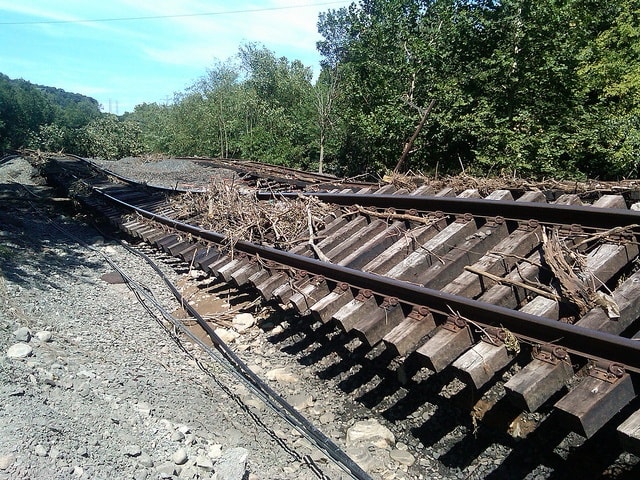
Photo courtesy MTAPhotos via Flickr.
[IMAGE]NY-MTA-Port-Jervis-rail-damage-MTAPhotos--2.jpg[/IMAGE]New York MTA Chairman/CEO Jay H. Walder invoked emergency powers to expedite the rebuilding of Metro-North Railroad’s devastated Port Jervis Line, which sustained catastrophic damage from Hurricane Irene.
Chairman Walder surveyed the damage inflicted on the line west of the Hudson River with MTA Board Members Susan Metzger and Carl Wortendyke as well as federal, state and local officials.
[IMAGE]NY-MTA-Port-Jervis-damage-MTAPhotos--2.jpg[/IMAGE]
“The damage suffered by the Port Jervis Line can only be described as catastrophic,” Walder said. “There are sections of track literally suspended in the air, and in many places we will have to build a new railroad from scratch, from the foundation to the tracks to the signals. I have directed Metro-North to take such steps as are necessary to expeditiously and fully address the catastrophic damage suffered along the Port Jervis Line as a result of Irene.
Rebuilding this infrastructure is going to be a long and difficult process, but we are taking every action in our power to continue serving our customers, to reduce unnecessary delay and to communicate every step of the way,” Walder added.
The MTA outlined the following actions necessary to continue serving customers and to begin the rebuilding process immediately:
• MTA Buses and bus operators will provide bus service on the impacted route until the infrastructure can be rebuilt and rail service can be restored. Local bus companies will also be utilized.
• Emergency powers will be used to expedite the rebuilding process:
- Existing funding will be tapped to begin work even as the MTA pursues FEMA and insurance compensation for the extensive storm damage.
- Normal procurement rules will be waived to allow Metro-North to quickly acquire the resources and assistance needed to rebuild, beginning immediately with the hiring of an engineering consultant to advise on the work.
• Special efforts will be made to communicate with the communities and customers who will be faced with long-term inconvenience, including:
- An MTA liaison will be assigned to meet with all local officials on a regular basis for the duration of the outage.
- A special website will be posted with regular updates on the progress of the rebuilding and the alternative service that will be offered, and social media will also be used to reach as many people as possible.
- The MTA will work with all local, state and federal officials to ensure proactive communication with customers on all parts of the Port Jervis Line.
[IMAGE]NY-MTA-Port-Jervis-rail-line-washout-MTAPhotos--2.jpg[/IMAGE]
The MTA has begun a careful and disciplined survey of every mile of the Port Jervis Line and all supporting structures, systems and equipment. A team of diverse specialists is being assembled to assess the full extent of damage and develop a work plan that addresses the need to rebuild miles of the right of way. This includes new foundation, tracks, switching equipment and signals, new bridges and even repair of parking areas as required. The MTA is committed to rebuilding this 100-year-old railway to 21st century standards.
More Rail
NJ TRANSIT Approves $65.6M for Hudson-Bergen Light Rail Improvements
The funding marks the first phase of a planned $250 million investment over five years to modernize stations, overhaul vehicles, and improve system reliability and passenger safety.
Read More →
STraffic Expands North American Presence with Fare Collection Technology
John Moon, Associate Director, Product Strategy at STraffic, discusses the company's growth in North America, its efforts to reduce fare evasion, and more.
Read More →
Study: Denver RTD Generates $2.1 Billion in Annual Economic Activity
An economic impact study finds the agency supports approximately 17,500 jobs, delivers $1.6 billion in annual community and mobility benefits, and generates $2.42 in economic value for every dollar invested.
Read More →
Mark Aesch Nominated to Lead Federal Transit Administration
The former Rochester transit chief and TransPro founder, who has also contributed to METRO Magazine, brings decades of industry experience and a focus on performance, accountability, and financial sustainability to the nomination.
Read More →
Transit Expands Agency Partnerships, Reaching 200 Official App Partners
COO Jake Sion discusses Transit’s growth, the success of its Transit Royale program, and how technology is helping agencies improve the rider experience.
Read More →
Trinity Metro Breaks Ground on $270M TEXRail Extension
The 2.1-mile extension will connect Fort Worth’s Medical District and Near Southside to downtown, surrounding communities, and Dallas-Fort Worth International Airport.
Read More →
Bringing Austin’s First Light Rail System to Life
Austin Transit Partnership CEO Greg Canally discusses the city's nearly 10-mile light rail project, its collaborative approach to project delivery, the importance of community engagement, and the milestones ahead as construction approaches in 2027.
Read More →
Metra Draft Plan Outlines Costs, Service Improvements for Regional Rail
The Systemwide Network Plan identifies infrastructure needs and potential investments to expand all-day, bidirectional rail service across the Chicago region.
Read More →
Amtrak Completes First Street Tunnel Upgrades, Restores Service
The nine-day construction project included replacing aging track infrastructure and modernizing switch systems near Washington Union Station.
Read More →
FRA Announces $2.3B for Passenger, Freight Rail Projects Nationwide
The CRISI Grant Program funding will support rail infrastructure improvements, safety upgrades, and projects aimed at improving freight and passenger rail service across 45 states and Washington, D.C.
Read More →