



New Flyer of America breaks ground on $25M Ala. facility revamp
The 36-acre, five-building campus will feature a new Vehicle Innovation Center dedicated to the advancement of bus and coach technology.


New Flyer of America Inc. broke ground on a $25 million building renovation and expansion project in Anniston, Ala. Photo: New Flyer

New Flyer of America Inc. broke ground on a $25 million building renovation and expansion project in Anniston, Ala. Photo: New Flyer
New Flyer of America Inc. broke ground today on a $25 million building renovation and expansion project in Anniston, Ala. The 36-acre, five-building campus will feature a new Vehicle Innovation Center (VIC), North America’s first innovation lab dedicated to the advancement of bus and coach technology. The VIC will be led in partnership with Motor Coach Industries Inc. (MCI), another U.S. subsidiary of the company, and delivers on the company’s commitment to improving U.S. jobs, infrastructure, manufacturing, and innovation.
“Repairing infrastructure through advanced technology is paramount to America’s competitiveness, safety and prosperity. Through New Flyer’s investment in advanced engineering and manufacturing, we have the potential to dramatically transform the future of public transportation in the U.S.,” said Wayne Joseph, President of New Flyer of America. “We are proud to power sustainable new technologies, collaborations for smart cities and opportunities to connect people to places.”
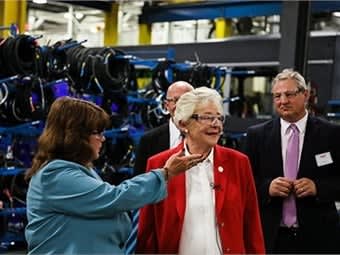
Alabama Gov. Kay Ivey was in attendance to commemorate the groundbreaking. Photo: New Flyer
Alabama Gov. Kay Ivey was in attendance to commemorate the groundbreaking, as part of her Listen, Learn, Help, and Lead Tour to assess community needs through roundtable discussions with local government and business leaders. New Flyer’s investment in the expansion was supported by the City of Anniston, State of Alabama, and Alabama Power (Southern Company).
Establishment of the VIC also includes development of an advisory group comprised of industry leaders. The VIC will formally open in October 2017, with the expansion expected to be completed by June 2018. Through ongoing delivery of interactive experiences and collaboration with industry leaders, the VIC will feature a world-class manufacturing lab, exhibit space, and training areas to:
Explore and advance bus and coach technology through sustainable research and development, fresh innovation, progressive manufacturing, and bold thinking;
Foster dialogue through discussion, education, and training on the latest zero-emission and autonomous driving vehicle technologies;
Engage learning through current and interactive exhibits, simulation and hands-on experiences, and observations;
Generate energy and commitment to clean air quality, safety, and economic benefits for people, communities, and business; and
Harness the positive influence of collaboration, environmental stewardship, and social change to advance mobility solutions.

The 36-acre, five-building campus will feature a new Vehicle Innovation Center (rendering shown) dedicated to the advancement of bus and coach technology. Image: New Flyer
“We are proud to join forces with New Flyer of America in bringing the Vehicle Innovation Center to life,” said Ian Smart, president of Motor Coach Industries. “By leveraging our strengths, we will amplify our industry-leading development of bus and coach technologies, and we look forward to driving American innovation forward with sustainable electric and autonomous solutions.”
Development of the VIC is supported by New Flyer and MCI partners, each contributing interactive learning experiences that highlight New Flyer’s electric and autonomous vehicle technologies. Partners confirmed to date include: Siemens, ABB, A123 Systems, XALT Energy, Parker / Vansco, Valeo (Spheros), Vapor Bus International (WABTEC), Powerex Inc., Ballard Power Systems, Hydrogenics, ChargePoint, Thermo King, EMP, Center for Transportation and the Environment, CALSTART, and Alabama Power. Elements of the VIC will be on display October 9-11 at the tri-annual APTA Expo in Atlanta.

The 2017-2018 expansion will add approximately 76,000 square feet, increasing New Flyer's Anniston, Ala. campus space to nearly 380,000 square feet (rendering shown). Image: New Flyer
The Anniston, Ala. campus, acquired by New Flyer of America in 2013, manufactures complete transit buses from high-strength frames to final assembly. In 2015, New Flyer invested $20 million to transform the campus into a world-class LEAN manufacturing facility capable of producing New Flyer’s Xcelsior® heavy-duty bus platform. The 2017-2018 expansion will add approximately 76,000 square feet, increasing the Anniston campus space to nearly 380,000 square feet.
The company has over 50 years of experience in manufacturing zero-emission buses (ZEBs); has 24 fabrication, manufacturing, distribution, and service centers across Canada and the U.S.
More Bus

New York MTA Plans Largest Bus Fleet Upgrade in More Than a Decade
The agency is seeking manufacturers for 650 new CNG buses to replace aging vehicles, improve reliability, and advance its broader fleet modernization strategy.
Read More →
Building a Flexible Path to Transit Electrification
John Hroncich discusses BAE Systems’ modular and scalable approach, lessons learned from decades of real-world operations, and how agencies can identify electrification strategies that fit their fleets.
Read More →
Bus Tech Talk: Keeping Transit Technicians Ahead of the Technology Curve
LA Metro’s Obed Mejia discusses technician training, evolving maintenance technology, fleet replacement, and strategies for getting the most out of today’s transit fleets.
Read More →
Biz Briefs: RIPTA Unveils New Frontrunners, Clevland RTA Adds New Siemens, and More
In METRO's latest installment, we take a look at recent news from Siemens, Prevost, Dodge, and more partnerships making headlines across the transportation sector.
Read More →
People Movement: Holly Arnold Joins Transdev and More
In this edition, we also cover recent appointments and announcements at Pace, CamTran, MCI, and more, showcasing the individuals helping to shape the future of transportation.
Read More →
The High Cost of Transit Buses: Industry Leaders Look to Procurement Reform
Transit leaders and policymakers examine how standardized bus designs, streamlined procurement, and predictable funding could help agencies stretch budgets and deliver better service.
Read More →
The Business Voice Behind Public Transportation
As chair of APTA’s Business Members Board of Governors, Ray Melleady explains how more than 850 business members are partnering with transit agencies to advance funding, innovation, and industry-wide collaboration.
Read More →
From Surviving to Thriving: Building Stronger Transportation Organizations
Bus Business Consultants founder Brian Dickson shares lessons on leadership, organizational health, and creating options for long-term success in a changing transportation industry.
Read More →
Finding the ‘Happy Medium’: Optimizing Maintenance Without Sacrificing Reliability
The key to maintenance optimization isn’t doing less work—it’s doing the right work at the right time on the right assets.
Read More →
LA Metro, City of West Hollywood, and Partners Advance Smarter Bus Lane Enforcement
The award-winning partnership combines AI-powered detection with human oversight to improve bus reliability, accessibility, and enforcement efficiency.
Read More →