



Report offers framework for transportation integration into smart cities
Cities working together can accelerate the iterative process through knowledge sharing, development of best practices.


A smart city is an ecosystem of innovations and stakeholders working together at different city scales, from neighborhoods to regions to enhance quality of life.
MTI
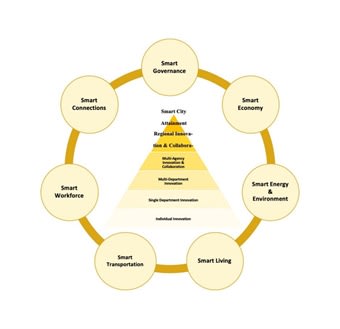
A smart city is an ecosystem of innovations and stakeholders working together at different city scales, from neighborhoods to regions to enhance quality of life.
MTI
How does a city achieve smart status? In “A Framework for Integrating Transportation into Smart Cities,” Mineta Transportation Institute (MTI) researchers examined existing smart cities to develop a framework that identifies strategies to transform transportation in cities.
A smart city is an ecosystem of innovations and stakeholders working together at different city scales, from neighborhoods to regions to enhance quality of life. Key areas of focus include: energy and environment, transportation, governance, workforce, living (or housing), economy, and connections. Smart cities can be described as a “pyramid of innovation,” which starts with the individual innovator and becomes progressively more advanced, culminating in increased regional innovation and multi-stakeholder collaboration.
“Fundamentally, smart cities are about progressively advancing innovation and collaboration” says report co-author and MTI Research Associate Dr. Susan Shaheen.
The three-phase smart city framework identified includes:
1. Issuing an initial assessment based on expert interviews and city demographics, design-thinking workshops, and problem statement development to better understand community concerns;
2. Implementing a refinement and prioritization process, while making use of communities of practice to collaboratively to advance institutional capabilities;
3. Executing pilot implementation(s) and evaluation(s).
Communities are developing smart city pilots and programs to overcome environmental, transportation, institutional, and other challenges. These communities tend to fall into four categories of smart cities:
Technology-oriented communities and regions driven by technological innovation, often trying to address related challenges, such as housing affordability and cost of living issues;
Economic revival cities and regions reinventing their economies for post-industrial economic development;
Growth cities and regions that are expanding economically and spatially, typically with fewer challenges associated with housing affordability and cost of living; and
Small and rural communities investing in place making and workforce development to retain talent.
While these innovations and interconnectedness of systems appear to be propelling cities into the future, there are concerns about how equitable these technology-based changes are. The report’s policy recommendations emphasize the need to ensure smart cities are accessible to everyone through proactive legislation and regulations.
“Our research demonstrates that if cities work together, on both regional and cross-jurisdictional challenges, they can accelerate the iterative process through knowledge sharing, establishing communities of practice, and the development of best practices,” says study co-author and Executive Director of the Smart Cities Lab, Mark Dowd.
More Technology

From Hardware to Digital Partner: Luminator Charts Its Next Chapter
CEO Magnus Friberg discusses Luminator’s shift toward becoming a digital partner, the growing importance of software and interoperability, and how AI can help agencies improve operations and passenger experience.
Read More →
Beyond the Checklist: A Structured Approach to Transit Maintenance
Reliability-Centered Maintenance helps transit agencies move beyond routine checklists to focus limited resources on the assets and failures that have the greatest impact on safety, reliability, and service.
Read More →
NJ TRANSIT Advances Bus Technology Upgrades Across Statewide Fleet
More than 1,500 buses now feature upgraded technology designed to improve arrival predictions and provide free Wi-Fi, with deployment expected to reach nearly 2,000 buses by the end of 2026.
Read More →

Building a Flexible Path to Transit Electrification
John Hroncich discusses BAE Systems’ modular and scalable approach, lessons learned from decades of real-world operations, and how agencies can identify electrification strategies that fit their fleets.
Read More →
Biz Briefs: Alstom Lands Canadian Contract, LYT to Supply California TSP, and More
In METRO's latest installment, we take a look at recent news from Complete Coach Works, Beep, FlixBus, and more partnerships making headlines across the transportation sector.
Read More →
From Legacy Silos to Conversational Intelligence
What if transit leaders could ask any operational question and get a trusted answer in seconds? Conversational AI is transforming how agencies use their data.
Read More →
USDOT Announces Rail Vehicle Replacement Grants, Chattanooga AV Shuttle Funding
More than $191 million in federal funding will help three transit agencies replace aging rail vehicles and support a new autonomous shuttle service in Chattanooga.
Read More →
Bus Tech Talk: Keeping Transit Technicians Ahead of the Technology Curve
LA Metro’s Obed Mejia discusses technician training, evolving maintenance technology, fleet replacement, and strategies for getting the most out of today’s transit fleets.
Read More →
Biz Briefs: RIPTA Unveils New Frontrunners, Clevland RTA Adds New Siemens, and More
In METRO's latest installment, we take a look at recent news from Siemens, Prevost, Dodge, and more partnerships making headlines across the transportation sector.
Read More →
Why Simulating Pedestrian Movement Has Become Essential for Modern Rail Stations
Pedestrian microsimulation is helping rail planners identify bottlenecks, test station designs, and prepare complex transit hubs for growing passenger volumes.
Read More →