



Republicans call to reject $5.5B Calif.-to-Vegas HSR loan
House Budget Committee Chairman Paul Ryan and Sen. Jeff Sessions, the top Republican on the Senate Budget Committee, claimed that the project is “costly, wasteful and risky.” ExpressWest’s founder/CEO and the National Association of Railroad Passengers both spoke out to defend the project.

LOS ANGELES — Officials told the AP that top Republicans in Congress want the Obama administration to reject a $5.5 billion loan being sought by XpressWest, a private Nevada company, to build a high-speed train from California to Las Vegas.
House Budget Committee Chairman Paul Ryan and Sen. Jeff Sessions, the top Republican on the Senate Budget Committee, claimed in a letter to Transportation Secretary Ray LaHood that the project is “costly, wasteful and risky.” ExpressWest’s founder/CEO responded to them in a letter defending the project. For the full story, click here.
Meanwhile, the National Association of Railroad Passengers released a statement opposing the congressmen's claims:
"The National Association of Railroad Passengers (NARP) denounced a partisan political attack on a high-speed rail project that would connect southern California and Las Vegas with fast, safe, and convenient train service. The project would create new jobs and ease congestion on one of the nation’s premier travel corridors.
Representative Paul Ryan (R-WI) and Senator Jeff Sessions (R-AL) wrote to U.S. Transportation Secretary Ray LaHood attacking the XpressWest high-speed rail project and asking him to reject a $5.5 billion Railroad Rehabilitation and Improvement Financing (RRIF) loan application. RRIF is an underutilized federal program of loans to incentivize private-sector infrastructure investments. The Congressmen urge U.S. DOT to reject the loan. They relied heavily on an analysis done by the anti-rail Reason Foundation, which has pushed the unsubstantiated claim that international high-speed projects have been “plagued by optimistic ridership and revenue forecasts.”
XpressWest initially would connect with Metrolink trains at Palmdale. Ultimately, the trains would offer a single-seat ride between Los Angeles to Las Vegas. A link with northern California would be provided by a connection at Palmdale with California’s planned Los Angeles-San Francisco high-speed rail line. The initial 185-mile segment would be an alternative to the heavily traveled Interstate-15. The train would reach top speeds of 150 mph, turning a four-hour drive into an 80 minute train trip. The line's construction would create over 80,000 direct and indirect construction-related jobs, 2,100 permanent jobs, and produce a $7.8 billion increase in economic activity. The train also would divert over two million annual automobile trips from I-15, saving an estimated 440,000 barrels of oil each year. Later phases could link Las Vegas with Phoenix, Salt Lake City and Denver, connecting 25 million people.
The letter is part of a total attack on intercity passenger rail. The Ryan budget released yesterday states that such projects "should be pursued only if they can be established as self-supporting commercial services.” This criterion has not been applied to highway projects. Highlighting public policies that hugely favor highways, a total of $53.3 billion in general funds have been transferred to the Highway Trust Fund since President George W. Bush signed into law the first transfer in 2008.
“When Congressmen from Wisconsin and Texas step in to prevent a Nevada-based business from developing service between two robust travel markets — markets currently choked with road and air congestion — it goes a long way towards explaining why the U.S. transportation network is in its current state,” said NARP President Ross Capon. “If Congress is going to base their transportation decisions on reports issued by the Reason Foundation, the U.S. will not see a new rail or transit project, ever, and existing services will be threatened.”
One troubling aspect of the Ryan-Sessions letter is that it lets Washington partisanship override local support for the project, which has been endorsed or supported by the Southern California Association of Governments; Los Angeles and San Bernardino counties; the cities of Victorville, Palmdale, Lancaster, Adelanto and Town of Apple Valley (acting through the High Desert Corridor Joint Powers Authority); and the California High Speed Rail Authority and the Los Angeles County Metropolitan Transportation Authority.
XpressWest has responded to the Ryan-Sessions letter, reiterating the project’s potential to create jobs, improve safety, and reduce air pollution and oil consumption."
More Rail
DART Customer Satisfaction Reaches Six-Year High
Overall satisfaction rose to 74.9%, while the agency’s Net Promoter Score reached a record 33.7.
Read More →
How DART's GoPass Is Redefining Regional Mobility
Serving 14 transit agencies, GoPass simplifies multimodal travel by allowing riders to plan, pay for, and manage an entire trip through one app.
Read More →
Amtrak Board Advances Plan to Restructure Organization, Seeks Public Input
The proposal, developed by Amtrak management and approved by the board for further consideration, is intended to modernize the organization's structure while improving accountability, operational efficiency, and customer service.
Read More →
Biz Briefs: STV teams with Amtrak, Motorcoach Operators Boost Fleet and Land Contracts, and More
From manufacturers and suppliers to transit agencies and motorcoach operators, these updates offer a snapshot of the projects, partnerships and business moves driving the industry forward.
Read More →
Metra Celebrates 100 Years of Electric Rail, Looks to the Future
The event was also a celebration of recent reforms to public transportation in the Chicago area, changes that could be as transformative in the future as the major civic achievement a century ago, said officials.
Read More →
LA Metro Marks Banner Year, Sets Ambitious Goals for New Fiscal Year
Incoming LA Metro Board Chair and Los Angeles Mayor Karen Bass joined outgoing Board Chair Fernando Dutra and LA Metro CEO Stephanie Wiggins to review accomplishments from fiscal year 2026, which included the opening of new rail extensions, advancement of major transit projects, expanded safety programs, and new rider amenities.
Read More →
DART Taps Nathaniel P. Ford Sr. as Next President/CEO
Since 2012, Ford has served as the CEO of the Jacksonville Transportation Authority
Read More →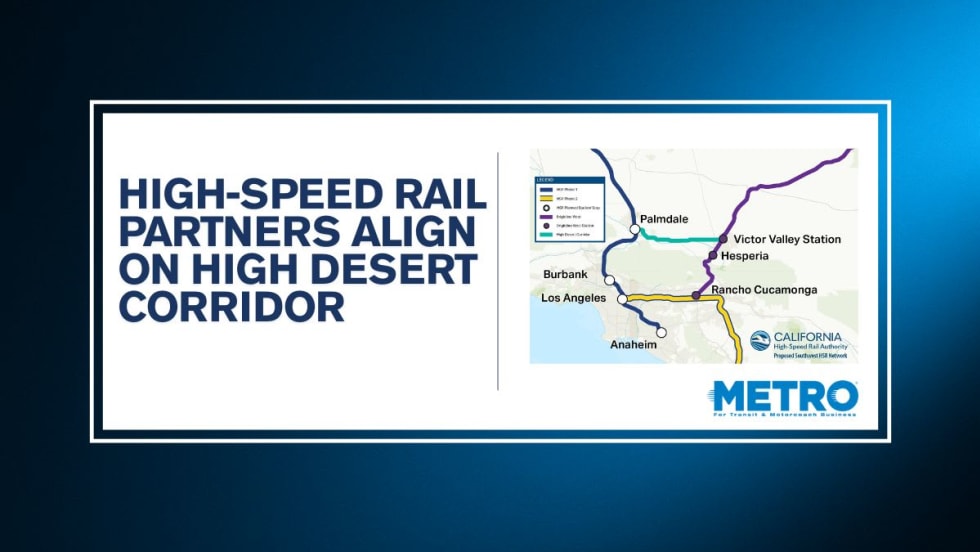
California High-Speed Rail Authority Signs MOU to Advance High Desert Corridor
The agreement deepens collaboration between the California High-Speed Rail Authority and the High Desert Corridor Joint Powers Agency, supporting design integration, cost savings, and faster delivery of a key Southern California rail link.
Read More →
Building the Next Generation of Transit Technology
In this edition of METROspectives, Luminator CEO Magnus Friberg discusses the company's transformation, the growing role of AI and software, and what's next for transit technology.
Read More →
How Data, Strategy, and Community Engagement Are Reshaping Transit
In this edition of METROspectives, strada360 CEO Steve Lassey discusses how transit agencies can better align planning with operations, leverage data to improve decision-making, and build public trust as they prepare for the future of mobility.
Read More →