



Seattle's King County Metro Restarting Fare Enforcement
Metro first will focus fare inspections on RapidRide routes, other high-ridership bus routes. and the Seattle Streetcar.

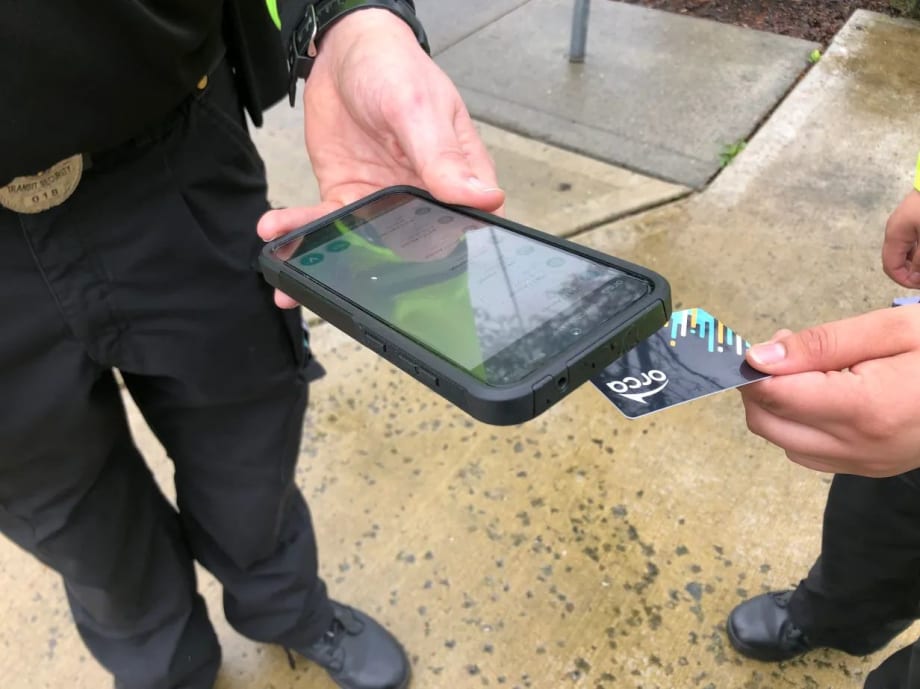
Metro’s Safety, Security, and Fare Enforcement Reform Initiative collaborated with thousands of riders, community members and Metro employees to make our transit system more equitable, secure, and welcoming.
Photo: King County Metro
Starting March 31, Seattle’s King County Metro Fare Enforcement Officers will ask riders for proof of fare payment on buses and streetcars, with “friendly, verbal reminders” set to be given to riders who did not pay.
Metro first will focus fare inspections on RapidRide routes, other high-ridership bus routes. and the Seattle Streetcar.
“Metro relies on fares to provide safe, clean and reliable transit service; however, we estimate that one-third or more of our riders are not paying their fare,” said Metro’s Chief Safety Officer Rebecca Frankhauser. “By restarting fare enforcement, we’re confident that many of our riders will return to their habits of tapping their ORCA cards or paying at the farebox.”
Metro’s Fare Enforcement Plan
Metro will deploy 30 Fare Enforcement Officers across the system from among the ranks of 175 Transit Security Officers.
The agency paused fare enforcement in 2020 to reassess and reimagine safety, security, and fare enforcement to make the transit system more equitable and welcoming.
Today, the agency often provides more than 300,000 rides each weekday and in 2024 bus ridership was about 90 million systemwide. Metro fares accounted for an estimated $73 million in revenue in 2024.
Metro’s adult fare is currently $2.75. Beginning March 31, Fare Enforcement Officers will accept proof of payment in the form of:
A recently tapped ORCA fare card.
An activated Transit GO Ticket on their phone.
A tapped ORCA card in Google Wallet.
A transfer slip issued to someone who paid cash at the farebox.
Metro explained that paying with an ORCA card provides information about ridership, which helps the agency serve them better.
Warnings, Fines, and More
Fare inspection will fully resume starting on May 31. At that time, in place of verbal reminders, riders who do not have valid proof of payment will receive a written warning.
Riders can receive two of these written warnings without consequence. However, third and subsequent citations may result in a fine or an alternative resolution. Alternative resolutions help ensure fairness. For example, if someone cannot afford to pay a fare, they cannot afford to pay a fine.
For third and subsequent violations, the rider may choose from the following:
Pay a fine of $40 within 90 days, reduced to $20 within 30 days.
Load $20 onto an ORCA card or—if eligible—$10 onto a reduced fare program card.
Enroll in a reduced fare program if eligible.
Perform two hours of community service.
Appeal to the Fare Adjudication Program Manager or request a customized resolution.
Redesigned Fare Inspection
Metro’s Safety, Security, and Fare Enforcement (SaFE) Reform Initiative collaborated with thousands of riders, community members and Metro employees to make our transit system more equitable, secure, and welcoming.
Metro’s SaFE Equity Workgroup led the redesign of fare inspection.
While Metro has always been committed to an equitable approach to fare inspection, the SaFE Equity Workgroup guided additional changes.
Some of the improvements include more affordable fines, more forgiving policies regarding late payments, and lower minimum amounts to load on ORCA or ORCA LIFT cards for riders pursuing one of the alternative resolution options.
The workgroup also made important recommendations on communications strategy, community outreach, messaging, tone, and visuals.
This guided Metro’s relaunch of fare enforcement, as well as multilingual communications and outreach earlier this year to raise awareness of this change and to let riders know they may be eligible for a reduced fare.
More Security and Safety

Transit Agencies Highlight Safety Gains at National Summit
Leaders from 15 major transit systems shared crime-reduction results and safety initiatives while discussing the role of continued federal support.
Read More →
DART Launches Major Security, Fare Enforcement Initiative
The 90-day demonstration will deploy coordinated security teams at five light rail stations while testing controlled access and gathering data to guide future investments.
Read More →
RTD Launches NextRide App to Consolidate Trip Planning, Fares, Security Reporting
The app expands on RTD’s existing NextRide web application and allows customers to view real-time vehicle locations and service alerts, purchase and store digital fares, and access customer support.
Read More →
TAPTCO Updates OSHA Compliance Training for Transit Maintenance Operations
The revamped program addresses 26 OSHA standards for maintenance facilities, with TAPTCO pointing to training, documentation, and everyday shop hazards as continuing challenges for transit operations.
Read More →
FRA Announces $5.3B in Rail Investments, Including $2B for Amtrak
Funding will support grade-crossing improvements, infrastructure upgrades, and new Amtrak equipment in 23 states.
Read More →
Chicago, Maryland Expand Non-Law-Enforcement Safety, Rider Support
The CTA and MTA are launching new programs aimed at de-escalation, crisis response, rider assistance, and greater transparency.
Read More →
LA Metro, City of West Hollywood, and Partners Advance Smarter Bus Lane Enforcement
The award-winning partnership combines AI-powered detection with human oversight to improve bus reliability, accessibility, and enforcement efficiency.
Read More →
LA Metro Reports 57% Decline in Homelessness on Transit System Since 2024
The agency's latest homelessness count offers new data on how care-based services and cross-sector partnerships can complement traditional transit security strategies.
Read More →
FTA Launches 'Transit Moves America' Dashboard to Highlight Agency Safety and Performance
The online dashboard transforms National Transit Database information into a public-facing resource that allows users to compare transit agencies on key operational and safety metrics.
Read More →
LA Metro Marks Banner Year, Sets Ambitious Goals for New Fiscal Year
Incoming LA Metro Board Chair and Los Angeles Mayor Karen Bass joined outgoing Board Chair Fernando Dutra and LA Metro CEO Stephanie Wiggins to review accomplishments from fiscal year 2026, which included the opening of new rail extensions, advancement of major transit projects, expanded safety programs, and new rider amenities.
Read More →