



SNCF taps Alstom-Bombardier consortium for next-generation trains
Will design and supply the new generation of two-tier equipment for lines D and E of the Île-de-France network, which is operated by SNCF Transilien. The first firm part of the order comprises the delivery of 71 trains.

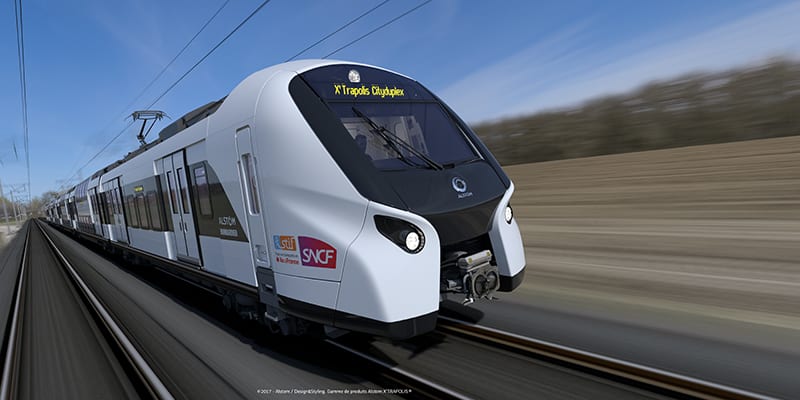
Alstom Styling & Design
Alstom Styling & Design
France’s SNCF selected the Alstom-Bombardier consortium to renew the trains on lines D and E of the Île-de-France network. The contract for 255 trains, worth an estimated $3.9 billion, is the largest contract ever financed by STIF.
Alstom, in partnership with Bombardier, will design and supply the new generation of two-tier equipment for lines D and E of the Île-de-France network, which is operated by SNCF Transilien. The first firm part of the order comprises the delivery of 71 trains, 100% funded by STIF (this amount includes all design studies, industrialization, project management, and homologation for a value of approximately $470 million. The first 71 trains will be delivered and enter circulation from 2021 onwards.
This "boa" train is entirely open (without separations between the cars) and was specifically designed for the dense zones of traffic in Île-de-France. Thanks to its large doors, the train provides extremely fluid passenger exits and entrances as well as offering three distinct travel spaces. Passengers can thus choose their space according to their journey time: platform zones for travelling standing-up when the journey is very short, making it easy to move around, like in the metro; mixed-use zones (standing or sitting) located lower down for journeys under 20 minutes, and higher up, areas offering regional-style comfort with more seating for longer trips. In each of the end cars, platforms provide wheelchair users with direct and quick access to dedicated spaces. Air conditioning, lighting, and seating have all been designed to provide a high level of comfort.
Based on Alstom's urban and suburban equipment solutions and enhanced by feedback from its customers, the train, baptized X'Trapolis Cityduplex, will guarantee the highest levels of availability, reliability, and safety. Each train can transport up to 1,860 passengers. Numerous innovations will reduce energy consumption by 25% compared to previous generations of equipment. The train notably contains eight motor bogies to provide superior performance compared to previous generations in terms of acceleration and deceleration with regenerative braking, an undeniable asset for exploitation.
To carry out this major project successfully, a total of around 2,000 people will work on the project under the Alstom-Bombardier consortium, including 550 experienced engineers, securing more than 8,000 jobs in the French rail sector.
More Rail

New York MTA Advances Final Contract for Second Avenue Subway Expansion
Contract Four is the largest in the Second Avenue Subway Phase 2 project and includes construction of station infrastructure, tracks, and signals for the subway expansion, MTA officials said. Work on Contract Four will begin in 2027.
Read More →
San Diego MTS Breaks Monthly Trolley Ridership Record
Agency officials said July’s ridership indicates MTS’s continued recovery from the pandemic.
Read More →
Report Examines NJ TRANSIT Reliability, Funding Challenges
The Garden State Initiative analysis examines the roles of Amtrak infrastructure, fleet management, and agency operations while recommending a more performance-based approach to improving reliability.
Read More →
Stadler, CapMetro Sign Long-Term Rail Fleet Support Agreement
Beginning in 2027, Stadler will provide on-site technical expertise, spare parts support, training, and obsolescence management to help extend the reliability and longevity of CapMetro’s GTW fleet.
Read More →
Biz Briefs: Alstom Lands Canadian Contract, LYT to Supply California TSP, and More
In METRO's latest installment, we take a look at recent news from Complete Coach Works, Beep, FlixBus, and more partnerships making headlines across the transportation sector.
Read More →
CATS Gold Line Marks 5 Years of Service, 2.8M Passenger Trips
With a six-mile expansion planned, the Charlotte streetcar is positioned to connect more neighborhoods and major transit hubs across the region.
Read More →
Why Simulating Pedestrian Movement Has Become Essential for Modern Rail Stations
Pedestrian microsimulation is helping rail planners identify bottlenecks, test station designs, and prepare complex transit hubs for growing passenger volumes.
Read More →
Amtrak Begins Major Construction at New York’s Sunnyside Yard
The new maintenance facility will support Amtrak’s Airo trainsets while improving maintenance efficiency and turnaround times in New York.
Read More →
Chicago Leaders Unveil Plans for O’Hare Airport Express Train
The privately developed project would offer a 15-minute trip between downtown and O’Hare’s Terminal 2, with trains operating every 15 minutes on a dedicated track. The service would use battery-electric trains and three existing freight rail rights-of-way.
Read More →
OCTA Maps Out 30-Year Strategy to Protect Coastal Rail Corridor
The draft feasibility report identifies strategies to protect the coastal rail line for decades as the agency continues near-term stabilization and sand placement efforts.
Read More →