



South Carolina Approves $24.5M VW Funds for School, Transit Buses
The state’s second round of Volkswagen settlement funding will be used to purchase 235 new propane school buses and three electric transit buses.

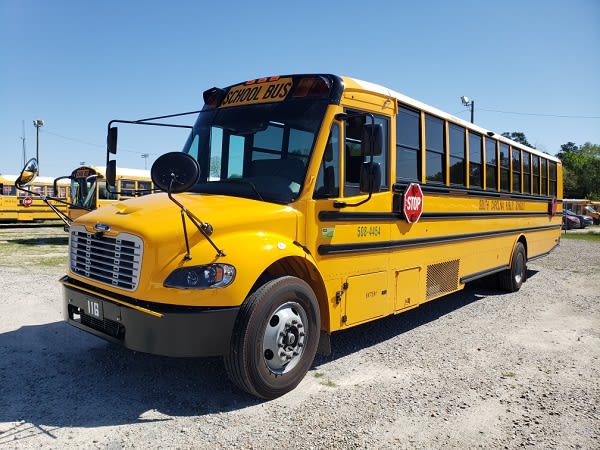
South Carolina will use $24.54 million of its Volkswagen settlement funds to purchase 235 new propane school buses and three electric transit buses. Shown here is one of the state’s Thomas Built Buses Saf-T-Liner C2 propane school buses.
Photo courtesy South Carolina Department of Education
South Carolina has announced that it will allocate a total of $24.54 million in the state's second round of Volkswagen (VW) settlement funding for new school and transit buses.
Gov. Henry McMaster, along with South Carolina Superintendent of Education Molly Spearman and South Carolina Department of Insurance (SCDOI) Director Ray Farmer, made the announcement on Tuesday to distribute VW funds for 235 new, propane-fueled school buses for 11 school districts and three electric transit buses to be used in Charleston and Florence, according to a news release from McMaster’s office.
Representatives from the Berkeley-Charleston-Dorchester Council of Governments and the Pee Dee Regional Transportation Authority (PDRTA), which will receive funding for the electric transit buses, were reportedly also in attendance.
“[This] marks an important day for our state,” McMaster said. “Director Farmer and his team accepted an immense challenge in determining how these funds should be invested to benefit as many South Carolinians as possible, and they have exceeded expectations. Because of [this] announcement, those in our state who rely on public transit and the children who rely on our school buses will be safer.”
“This announcement shows South Carolina is fully committed to providing the safest, most efficient, and environmentally friendly school buses in the nation,” Spearman added. “Not only will these new propane buses help ensure over 300,000 bus riders get to and from school safely and on time, it will save taxpayers millions of dollars while drastically reducing emissions.”
As School Bus Fleetpreviously reported, McMaster appointed the SCDOI as the lead agency for administering the state’s $34 million share of VW funds in 2017. Two years later, in 2019, McMaster announced that $9.33 million would be invested to purchase 78 new propane school buses and three transit buses under the state’s first round of VW funds.
For the state’s second round of funding, the SCDOI partially funded three of 11 total applications, according to McMaster’s office. The award recipients include:
1. South Carolina Department of Education (SCDOE)
$23,635,830 for 235 new propane school buses.
The SCDOE has committed $87,400 to building two new propane fueling stations to expand the state’s propane school bus fleet.
School districts expected to receive propane school buses include Aiken County Public School District, Beaufort County School District, Berkeley County School District, Charleston County School District, Dorchester School District Two, Greenville County Schools, Horry County Schools, Lexington County School District One, Richland County School District One, Richland School District Two, and York County School District Four.
2. Berkeley-Charleston-Dorchester Council of Governments
$608,000 for one electric transit bus for Charleston Area Regional Transportation Authority (CARTA).
The council has committed 20% of the funds as a local match.
The council will purchase an electric bus manufactured by Proterra in South Carolina.
The council will leverage existing charging infrastructure for charging the bus.
3. Pee Dee Regional Transportation Authority
$295,500 for two electric transit buses and charging infrastructure.
PDRTA will apply for federal funds to cover 85% of the costs of the buses and charging infrastructure.
These will be the first electric transit buses for the PDRTA.
Learn more about South Carolina’s VW funds.
Watch McMaster's press conference announcing the state's second round of VW funding below.
Originally posted on School Bus Fleet
More Bus
Biz Briefs: New Flyer Delivers in Columbus, Houston, Beep and Freebee Merge, and More
In this edition of Biz Briefs, we spotlight the latest developments shaping the future of mobility.
Read More →
People Movement: Dan Dipert Coaches Adds Third-Generation Leader, Keolis Names New Valley Metro VP/GM, and More
In this edition, we also cover recent appointments and announcements at the Wabtec, SilverRide, HNTB, and more, showcasing the individuals helping to shape the future of transportation.
Read More →
New York MTA Plans Largest Bus Fleet Upgrade in More Than a Decade
The agency is seeking manufacturers for 650 new CNG buses to replace aging vehicles, improve reliability, and advance its broader fleet modernization strategy.
Read More →
Building a Flexible Path to Transit Electrification
John Hroncich discusses BAE Systems’ modular and scalable approach, lessons learned from decades of real-world operations, and how agencies can identify electrification strategies that fit their fleets.
Read More →
Bus Tech Talk: Keeping Transit Technicians Ahead of the Technology Curve
LA Metro’s Obed Mejia discusses technician training, evolving maintenance technology, fleet replacement, and strategies for getting the most out of today’s transit fleets.
Read More →
Biz Briefs: RIPTA Unveils New Frontrunners, Clevland RTA Adds New Siemens, and More
In METRO's latest installment, we take a look at recent news from Siemens, Prevost, Dodge, and more partnerships making headlines across the transportation sector.
Read More →
People Movement: Holly Arnold Joins Transdev and More
In this edition, we also cover recent appointments and announcements at Pace, CamTran, MCI, and more, showcasing the individuals helping to shape the future of transportation.
Read More →
The High Cost of Transit Buses: Industry Leaders Look to Procurement Reform
Transit leaders and policymakers examine how standardized bus designs, streamlined procurement, and predictable funding could help agencies stretch budgets and deliver better service.
Read More →
The Business Voice Behind Public Transportation
As chair of APTA’s Business Members Board of Governors, Ray Melleady explains how more than 850 business members are partnering with transit agencies to advance funding, innovation, and industry-wide collaboration.
Read More →
From Surviving to Thriving: Building Stronger Transportation Organizations
Bus Business Consultants founder Brian Dickson shares lessons on leadership, organizational health, and creating options for long-term success in a changing transportation industry.
Read More →