



Tolar Manufacturing introducing SmartPlace solution
With over 25 years in business, Tolar arguably has the largest portfolio of transit shelters and related street furniture in North America.

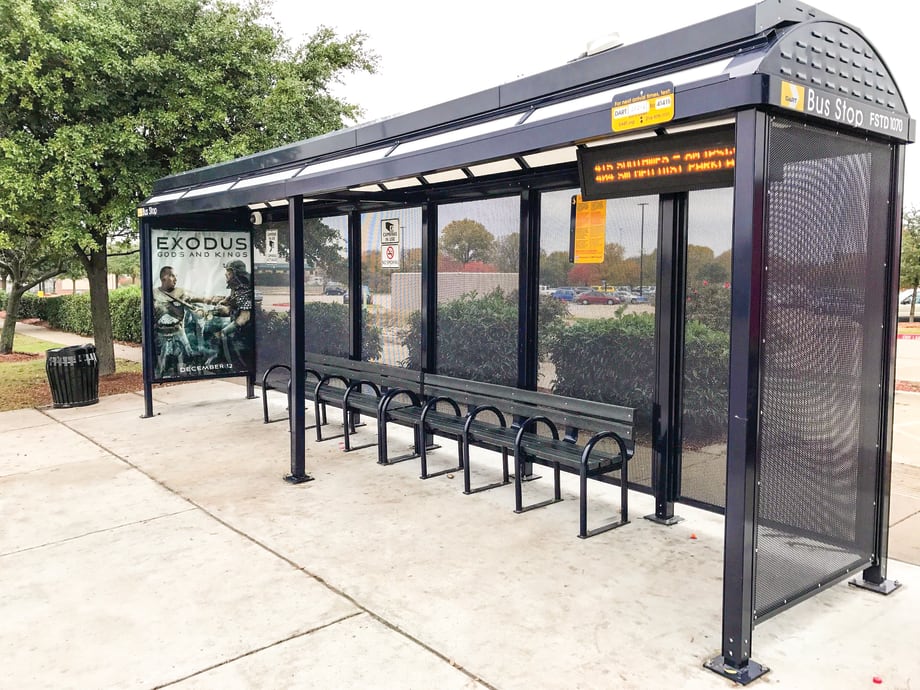
Tolar.
Tolar.
Tolar Manufacturing has been providing best-in-class, distinctive “Sense of Place™” street furniture solutions for transit agencies and outdoor advertising companies since its founding by Gary Tolar in 1991.
With over 25 years in business, Tolar arguably has the largest portfolio of transit shelters and related street furniture in North America. The company’s most recent $6.8 million multi-year contract award for LYNX in Orlando, Fla. comes on the heels of multiple competitively awarded contracts and extensions in the last several months for cities in Fla., Texas, Calif., Colo., Mo., Mont., Hawaii and B.C., Canada.
Much of Tolar’s success is due to its compelling drive to continually push the boundaries of what’s possible. Currently, that means focusing on innovation and technology directly within bus stops. Providing timely and accurate information at bus and rail stops, supporting the information delivered to a passenger’s mobile device, is quickly becoming the norm. But, utilizing technology to deliver real-time information is only the tip of the iceberg.
Tolar Manufacturing’s SmartPlace™ is leading the way with distinctive at-stop digital solutions that addresses growing passenger expectations, from real-time information housed in oversize displays and free-standing kiosks, to solar solutions for safety and security, revenue-generating digital advertising displays, charging stations, closed-caption cameras, and more.
Budget concerns often limit a community’s ability to provide weather-protecting transit shelters, comfortable seating, and innovative technology at bus stops. Meeting the challenge head on, Tolar has launched eye-catching, oversized, at-stop digital displays that attract revenue-generating advertisers while providing a passenger amenity solution that reflects the true character of a community. Not only can real-time passenger information be provided through these displays, they can also integrate with the data to provide contextually relevant ads, news, and information — a wonderful selling point for paying advertisers.
Pairing its diverse transit shelter design portfolio with customized branding and cutting-edge technology has allowed Tolar Manufacturing Co. to grow into the North American leader of transit shelter design and fabrication. With more than 500 designs and hundreds of customized solutions in its portfolio, Tolar Manufacturing has the experience and ability to create outdoor structures of durability and distinction that reflect the character of a community, that’s the “Tolar Difference.”
Visit Tolar at the APTA Expo at Booth #2303
More Security and Safety

Transit Agencies Highlight Safety Gains at National Summit
Leaders from 15 major transit systems shared crime-reduction results and safety initiatives while discussing the role of continued federal support.
Read More →
DART Launches Major Security, Fare Enforcement Initiative
The 90-day demonstration will deploy coordinated security teams at five light rail stations while testing controlled access and gathering data to guide future investments.
Read More →
RTD Launches NextRide App to Consolidate Trip Planning, Fares, Security Reporting
The app expands on RTD’s existing NextRide web application and allows customers to view real-time vehicle locations and service alerts, purchase and store digital fares, and access customer support.
Read More →

TAPTCO Updates OSHA Compliance Training for Transit Maintenance Operations
The revamped program addresses 26 OSHA standards for maintenance facilities, with TAPTCO pointing to training, documentation, and everyday shop hazards as continuing challenges for transit operations.
Read More →
How VaporVision Adds Value to Transit Door Systems
Wabtec engineers explain how the system improves doorway detection, strengthens diagnostics and gives transit agencies and OEMs greater operating flexibility.
Read More →
FRA Announces $5.3B in Rail Investments, Including $2B for Amtrak
Funding will support grade-crossing improvements, infrastructure upgrades, and new Amtrak equipment in 23 states.
Read More →
Chicago, Maryland Expand Non-Law-Enforcement Safety, Rider Support
The CTA and MTA are launching new programs aimed at de-escalation, crisis response, rider assistance, and greater transparency.
Read More →
LA Metro, City of West Hollywood, and Partners Advance Smarter Bus Lane Enforcement
The award-winning partnership combines AI-powered detection with human oversight to improve bus reliability, accessibility, and enforcement efficiency.
Read More →
LA Metro Reports 57% Decline in Homelessness on Transit System Since 2024
The agency's latest homelessness count offers new data on how care-based services and cross-sector partnerships can complement traditional transit security strategies.
Read More →
FTA Launches 'Transit Moves America' Dashboard to Highlight Agency Safety and Performance
The online dashboard transforms National Transit Database information into a public-facing resource that allows users to compare transit agencies on key operational and safety metrics.
Read More →