



Web Extra: D.C. Metro programs empower disabled riders
Alternatives to paratransit offered by the agency have enabled it to contain costs and provide riders with disabilities with more affordable transportation options.

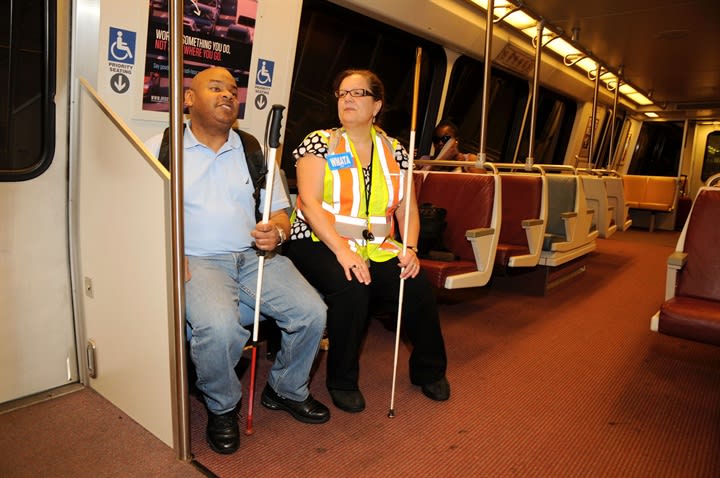
In the past six months, more than 3,700 people with disabilities have participated in Metro's Travel Training Program. Photo courtesy of WMATA.
[IMAGE]WMATATravelTraining-2.jpg[/IMAGE] Washington Metropolitan Area Transit Authority’s (Metro) management and cost containment efforts are beginning to change the way some people with disabilities use public transportation.
In a recent briefing for the Board Finance and Administration Committee, the head of MetroAccess detailed those efforts and recommended exercising the final option of the contract with the current provider — MV Transportation — while preparing for the next round of competition for the contracted service.
Metro officials anticipated slower ridership growth this year after taking several steps to manage demand, which included changing the MetroAccess fare structure and service area to align with Americans with Disabilities Act (ADA) requirements. In addition, more people with disabilities are choosing to use Metro’s accessible fixed-route system thanks to greater awareness of Metro’s travel training, reduced fare and free ride programs.
In the past six months, more than 3,700 people with disabilities have participated in Metro’s Travel Training Program, which teaches people with disabilities how to travel independently and safely on Metrobus and Metrorail. Training sessions are customized based on an individual’s needs.
"When customers come to us and they have not had the opportunity to familiarize themselves with the accessibility features of our MetroBus and MetroRail systems, there’s staff that will escort them out into the system, and teach them how to navigate the stations, use the fare vending machines, handle the fare media, and use our information systems to find their bus or train to get where they’re going," Christian Kent, Assistant General Manager of Access Services, explained.
However, Kent added, some riders need more time to go through the process, since the Metro staff can usually only devote a day or two per person. The agency has partnered with the local Centers for Independent Living to create a program that helps riders in such cases.
"If the customer — maybe someone who is blind or has low vision — has less of a comfort level and wants to spend more time with the instructor, we refer them to the regional program that we operate with our Centers for Independent Living," Kent said. "They can spend more time with the customer going over those same things in more detail, perhaps even as long as a week, to really help them gain the confidence to use the fixed-route system."
The Travel Training Program has a 91 percent success rate, Kent added. Riders that use the program often say they no longer or very rarely use paratransit, as opposed to riding bus and rail, or say that their use of bus and rail has increased as a result of travel training.
More than 7.6 million trips have been taken on Metrobus and Metrorail under Metro’s Reduced Fare Program, under which people with disabilities pay significantly less than they would otherwise for a MetroAccess trip. Riders who qualify for the program pay half the regular fare on Metrobus and Metrorail, which is no more than 85 cents per trip on Metrobus and $2.50 per trip on Metrorail. The Program also allows would-be customers who have a qualifying disability that don’t use the MetroAccess paratransit service to ride for half fare on rail, Kent said.
The free ride program allows eligible paratransit customers to ride without charge on the bus or rail system, and is designed to facilitate greater independence, Kent said. “[Qualified riders] can make use of the system without the need for an advanced reservation like you would have on paratransit." The program has been in existence since 2004, but the agency has been promoting it more over the past year as part of its cost containment efforts.
MetroAccess ridership and costs have doubled during the past five years, from 1.2 million passengers transported at a cost of $52.3 million in FY2006 to 2.4 million passengers budgeted at $103.7 million in FY2011. However, ridership for the first half of FY2011 was only 3 percent higher compared to FY2010, whereas in the past five years the growth rate has been as high as 22 percent year over year.
The actual cost to Metro of a MetroAccess trip is about $40. MetroAccess fares currently cost twice the amount of what the fare would cost on the fastest comparable trip if the same trip were taken on fixed-route services, such as Metrobus or Metrorail, up to a maximum of $7.
In addition, Metro implemented conditional eligibility, which allows people with disabilities to use MetroAccess for some trips and Metro’s fully accessible Metrobus and Metrorail service for others. For instance, a person with asthma might be able to take Metrobus or Metrorail for some trips but would need to take MetroAccess when outside temperatures become too hot or cold.
Because these demand management efforts have been successful, Metro anticipates a savings of $4 million in the proposed FY2012 budget. In the coming months, Metro officials plan to ask for board approval to exercise the final contract option of the existing contract with MV Transportation through June 2013. During this final phase of the contract, Metro plans to explore alternative service delivery models, revise/redesign pricing structure and draft a new performance-based RFP.
After only one year of the new efforts to promote of these programs, Metro started seeing positive results, Kent said. "The new promotion of these programs and the enhancements we’ve made to our eligibility process started in 2009. We really started to see results quickly," Kent said.
The funding source for the programs was a $1 million Regional Travel Training grant, which came from Job Access Reverse Commute (JARC) and New Freedom monies.
More Paratransit

Biz Briefs: RIPTA Unveils New Frontrunners, Clevland RTA Adds New Siemens, and More
In METRO's latest installment, we take a look at recent news from Siemens, Prevost, Dodge, and more partnerships making headlines across the transportation sector.
Read More →
King County Metro Makes ADA Paratransit Easier to Navigate
METRO's Innovative Solutions Award winner replaces complex service-area descriptions with an accessible, interactive map that puts paratransit information directly in customers’ hands.
Read More →
Jacksonville’s NAVI Project Charts a New Course for Autonomous Public Transportation
Through its NAVI program, JTA is showing how autonomous vehicles, intelligent infrastructure, and coordinated operations can work together to deliver everyday public transportation.
Read More →
Driving Smarter Paratransit
John Hanlon shares how AlphaRoute is leveraging AI-powered technology to help paratransit providers optimize operations, support frontline staff, and enhance the rider experience.
Read More →
METRO Magazine Announces 2026 Innovative Solutions Awards Winners
Projects Recognized for Advancing Mobility Through Technology, Accessibility, Workforce Innovation, and Operational Excellence
Read More →
Biz Briefs: STV teams with Amtrak, Motorcoach Operators Boost Fleet and Land Contracts, and More
From manufacturers and suppliers to transit agencies and motorcoach operators, these updates offer a snapshot of the projects, partnerships and business moves driving the industry forward.
Read More →
Biz Briefs: Masabi Teams with St. Louis Metro and More
In METRO's latest installment, we take a look at recent news from Transdev, Hitachi, and more partnerships making headlines across the transportation sector.
Read More →
New York MTA Leverages Zoning Program to Advance Station Accessibility
Accessibility enhancements at Nevins St Station will be financed through a development agreement tied to the MTA's Zoning for Accessibility initiative.
Read More →
Reinventing Fleet Maintenance with Real-time Visibility and AI
Transit leaders need to know what needs fixing, where to look, who is responsible, when work is completed, and what it costs without having to chase information across disconnected systems.
Read More →
SamTrans Sets Priorities for Potential Connect Bay Area Revenue
The board-approved framework allocates future funding to maintaining service, rider improvements, equity initiatives, and infrastructure repairs.
Read More →