



Web Extra: U. of South Fla. enhances shuttle service
With bus tracking and passenger counting capabilities, as well as a new route on the way, the Bull Runner circulator now offers Tampa students and faculty even more mobility campus-wide.

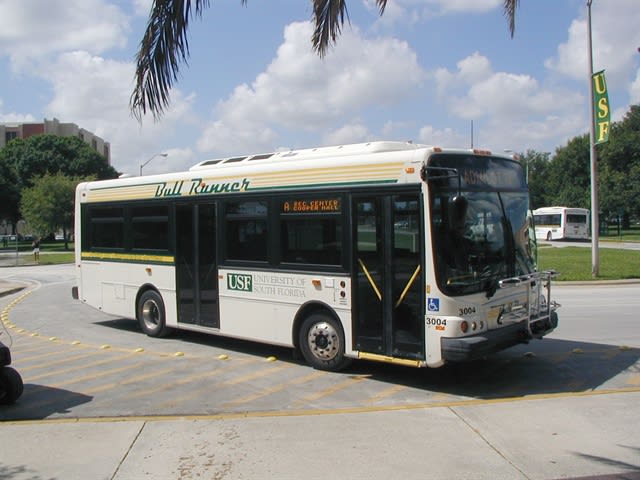
[IMAGE]UofSouthFlaBullRunnerShuttle-2.jpg[/IMAGE] The Tampa, Fla.-based University of South Florida’s (USF) circulator shuttle service, the Bull Runner, now provides riders with enhanced convenience and security, with a bus tracking system and, soon, an additional route that will pick up many students right at their apartments.
Started in 1997, the Bull Runner transported 84,000 people in its first year. The current ridership is over one million a year, said Rick Fallin, transit manager, University of South Florida. The fleet is comprised of 32 buses, with a combination of mostly Startrans and Glaval cutaways and Thomas Built and Blue Bird low floor transit style buses. All USF students, faculty and staff have fare free access to the Bull Runner with their USF I.D. card.
While the USF network has three campuses, the Bull Runner primarily services the main campus in Tampa. The campus is a little over 900 acres. The shuttle currently runs on five routes, but will extend to six in the fall, when the Bull Runner will begin offering service to the south of campus, which holds densely populated student housing areas.
The service’s primary source of funding is a transit access fee through tuition revenues, which is calculated based on each assessed credit hour per student. However, one local business also boosts the service with significant financial backing. To the west of campus, the shuttle connects with the University Mall and continues through the mall area. “The mall has been, through the years, a huge supporter, publicity-wise and financially, to the Bull Runner,” Fallin said.
To heighten the eco-friendly factor of the system, the Parking and Transportation Services Department began using biodiesel to fuel the Bull Runner in 2002. Starting with a B100 blend and then experimenting with various blend ratios to get optimum performance, the department now uses a B20 blend. “It’s been a very successful program,” Fallin said.
Most recently, the University Parking & Transportation Department implemented a GPS automatic vehicle location (AVL) system, the Bull Tracker, on its fleet. The AVL system went online in April 2010. It was paid for out of transportation reserves and access fees and uses software from Los Angeles-based Syncromatics, according to a USF news release. The Bull Tracker system is available on the Web and can be downloaded on mobile handheld devices.
The AVL offers several services, including the ability to see arrival predictions for all buses at all stops, the ability to track buses along the routes so riders can plan their day accordingly, the ability to set up alerts for recurring use via text message and bus viewing in real-time. USF also implemented automatic passenger counting on buses so riders can find out how full a bus is before it arrives.
The bus tracking system has been going very well overall, Fallin said. “Having a new system and getting everything tweaked and right is a process. But the company that provides the service is been very aggressive in making sure all of our expectations are met. We give them a pretty high mark on getting that accomplished so far.”
Like many other university transit programs, the program challenge tends to be keeping buses on the road, drivers behind the wheel, managing the level of expectation for service, and dealing with parking and traffic issues, Fallin added. “Customer expectations are pretty high, so to meet those is a bit of a challenge,” he said. “We work under the Parking and Transportation Services Department, so we’re aligned with the parking issues on campus, and those are always a challenge, to mitigate the need for vehicle traffic on campus and provide the best service that will help offset that need as much as possible.”
The Bull Runner also offers a student driver training program, using USF students as bus drivers. Approximately two-thirds of the Bull Runner drivers are USF students.
More Bus

New York MTA Plans Largest Bus Fleet Upgrade in More Than a Decade
The agency is seeking manufacturers for 650 new CNG buses to replace aging vehicles, improve reliability, and advance its broader fleet modernization strategy.
Read More →
Building a Flexible Path to Transit Electrification
John Hroncich discusses BAE Systems’ modular and scalable approach, lessons learned from decades of real-world operations, and how agencies can identify electrification strategies that fit their fleets.
Read More →
Bus Tech Talk: Keeping Transit Technicians Ahead of the Technology Curve
LA Metro’s Obed Mejia discusses technician training, evolving maintenance technology, fleet replacement, and strategies for getting the most out of today’s transit fleets.
Read More →
Biz Briefs: RIPTA Unveils New Frontrunners, Clevland RTA Adds New Siemens, and More
In METRO's latest installment, we take a look at recent news from Siemens, Prevost, Dodge, and more partnerships making headlines across the transportation sector.
Read More →
People Movement: Holly Arnold Joins Transdev and More
In this edition, we also cover recent appointments and announcements at Pace, CamTran, MCI, and more, showcasing the individuals helping to shape the future of transportation.
Read More →
The High Cost of Transit Buses: Industry Leaders Look to Procurement Reform
Transit leaders and policymakers examine how standardized bus designs, streamlined procurement, and predictable funding could help agencies stretch budgets and deliver better service.
Read More →
The Business Voice Behind Public Transportation
As chair of APTA’s Business Members Board of Governors, Ray Melleady explains how more than 850 business members are partnering with transit agencies to advance funding, innovation, and industry-wide collaboration.
Read More →
From Surviving to Thriving: Building Stronger Transportation Organizations
Bus Business Consultants founder Brian Dickson shares lessons on leadership, organizational health, and creating options for long-term success in a changing transportation industry.
Read More →
Finding the ‘Happy Medium’: Optimizing Maintenance Without Sacrificing Reliability
The key to maintenance optimization isn’t doing less work—it’s doing the right work at the right time on the right assets.
Read More →
LA Metro, City of West Hollywood, and Partners Advance Smarter Bus Lane Enforcement
The award-winning partnership combines AI-powered detection with human oversight to improve bus reliability, accessibility, and enforcement efficiency.
Read More →