



Sydney Rail Ops Designed with Humans in Mind
Sydney, Australia’s new facility will be able to operate under extreme events with redundant and diverse power and communication feeds.
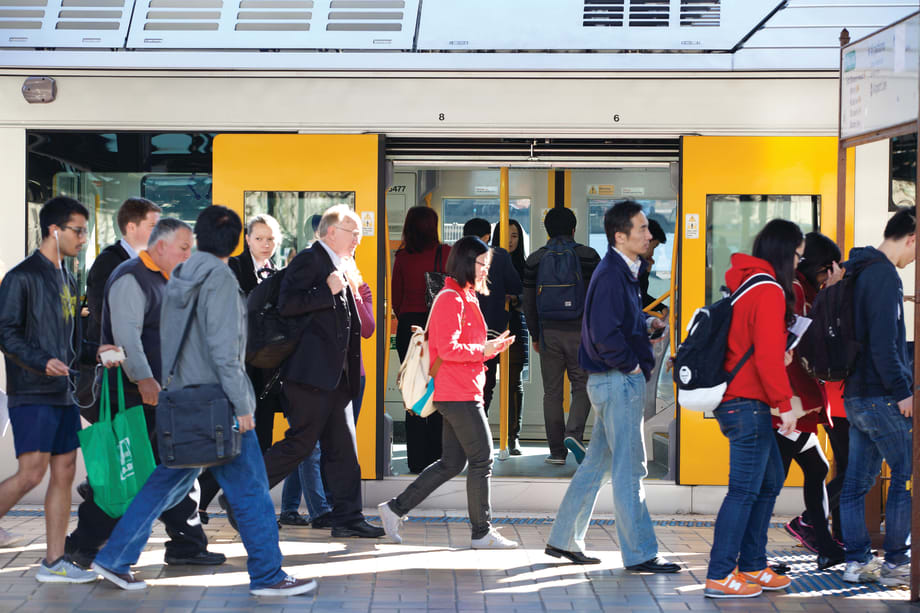
All photos courtesy Sydney Rail
All photos courtesy Sydney Rail
I recently visited Australia to meet with Howard Collins, who is CEO of Sydney Rail as well as acting CEO of New South Wales TrainLink. Collins oversees the operations of the entire train transit network in Australia’s largest city of Sydney and the state of New South Wales (NSW) with nearly 13,000 employees. Sydney Trains operates on 506 miles of track over eight lines. It operates on train frequencies of every three minutes or better in the underground core, five to 10 minutes at most major stations all day. While there, I toured their almost-ready-to-open Rail Operations Center (ROC).
The ROC – Rail Operations Center
Sydney Rail just completed construction and is opening their new ROC designed to meet the system’s needs for the next 50 years. It’s overseen by Anthony Eid, Sydney Rail’s executive director, future network delivery, and he is a proud “papa” of this facility we were privy to seeing before its grand opening.
The building serves as a single integrated center with control capability to manage day of operations (DoO) transit service. The ROC main control center houses 104 transit dispatchers/controllers and integrates over 25 functionally different roles. Prior to this, dispatchers/controllers were based in six control centers across the Sydney Rail network.
A technically complex building, ROC was required to achieve reliability targets along with addressing security threats. The ROC will be able to operate under extreme events with redundant and diverse power and communication feeds and the ability to withstand a significant blast.
Human-centered design
To manage integration of all the teams set to co-locate in the ROC, a Control Suite Design Methodology was adopted. Key principles focused on the application of a human-centered design approach; this extended to the control room layout and design of operator specific workstations. The methodology was based on International Standards ISO 9241-210: Human-centered design for interactive systems, and ISO 11064: Ergonomic design of control centers. Over 50 human factor workshops were conducted with 200 dispatcher/controller representatives from five directorates.
A virtual reality (VR) model of the control room floor was produced with Ergonomie Australia, a human factor consultancy in Sydney. The visualization of the control room using VR made it possible to evaluate the full-scale design in an immersive manner. Using VR, controllers experienced the environment prior to implementation. Operational concerns were addressed early in the design process, thus increasing insights and buy-in of the proposed concept while avoiding expensive modifications.
The result created was workstations that vary greatly from the previous desk configurations used. The new design provides an open, curved desk, optimizing the operators’ viewing angle and distance to multiple monitors. The primary communication device has moved from the side of the workstation to a recess in the center of the worktop, where operators can pull it out to their preferred reach and viewing distance. The operators now have sit-to-stand workstations that raise or lower based on controller preference. These are beneficial to operators working long or extended shifts. The worktop is split into “front and back,” allowing operators to adjust the work surface height and monitors to obtain an ergonomic workstation.
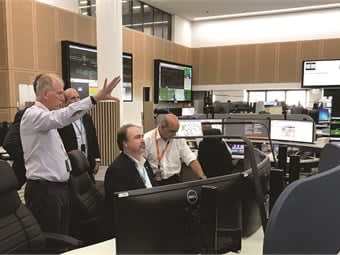
A human-centered design approach was applied to the control room layout and operator-specific workstations.
Command and Control
To further facilitate situational awareness, the world’s largest operational LED command and control overview display is up on the wall in the front of the ROC control room. Nicknamed the “WOW” board, this 106-foot by 12-foot (32.5m x 3.65m) operational visual display system (OVDS) contains 41 million pixels and the largest number of processors ever installed in an LED display. It shows train activity live on the network and displays images from over 40 sources, such as DoO information, which is dynamically reconfigured during incidents to support faster response.
Temperature control is a priority for staff and workstation technology. Heating and cooling happens from the floor up for the comfort of the staff. Noise suppression keeps conversations and noises down and the overall room feels calm.
Control Room Layout
Integrating all the teams, the ROC Control Room floor locates numerous key groups strategically and brings previously-siloed groups into the operations center as follows:
Management – The centralized “incident coordination” or management hub includes the ROC Duty Control Manager (DCM) where the “Captain Kirk” chair is located, Network Incident Managers (NIMs), Control Duty Manager, NSW TrainLink Shift Manager, and CIU Team Leader. Co-location of these roles allows the ROC DCM and NIMs to be well-informed on all incidents and levels of service across the network, facilitating better and faster decision making.
Customer Support and Reporting Pod – Located next to the management hub, this area comprises of a Customer Information Support Officer, the Social Media Operators, and the Train Monitoring officers.
Security – The Security team is situated on the periphery overseeing day of operation across the ROC. The security team will coordinate responses to security incidents with police and emergency services respond to security alarms and help point activations, and monitor the CCTV network for security incidents occurring at railway stations, trains, and other facilities.
ICON – Includes ICON Electrical, Infrastructure, and Technology groups.
Fleet Control – Main, Intercity, and Balance Boards, as well as external operators Waratah Fleet Support (FOSO) and New Intercity Fleet Support (NIF) are housed here.
Train Crew – Train Crewing Assignment Centre (TCAC) Assigners, TCAC Team Leader, Train Crew Liaison Officer (TCLO).
NSW Trains – Four NSW Trainlink operators to provide a link between NSW Trains and Sydney Trains services and facilitate joint management of incidents when required.
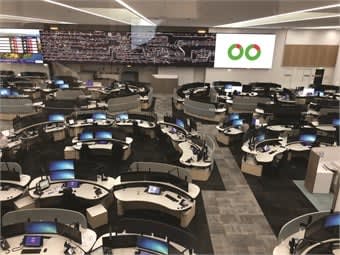
To further facilitate situational awareness, the world’s largest operational LED command and control overview display is up on the wall in the front of the ROC control room.
Extra Features
A number of breakout rooms and facilities are provided on Level 4, including:
Dedicated training room and facilities for Control Room Floor staff.
Purpose-built incident and emergency management room overlooking ROC.
Viewing platform so not to distract staff on the control room floor.
Stronger shared awareness
Overall this new Sydney Rail Operations Center (costing just over $200 million) sets the bar high for other mega-city transit systems by having one of the most sophisticated, data-driven, and ergonomically designed Operations Control Centers in the world. Now complete it will allow for stronger shared awareness of network status and focus on delivering higher-quality customer service, improved communications, and better decision making — due to improved information flow by bringing all agency stakeholders into one common area and allow for creation of common priorities among them.
Paul Comfort is VP business development with Trapeze Group.
More Rail
Amtrak, CN Reach Agreements to Strengthen Passenger Rail Service, Safety
The agreement resolves a more than decade-long proceeding before the Surface Transportation Board concerning the terms and conditions for Amtrak services, such as the City of New Orleans, Illini/Saluki, and Wolverine.
Read More →
New York MTA Advances Final Contract for Second Avenue Subway Expansion
Contract Four is the largest in the Second Avenue Subway Phase 2 project and includes construction of station infrastructure, tracks, and signals for the subway expansion, MTA officials said. Work on Contract Four will begin in 2027.
Read More →
San Diego MTS Breaks Monthly Trolley Ridership Record
Agency officials said July’s ridership indicates MTS’s continued recovery from the pandemic.
Read More →
Report Examines NJ TRANSIT Reliability, Funding Challenges
The Garden State Initiative analysis examines the roles of Amtrak infrastructure, fleet management, and agency operations while recommending a more performance-based approach to improving reliability.
Read More →
Stadler, CapMetro Sign Long-Term Rail Fleet Support Agreement
Beginning in 2027, Stadler will provide on-site technical expertise, spare parts support, training, and obsolescence management to help extend the reliability and longevity of CapMetro’s GTW fleet.
Read More →
Biz Briefs: Alstom Lands Canadian Contract, LYT to Supply California TSP, and More
In METRO's latest installment, we take a look at recent news from Complete Coach Works, Beep, FlixBus, and more partnerships making headlines across the transportation sector.
Read More →
CATS Gold Line Marks 5 Years of Service, 2.8M Passenger Trips
With a six-mile expansion planned, the Charlotte streetcar is positioned to connect more neighborhoods and major transit hubs across the region.
Read More →
Why Simulating Pedestrian Movement Has Become Essential for Modern Rail Stations
Pedestrian microsimulation is helping rail planners identify bottlenecks, test station designs, and prepare complex transit hubs for growing passenger volumes.
Read More →
Amtrak Begins Major Construction at New York’s Sunnyside Yard
The new maintenance facility will support Amtrak’s Airo trainsets while improving maintenance efficiency and turnaround times in New York.
Read More →
Chicago Leaders Unveil Plans for O’Hare Airport Express Train
The privately developed project would offer a 15-minute trip between downtown and O’Hare’s Terminal 2, with trains operating every 15 minutes on a dedicated track. The service would use battery-electric trains and three existing freight rail rights-of-way.
Read More →