



The motorcoach operator's guide to the coronavirus
Here's everything you need to know about combatting the virus, as well as help your employees and clients stay healthy.


This story initially appeared in Luxury Coach & Transportation (LCT) on March 5. Kevin Haegele/LCT
Everything you need to know about the coronavirus (COVID-19)
COVID-19, commonly referred to as the Coronavirus, is a new disease being monitored by the Centers for Disease Control and Prevention (CDC). It is so new that the CDC is still learning how it spreads, the severity of illness it causes, and to what extent it may continue to spread in the U.S.
How It Spreads
Person-to-person spread
The virus is thought to spread mainly from person-to-person, between those who are in close contact with one another (within about six feet), through respiratory exhales when an infected person coughs or sneezes. Small droplets can land in the mouth or be inhaled by people who are nearby.

Avoid touching your face anywhere (Photo provided to METRO Magazine by LCT. Photo by Pexels user Pixabay)
Can someone spread the virus without being sick?
Some spread might be possible before people show any symptoms of actually being sick, but this is not thought to be the main way the virus spreads.
Can you catch it from infected surfaces, seat belt latches, and door handles?
It is possible to become infected by touching a surface or object that has the virus on it and then touching your mouth, nose, or eyes. The virus can live for up to 48 hours on handrails, seat belt latches, and handles. However, this is not thought to be the main way this virus spreads.
How easily the virus spreads
The spread varies from person to person based upon overall health and genetics. The virus that causes COVID-19 seems to be spreading easily and sustainably in communities (“community spread”) in some affected geographic areas.
What is Community Spread?
It means people have been infected with the virus in their community, even if they have not recently traveled anywhere.
The Symptoms
Symptoms will appear two to 14 days after exposure and can range from mild to severe. Watch for:
Fever.
Cough.
Shortness of breath.
Avoid touching your face anywhere (Photo provided to School Bus Fleet by LCT. Photo by Pexels user Pixabay)
How to Protect Your Employees and Clients
There is currently no vaccine to prevent Coronavirus disease 2019 (COVID-19). Here's what you, your employees, and your clients can do to avoid spreading the virus, according to the CDC.
Avoid close contact with people who are sick.
Avoid touching your eyes, nose, and mouth.
Stay home if you are sick.
Cover your cough or sneeze with a tissue, then throw the tissue in the trash.
Clean and disinfect frequently touched objects and surfaces using a regular household cleaning spray or wipe.
Avoid shaking hands with your passengers.
Follow CDC’s recommendations for using a facemask:
The CDC does not recommend that people who are well wear a facemask to protect themselves from respiratory diseases, including COVID-19.
Facemasks should be used by people who show symptoms of COVID-19 to help prevent the spread of the disease to others. The use of facemasks is also crucial for health workers and people who are taking care of someone in close settings (at home or in a health care facility).
Wash your hands often with soap and water for at least 20 seconds, especially after going to the bathroom; before eating; and after blowing your nose, coughing, or sneezing. For more information about handwashing, see the CDC’s handwashing website.
If soap and water are not readily available, use an alcohol-based hand sanitizer with at least 60% alcohol. Always wash hands with soap and water if hands are visibly dirty.
The CDC has also created a guide specifically for businesses and employers to plan and respond to coronavirus, which can be found here. A CDC guide with specific guidance for travelers can be found here.
Treatment of Coronavirus
There is no specific antiviral treatment recommended for COVID-19. People with COVID-19 should receive supportive care to help relieve symptoms. For severe cases, treatment should include care to support vital organ functions. People who think they may have been exposed to COVID-19 should contact their healthcare provider immediately.
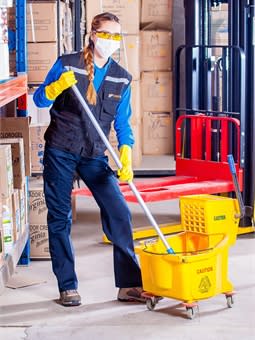
Be sure to wear disposable gloves while you clean. The facemask is optional. (Photo provided to METRO Magazine by LCT. Photo by Pexels user Pixabay)
Preventing Vehicle Contamination
Clean porous (soft) surfaces (e.g. seat covers and carpet) by removing visible contamination if present and using appropriate cleaners. For items that can be laundered, use the warm setting and dry items completely on high heat.
For non-porous (hard) surfaces, use disinfectant products with EPA-approved emerging viral pathogens claims that are expected to be effective against the virus that causes COVID-19 (SARS-CoV-2). All products should be used according to label instructions (e.g., concentration, application method, and contact time).
The flu virus can survive on hard surfaces for up to 48 hours. Cleaning products can also kill most, if not all, flu virus, including products containing:
chlorine.
hydrogen peroxide.
detergents (soap).
iodophors (iodine-based antiseptics).
alcohols.
In general, focus efforts on surfaces that are likely to be touched frequently. It is recommended the person cleaning the vehicle wear disposable gloves while properly sanitizing the vehicle.
How to Properly Keep Your Clients Informed
As panic and fear begin setting in for business travelers, it is important that transportation operators do their part to stop the mass hysteria. You can help by frequently sharing information with your clients, as they are needlessly canceling business trips, conventions, and festivals.

Wash your hands. (Photo provided to METRO Magazine by LCT. Photo by Pexels user Burst)
The common influenza virus affects 5% to 20% of the U.S. population each year. That affects 9.3 to 49 million people each year. As of this writing, there are 150 known cases in America. It’s a tiny fraction of the 329.4 million people living in America.
Here are some methods you can use to communicate educational information about the Coronavirus:
Post the letter below on your website with a link to the CDC. For example, Steve Qua of Company Car & Limousine in Ohio created a blog, The Travelers Guide to Coronavirus, in an effort to keep his clients informed.
Send a message to your clients by text using SMS technology.
Send a mass email to your clients using the letter below as a template.
Provide memos to your chauffeurs and staff providing educational information.
Post educational memos on internal bulletin boards with other employment notices.
Here is a sample letter you may feel free to copy and adapt to your needs to help you inform clients:
Dear [Client],
We are sure you have concerns about the Coronavirus as we do. We want you to know we have always taken pride in the cleanliness of our vehicles. We are taking additional steps to ensure our passengers and chauffeurs are traveling in vehicles that are thoroughly cleaned multiple times each day during this health crisis. In addition, our chauffeurs have been asked to avoid the pleasantry of a handshake.
The likelihood of becoming infected on an airplane or in a public transportation vehicle is about the same as any other place where many people gather such as restaurants, stadiums, theaters, and nightclubs.
We place great emphasis on your safety as well as the health and safety of our employees. Our vehicles are cleaned between each trip with anti-bacterial cleaning products for your protection as well as keeping our chauffeurs safe.
The Center for Disease Control has issued a statement indicating domestic travel in the U.S. is still safe and there is no need to cancel trips or events held within the U.S. The CDC recommends travelers take the following precautions:
Avoid close contact with people who are sick.
Cover your cough or sneeze with a tissue, then throw the tissue in the trash. Clean and disinfect frequently touched objects and surfaces such as handles, seatbelt buckles, air vents, buttons, and armrests using a disinfectant wipe.
Wash your hands often with soap and water for at least 20 seconds, especially after going to the bathroom; before eating; and after blowing your nose, coughing, or sneezing.
If soap and water are not readily available, use an alcohol-based hand sanitizer that contains 60% to 95% alcohol.
We wanted to share this information with you so you may travel with us with confidence.
Sincerely,
[Your name here]
Sources used to help compile this guide: Centers for Disease Control and Prevention, United Motorcoach Association
More Security and Safety

Transit Agencies Highlight Safety Gains at National Summit
Leaders from 15 major transit systems shared crime-reduction results and safety initiatives while discussing the role of continued federal support.
Read More →
DART Launches Major Security, Fare Enforcement Initiative
The 90-day demonstration will deploy coordinated security teams at five light rail stations while testing controlled access and gathering data to guide future investments.
Read More →
RTD Launches NextRide App to Consolidate Trip Planning, Fares, Security Reporting
The app expands on RTD’s existing NextRide web application and allows customers to view real-time vehicle locations and service alerts, purchase and store digital fares, and access customer support.
Read More →

TAPTCO Updates OSHA Compliance Training for Transit Maintenance Operations
The revamped program addresses 26 OSHA standards for maintenance facilities, with TAPTCO pointing to training, documentation, and everyday shop hazards as continuing challenges for transit operations.
Read More →
How VaporVision Adds Value to Transit Door Systems
Wabtec engineers explain how the system improves doorway detection, strengthens diagnostics and gives transit agencies and OEMs greater operating flexibility.
Read More →
FRA Announces $5.3B in Rail Investments, Including $2B for Amtrak
Funding will support grade-crossing improvements, infrastructure upgrades, and new Amtrak equipment in 23 states.
Read More →
Chicago, Maryland Expand Non-Law-Enforcement Safety, Rider Support
The CTA and MTA are launching new programs aimed at de-escalation, crisis response, rider assistance, and greater transparency.
Read More →
LA Metro, City of West Hollywood, and Partners Advance Smarter Bus Lane Enforcement
The award-winning partnership combines AI-powered detection with human oversight to improve bus reliability, accessibility, and enforcement efficiency.
Read More →
LA Metro Reports 57% Decline in Homelessness on Transit System Since 2024
The agency's latest homelessness count offers new data on how care-based services and cross-sector partnerships can complement traditional transit security strategies.
Read More →
FTA Launches 'Transit Moves America' Dashboard to Highlight Agency Safety and Performance
The online dashboard transforms National Transit Database information into a public-facing resource that allows users to compare transit agencies on key operational and safety metrics.
Read More →