



New Flyer unveils CHARGE H2 hydrogen fuel-cell buses
The company is the only manufacturer to offer both a 40-foot and 60-foot fuel cell-electric model that qualifies for federal funding.

New Flyer currently has significant ZEB orders from major cities including Toronto, Boston, Minneapolis, New York, Portland, and Vancouver.
New Flyer
New Flyer currently has significant ZEB orders from major cities including Toronto, Boston, Minneapolis, New York, Portland, and Vancouver.
New Flyer
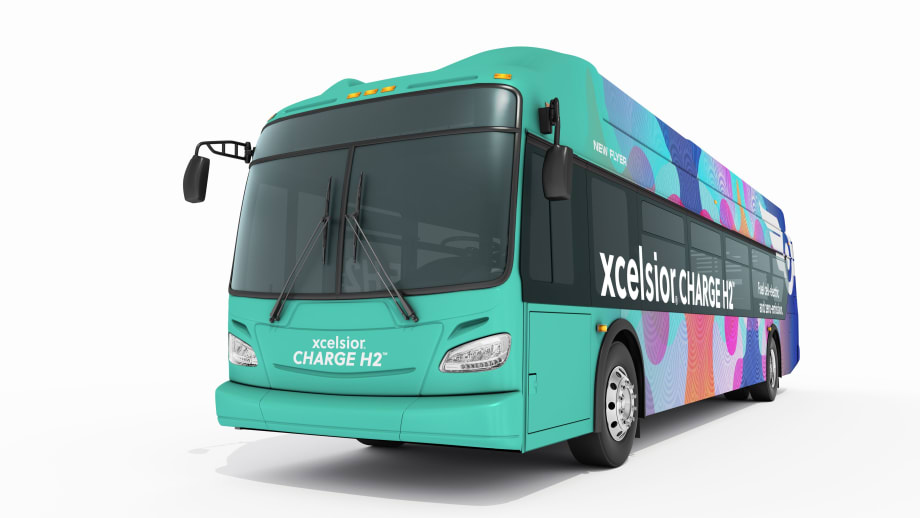
New Flyer of America Inc. and New Flyer Industries Canada ULC unveiled the Xcelsior CHARGE H2™ — its fuel cell-electric heavy-duty transit bus — and announced that both the 40-foot and 60-foot model have successfully completed the Federal Transit Administration (FTA) Model Bus Testing Program at Altoona, Pennsylvania.
The announcement makes the Xcelsior CHARGE H2™ the first 60-foot fuel cell-electric bus to complete Altoona, and establishes New Flyer as the only manufacturer to offer both a 40-foot and 60-foot fuel cell-electric model that qualifies for federal funding.
The Xcelsior CHARGE H2™ are vehicles that use environmentally-friendly hydrogen and fuel-cell technology to create electricity and charge batteries for extended-range zero-emission transit operations, saving 85-175 tons of greenhouse gas per year from tailpipe emissions compared to a traditional diesel bus. With a range of up to 300 miles, the bus can be refueled in six to 20 minutes depending on the model and operating conditions, and requires no overnight plug-in electrical re-charging. The Xcelsior CHARGE H2™ also features regenerative braking while decelerating, which recharges the batteries and reduces energy consumption for extending range. The only tailpipe output is clean water vapor.
New Flyer has over 50 years of experience manufacturing zero-emission buses (ZEBs). It introduced its next-generation battery-electric bus, the Xcelsior CHARGE™ in 2017. With the addition of the Xcelsior CHARGE H2™, New Flyer offers the most diverse lineup of commercially available zero-emission transit buses in North America, and remains the only North American manufacturer to provide all three types of ZEB propulsion systems: trolley-electric, all battery-electric, and fuel-cell electric.
New Flyer is currently delivering 25 Xcelsior CHARGE H2™ fuel cell-electric buses to three transit agencies as part of California Climate Investments (CCI). CCI is a statewide initiative that puts billions of Cap-and-Trade dollars to work reducing greenhouse gas emissions, strengthening the economy, and improving public health and the environment, particularly in disadvantaged communities, low-income communities, and low-income households.
“We anticipate fuel cells for extended range will complement all battery-electric technology, not only in transit, but other industries such as commercial trucks,” said Chris Stoddart, president, New Flyer.
New Flyer currently has significant ZEB orders from major cities including Toronto, Boston, Minneapolis, New York, Portland, and Vancouver. In California alone, New Flyer has sold nearly 80 battery-electric buses, with active programs in Coachella Valley, Los Angeles, Oakland, Orange County, and San Diego. Since 1972, New Flyer has delivered over 10,000 buses to the state of California, beginning with zero-emission trolley-electric buses.
More Technology

From Hardware to Digital Partner: Luminator Charts Its Next Chapter
CEO Magnus Friberg discusses Luminator’s shift toward becoming a digital partner, the growing importance of software and interoperability, and how AI can help agencies improve operations and passenger experience.
Read More →
Beyond the Checklist: A Structured Approach to Transit Maintenance
Reliability-Centered Maintenance helps transit agencies move beyond routine checklists to focus limited resources on the assets and failures that have the greatest impact on safety, reliability, and service.
Read More →
NJ TRANSIT Advances Bus Technology Upgrades Across Statewide Fleet
More than 1,500 buses now feature upgraded technology designed to improve arrival predictions and provide free Wi-Fi, with deployment expected to reach nearly 2,000 buses by the end of 2026.
Read More →

Building a Flexible Path to Transit Electrification
John Hroncich discusses BAE Systems’ modular and scalable approach, lessons learned from decades of real-world operations, and how agencies can identify electrification strategies that fit their fleets.
Read More →
Biz Briefs: Alstom Lands Canadian Contract, LYT to Supply California TSP, and More
In METRO's latest installment, we take a look at recent news from Complete Coach Works, Beep, FlixBus, and more partnerships making headlines across the transportation sector.
Read More →
From Legacy Silos to Conversational Intelligence
What if transit leaders could ask any operational question and get a trusted answer in seconds? Conversational AI is transforming how agencies use their data.
Read More →
USDOT Announces Rail Vehicle Replacement Grants, Chattanooga AV Shuttle Funding
More than $191 million in federal funding will help three transit agencies replace aging rail vehicles and support a new autonomous shuttle service in Chattanooga.
Read More →
Bus Tech Talk: Keeping Transit Technicians Ahead of the Technology Curve
LA Metro’s Obed Mejia discusses technician training, evolving maintenance technology, fleet replacement, and strategies for getting the most out of today’s transit fleets.
Read More →
Biz Briefs: RIPTA Unveils New Frontrunners, Clevland RTA Adds New Siemens, and More
In METRO's latest installment, we take a look at recent news from Siemens, Prevost, Dodge, and more partnerships making headlines across the transportation sector.
Read More →
Why Simulating Pedestrian Movement Has Become Essential for Modern Rail Stations
Pedestrian microsimulation is helping rail planners identify bottlenecks, test station designs, and prepare complex transit hubs for growing passenger volumes.
Read More →