




RELATED: First N.Y. interoperapable, on-route charger installed
$3M available for innovative solutions to improve New York transportation
NYSERDA and NYSDOT will award the funding as part of a two-step competitive process.
April 19, 2019
The announcement supports Gov. Andrew M. Cuomo’s nation-leading Green New Deal and supports the state’s goal of reducing greenhouse gas emissions 40% by 2030.
CC0 Public Domain
3 min to read
The announcement supports Gov. Andrew M. Cuomo’s nation-leading Green New Deal and supports the state’s goal of reducing greenhouse gas emissions 40% by 2030.
CC0 Public Domain
The New York State Energy Research and Development Authority (NYSERDA) and New York State Department of Transportation (NYSDOT) announced $3 million in available funding for innovative proposals to improve the efficiency of New York’s transportation system while reducing energy consumption and greenhouse gas emissions. The announcement supports Gov. Andrew M. Cuomo’s nation-leading Green New Deal and supports the state’s goal of reducing greenhouse gas emissions 40% by 2030.
NYSERDA and NYSDOT will award the funding as part of a two-step competitive process. Applicants must first submit concept papers that illustrate proposals with broad application or impact across New York State, demonstrate new technologies, increase access to alternative modes of transportation, or make roads safer. Concept papers will be accepted through Oct. 30, 2019 and must center on innovative strategies in one of the following areas:
Efficient mobility solutions: Projects to reduce transportation congestion and shift travel demand to more energy-efficient modes, such as public transportation, greater bicycle availability, and overall improvements in mobility for people and commercial goods.
Efficient infrastructure, operations, and systems planning: Projects to increase transportation efficiency by optimizing operations, expanding transportation options, or employing technology-driven approaches that can improve and be integrated into larger infrastructure improvement initiatives.
NYSERDA and NYSDOT will undertake a competitive process to identify applicants with the best concept papers who will then be invited to submit proposals. Proposals will then be reviewed and selected to be awarded funding.
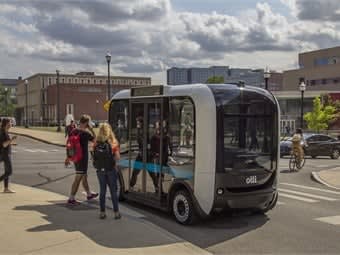
The Olli Bus s being tested at the University at Buffalo with a goal of replacing a gas-emitting student shuttle in the future.
Olli
The transportation sector is one of the largest producers of energy related greenhouse gas emissions in New York State. NYSERDA and NYSDOT have collaborated on numerous projects that support new, innovative technologies and local initiatives to reduce greenhouse gas emissions. The projects include:
Supporting a tri-city commuter challenge in Westchester County, which resulted in employees in New Rochelle, White Plains, and Yonkers increasing their use of public transportation and reducing greenhouse gas emissions.
Funding the Olli Bus, a self-driving electric shuttle, which is being tested at the University at Buffalo with a goal of replacing a gas-emitting student shuttle in the future.
Launching a bike-share program in Ithaca and implementing plans to double the percentage of bike use in and around the city.
In addition to these projects, New York State has launched numerous initiatives as part of its overall clean transportation strategy to reduce greenhouse gas emissions and support the Governor’s nation-leading clean energy and climate agenda. These initiatives are increasing the number of electric vehicles and charging stations in New York on a path to achieve Gov. Cuomo's Charge NY goal of 10,000 electric vehicle charging stations by the end of 2021. In fact New Yorkers bought more electric vehicles in one year than ever before — more than 16,000 electric vehicles were sold in 2018, about 60% more than in 2017. Major transportation initiatives include:
The New York Power Authority’s commitment of up to $250 million through 2025 for EVolve NY, an initiative that partners with the private sector and other key stakeholders to address market gaps in charging infrastructure to accelerate EV adoption and deployment of fast chargers in high-traffic corridors across the state.
NYSERDA's $5 million Charge Ready NY initiative, which provides $4,000 per vehicle charging port for public or private employers, building owners, municipalities, and non-profit organizations to install Level 2 charging stations, for a total of 1,250 new charging ports.
The Department of Environmental Conservation’s availability of $300,000 for rebates to municipalities for the purchase or lease of electric vehicles.
More Technology

From Hardware to Digital Partner: Luminator Charts Its Next Chapter
CEO Magnus Friberg discusses Luminator’s shift toward becoming a digital partner, the growing importance of software and interoperability, and how AI can help agencies improve operations and passenger experience.
Read More →
Beyond the Checklist: A Structured Approach to Transit Maintenance
Reliability-Centered Maintenance helps transit agencies move beyond routine checklists to focus limited resources on the assets and failures that have the greatest impact on safety, reliability, and service.
Read More →
NJ TRANSIT Advances Bus Technology Upgrades Across Statewide Fleet
More than 1,500 buses now feature upgraded technology designed to improve arrival predictions and provide free Wi-Fi, with deployment expected to reach nearly 2,000 buses by the end of 2026.
Read More →

Building a Flexible Path to Transit Electrification
John Hroncich discusses BAE Systems’ modular and scalable approach, lessons learned from decades of real-world operations, and how agencies can identify electrification strategies that fit their fleets.
Read More →
Biz Briefs: Alstom Lands Canadian Contract, LYT to Supply California TSP, and More
In METRO's latest installment, we take a look at recent news from Complete Coach Works, Beep, FlixBus, and more partnerships making headlines across the transportation sector.
Read More →
Sponsored•September 8, 2026
From Legacy Silos to Conversational Intelligence
What if transit leaders could ask any operational question and get a trusted answer in seconds? Conversational AI is transforming how agencies use their data.
Read More →
USDOT Announces Rail Vehicle Replacement Grants, Chattanooga AV Shuttle Funding
More than $191 million in federal funding will help three transit agencies replace aging rail vehicles and support a new autonomous shuttle service in Chattanooga.
Read More →
Bus Tech Talk: Keeping Transit Technicians Ahead of the Technology Curve
LA Metro’s Obed Mejia discusses technician training, evolving maintenance technology, fleet replacement, and strategies for getting the most out of today’s transit fleets.
Read More →
Biz Briefs: RIPTA Unveils New Frontrunners, Clevland RTA Adds New Siemens, and More
In METRO's latest installment, we take a look at recent news from Siemens, Prevost, Dodge, and more partnerships making headlines across the transportation sector.
Read More →
Why Simulating Pedestrian Movement Has Become Essential for Modern Rail Stations
Pedestrian microsimulation is helping rail planners identify bottlenecks, test station designs, and prepare complex transit hubs for growing passenger volumes.
Read More →