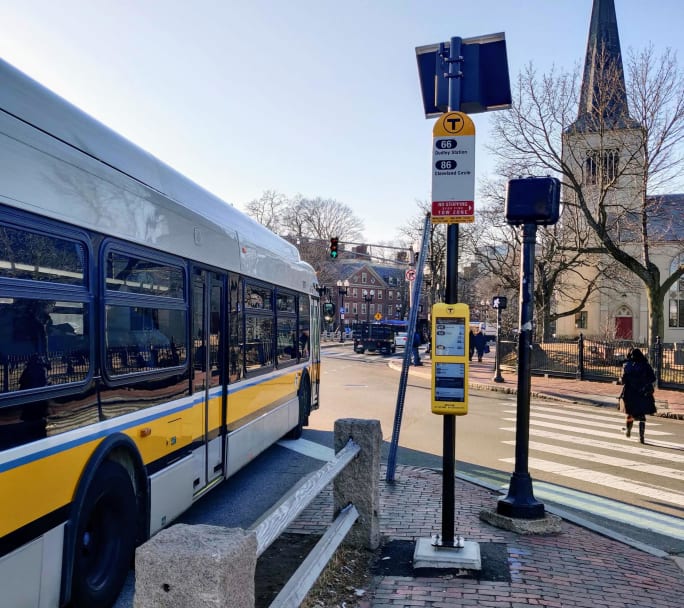
The Massachusetts Bay Transportation Authority (MBTA) launched a pilot that brings real-time bus information beyond major transit hubs, to individual bus stops. The solar-powered electronic ink (E Ink) signs are located at 18 bus stops in several Boston neighborhoods.
Each sign provides stop-specific information, including bus arrival times, service alerts, and nearby modes or routes. The signs can also display information in the event that snow or other weather-related circumstances impact service.
Ad Loading...
The E Ink pilot is a facet of the MBTA’s Better Bus Project, which is a major component of the MBTA’s efforts to improve bus service and the system as a whole.
The Better Bus Project is a key component of the MBTA’s $8 billion, 5-year investment program with the goal of Building a Better T.
The MBTA’s bus network spans more than 50 cities and towns, and is comprised of over 7,500 individual bus stops. The vast majority of stops have no direct connection to power, which creates a significant challenge to providing real-time information at bus stops. Recognizing that real-time information is among the most frequently requested amenities at bus stops, this pilot’s goal is to better understand whether this technology is a viable solution for delivering real-time information at bus stops on a larger scale, according to MBTA officials.
The signs are powered entirely by solar energy, displaying real-time information through a software application built in-house by the MBTA’s Customer Technology Department. The signs are located at 18 high-ridership stops that were individually screened for sufficient solar exposure.
This pilot builds on the success of a previous effort to test several types of E Ink signs along the D Branch of the Green Line. Under that 2017 initiative, signs were monitored for performance, durability, and customer value. Based on the results of that program, the MBTA initiated a new procurement to deploy E Ink signs, which led to the selection of S&A Fleetwatch that installed the E Ink signs.
CEO Magnus Friberg discusses Luminator’s shift toward becoming a digital partner, the growing importance of software and interoperability, and how AI can help agencies improve operations and passenger experience.
Reliability-Centered Maintenance helps transit agencies move beyond routine checklists to focus limited resources on the assets and failures that have the greatest impact on safety, reliability, and service.
More than 1,500 buses now feature upgraded technology designed to improve arrival predictions and provide free Wi-Fi, with deployment expected to reach nearly 2,000 buses by the end of 2026.
John Hroncich discusses BAE Systems’ modular and scalable approach, lessons learned from decades of real-world operations, and how agencies can identify electrification strategies that fit their fleets.
In METRO's latest installment, we take a look at recent news from Complete Coach Works, Beep, FlixBus, and more partnerships making headlines across the transportation sector.
What if transit leaders could ask any operational question and get a trusted answer in seconds? Conversational AI is transforming how agencies use their data.
More than $191 million in federal funding will help three transit agencies replace aging rail vehicles and support a new autonomous shuttle service in Chattanooga.
LA Metro’s Obed Mejia discusses technician training, evolving maintenance technology, fleet replacement, and strategies for getting the most out of today’s transit fleets.
In METRO's latest installment, we take a look at recent news from Siemens, Prevost, Dodge, and more partnerships making headlines across the transportation sector.
Pedestrian microsimulation is helping rail planners identify bottlenecks, test station designs, and prepare complex transit hubs for growing passenger volumes.