



Understand your customer’s needs and they’ll say ‘yes’ to transit
Beyond providing reliable and affordable service, transit agencies strive to meet mobility needs of all potential riders.
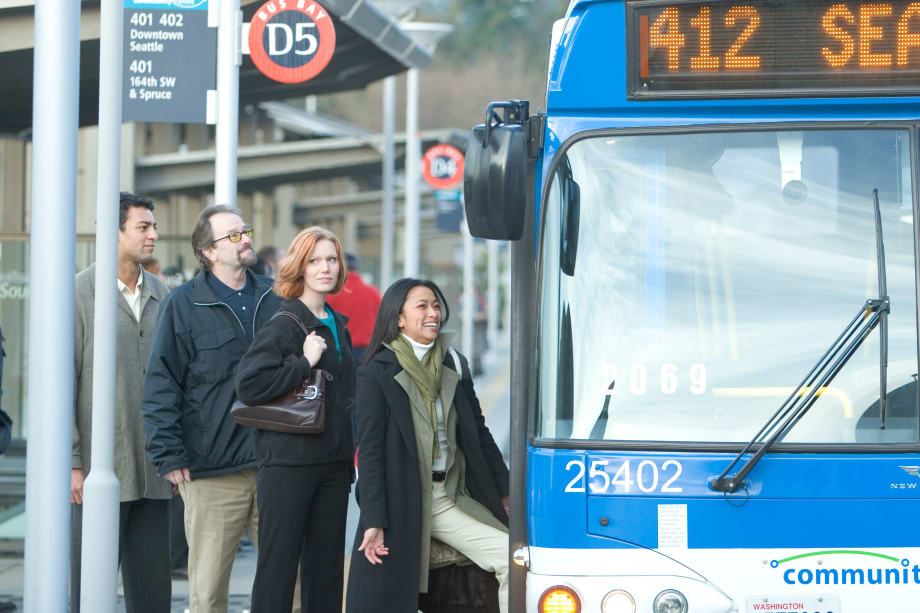
Buses have fewer route restrictions and are ripe for innovations that can harness the flexibility of TNCs to boost ridership.
Community Transit
Buses have fewer route restrictions and are ripe for innovations that can harness the flexibility of TNCs to boost ridership.
Community Transit
Across the nation, transit leaders face complex challenges as they strive to enhance their systems and services while adapting to private-sector innovations currently disrupting the transportation industry. Yet, this upheaval places transit agencies in a unique position to seize opportunities as they emerge — by rethinking and refining their services and plans to reflect a customer-centered viewpoint.
Beyond providing reliable and affordable service, transit agencies strive to meet mobility needs of all potential riders, by ensuring easy access, convenience, affordability, and safety. Such a vision has long been difficult to achieve due to the gap between fixed-route transit options and individuals’ unique points of origin and destination. But, with increasingly prevalent Transportation Network Companies (TNCs), such as Uber and Lyft, and technologies that help people orchestrate transit access, now is our chance to elevate transit’s value to its highest level ever.
Here are a few ways (“five E’s”) that may help transit agencies gain greater insight into people’s travel needs, common obstacles, and what they value most:
• Envision door-to-door trips
Look beyond the map of existing transit routes to consider partnerships to accommodate the entire trip individuals make every day. Imagine certain types of riders — such as a daily commuter, a parent with two small children, or a senior citizen — standing at their front doors, about to embark on a trip. Where are they headed? What factors are they weighing as they consider using transit? For some, speed and predictability might be critical, while for others cost or safety might be concerns. For all, time savings by integrating trips and payments can be a motivating factor. Also, how simple is it for riders to plan their trips using online tools? By envisioning people’s travel goals and real or perceived hurdles, we can refine, or redefine, services to bring people a few steps closer to saying “yes” to public transportation.
• Emphasize convenience and comfort
People who use ride-share services often remark on how easy they are: they know exactly when the car will arrive and what the ride will cost, and they pay with one tap on a device. Most transit agencies are still working toward this level of simplicity, although some have made multimodal trips more seamless through integrated fare systems and real-time arrival/departure information pushed to people’s smartphones. Beyond these technology enhancements, we can do more to emphasize rider comfort, from boosting safety and lighting in stations and stops, to helping them work in comfort with amenities such as power outlets and Wi-Fi.
• Experiment with flexibility
TNCs seem to appeal to the public mainly due to their on-demand availability and the lack of a fixed route. Naturally, trains have fixed routes, but buses have fewer route restrictions and are ripe for innovations that can harness this flexibility to boost ridership. Perhaps, weekend service could be added to a route typically only run on weekdays, accommodating people who work, shop, or visit family on the weekend. In certain areas, buses can even provide front-door or nearby pickup by allowing for on-demand point deviation, when bus drivers can respond to rider pickup requests within a narrow band of their main route. Start with a pilot — it costs little and may reap major benefits.
• Engage the public openly and often
Traditionally, transit agencies have reached out for public input mainly when they were considering service modifications or new investments. This kind of engagement is very important, but agencies really should be in a constant dialogue with the public to understand their needs, learn what’s working, and what’s not, and get clearer on the ways transit lends unique value to them. It is critical to engage heavy users like commuters to increase transit’s viability as part of a region’s multimodal transportation network, but also strive to include a broader universe of stakeholders, such as social service organizations, school administrators, and other interest groups. Through such interactions, many breakthrough ideas and synergies come to light. An added benefit: people who have never used public transit, and who may have a mental barrier about trying it, may get a clearer picture of how the system can work for them personally. They will be more likely to explore their options, gain experience with transit and even vote for ballot initiatives that support enhancements to the transit experience.
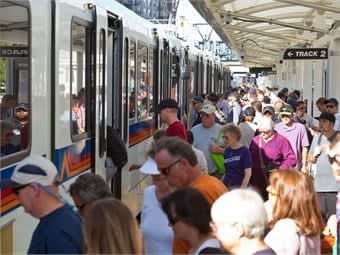
Some transit agencies have made multimodal trips more seamless through integrated fare systems and real-time arrival/departure information pushed to people’s smartphones.
Denver RTD
• Employ the right data
Whether you crunch your numbers using outside consultants or inside expertise, make data a vital part of how you evaluate and improve the customer experience. Good data provides insights into customer behaviors, and helps predict how these behaviors might change in the future based on your agency’s decisions today. How do you get better data? Ask for it. After all, millions of people share their locations with ride-sharing companies every day. Experiment with collecting location data to learn more about where your customers begin and end their trips. Asking the right questions also can help you discover the reasons behind each poorly rated transit experience. Of course, the public is more willing to share where they are and what they’re thinking when we protect their privacy. Through a careful, transparent process, transit agencies can encourage customers to allow their location data to be harnessed to improve service.
More broadly, the American Public Transportation Association may be able to amass a nationwide repository of such vital rider data that agencies can analyze and use to boost rider experience. And, let’s not overlook the potential of working with the wireless carriers, who could ask users up front to agree to share their travel patterns with transit providers as a way to improve their quality of life through more informed transit services.
As we consider and implement ideas for improving the customer experience on transit assets, it is necessary to integrate TNCs and other service providers into our thinking. There’s no doubt that TNCs compete with certain public transit offerings, and they hold the key to providing seamless, convenient door-to-door mobility for people from all walks of life, in a wide range of communities. The key to such integrated mobility — the smartphone — is in the hands of three out of four people, including two out of three people with incomes below $30,000, according to Pew Research. This represents a tremendous opportunity. Transit agencies must continue to play to their strengths — offering efficient, reliable and safe transportation options on a mass scale — while creating partnerships with TNCs to close those first- and last-mile gaps in people’s trips.
Envisioning an improved mobility network will keep customer experience top of mind — and the response from riders will be greater engagement, increased system usage and their enduring support of transit initiatives at the ballot box.
Kimberly Slaughter serves as national transit/rail market sector leader and senior vice president for HNTB Corp.
More New Mobility

From Hardware to Digital Partner: Luminator Charts Its Next Chapter
CEO Magnus Friberg discusses Luminator’s shift toward becoming a digital partner, the growing importance of software and interoperability, and how AI can help agencies improve operations and passenger experience.
Read More →
Biz Briefs: Alstom Lands Canadian Contract, LYT to Supply California TSP, and More
In METRO's latest installment, we take a look at recent news from Complete Coach Works, Beep, FlixBus, and more partnerships making headlines across the transportation sector.
Read More →
CharterUP’s Armir Harris on Technology, AI, and the Future of Group Mobility
In a recent episode of METROspectives, CharterUP Founder/CEO Armir Harris discussed the company’s evolution from an online charter bus marketplace into a technology platform supporting public- and private-sector mobility and much more.
Read More →
Jacksonville’s NAVI Project Charts a New Course for Autonomous Public Transportation
Through its NAVI program, JTA is showing how autonomous vehicles, intelligent infrastructure, and coordinated operations can work together to deliver everyday public transportation.
Read More →
Biz Briefs: Luminator Marks Milestone and More
From manufacturers and suppliers to transit agencies and motorcoach operators, these updates offer a snapshot of the projects, partnerships and business moves driving the industry forward.
Read More →
New Tricks for Old Bureaucracies: Joshua Schank on Making Transit Innovation Stick
Former LA Metro Chief Innovation Officer Joshua Schank discusses why good ideas aren't enough, how transit agencies can overcome resistance to change, and why today's challenges demand more innovation.
Read More →
How DART's GoPass Is Redefining Regional Mobility
Serving 14 transit agencies, GoPass simplifies multimodal travel by allowing riders to plan, pay for, and manage an entire trip through one app.
Read More →
Biz Briefs: OCTA Taps Clean Energy for Hydrogen Station, Stadler to Supply Via Rail Vehicles, and More
From manufacturers and suppliers to transit agencies and motorcoach operators, these updates offer a snapshot of the projects, partnerships and business moves driving the industry forward.
Read More →CharterUP Expands Into New Mobility and Autonomous Transportation
Vice President of New Mobility Stephen Joos discusses how CharterUP is leveraging its nationwide transportation network, technology platform, and autonomous vehicle partnerships to expand into workforce mobility, campus shuttles, and transit solutions.
Read More →
METRO Magazine Announces 2026 Innovative Solutions Awards Winners
Projects Recognized for Advancing Mobility Through Technology, Accessibility, Workforce Innovation, and Operational Excellence
Read More →